 Reviewed by
Key facts
- Chronic pain commonly means pain lasting longer than three months. In CDC's 2021 survey, 20.9% of U.S. adults reported pain on most days or every day during the previous three months. CDC.
- Pain involves biological, psychological, and social factors. Mood, stress, and support can influence pain, while pain can also affect those parts of life. NINDS.
- Depression, anxiety disorders, and sleep problems commonly accompany chronic pain. Addressing these symptoms is part of comprehensive support. NINDS.
- The UK NICE guideline recommends considering CBT or ACT for chronic primary pain in people aged 16 and older. Evidence for biofeedback and relaxation varies by pain condition. NICE guideline via NCBI Bookshelf. NCCIH.
What is chronic pain?
Chronic pain is pain that persists or recurs for longer than three months, beyond the time tissue would normally be expected to heal. It can follow an injury, surgery, or illness, or it can arise with no clear physical cause. Common forms include back and neck pain, arthritis, migraine, fibromyalgia, and nerve-related (neuropathic) pain.
The duration of pain does not establish its cause. Tell your clinician about changes in symptoms and the effect on sleep, movement, work, and relationships. Treatment can then address both the underlying condition, when identified, and the ways pain disrupts everyday life.
Unlike acute pain, which acts as a useful alarm warning you to protect an injured part of the body, chronic pain often outlives its original purpose. The nervous system can become more sensitive over time, a process sometimes called central sensitization, so the volume of pain signals stays turned up even when there is little or no ongoing tissue damage. According to the U.S. Centers for Disease Control and Prevention (CDC), chronic pain affected roughly one in five U.S. adults in its 2021 survey, making it one of the most common reasons people seek health care. If you live with it, you are part of a very large group, and effective help exists.
| Feature | Acute pain | Chronic pain |
|---|---|---|
| How long it lasts | Days to weeks, under three months | Three months or longer, past normal healing |
| What it signals | A useful alarm protecting injured tissue | May persist after healing or signal an ongoing health condition |
| Cause | A clear injury, surgery, or illness | May persist after healing or arise without clear cause |
| Nervous system | Settles as tissue heals | Can stay sensitized, keeping pain signals turned up |
| Effect on life | Temporary limits on activity | Reshapes mood, sleep, work, and relationships |
| Care focus | Treat the injury, short-term relief | Medical, physical, and psychological care working together |
The mind-body link
Pain is not measured by a sensor in the body and piped straight to awareness. Every pain signal is filtered, interpreted, and amplified or dampened by the brain. This is why the same injury can feel mild in one moment and severe in another, depending on attention, stress, fear, fatigue, and context. Recognizing this is not a way of dismissing pain as imaginary. It is the foundation of modern, science-based pain care.
The leading framework is the biopsychosocial model, endorsed by the International Association for the Study of Pain (IASP), which defines pain as an experience shaped by biological, psychological, and social factors together. Stress hormones, muscle tension, poor sleep, low mood, and the meaning a person attaches to their pain all influence how intense and disabling it becomes. Because the brain is part of the system, working on thoughts, behavior, and stress is a legitimate way to change the experience of pain, not a substitute for it.
One well-studied pattern is pain catastrophizing, the tendency to magnify the threat of pain, feel helpless about it, and ruminate on it. Catastrophizing predicts higher pain intensity and greater disability, and it is one of the targets psychological treatments work to soften.
Pain, depression, and anxiety
Chronic pain and mental health conditions travel together. Living with constant pain is exhausting, isolating, and often frightening, and it can erode the activities, relationships, and sleep that protect mental health. At the same time, depression and anxiety can lower pain tolerance and make pain feel more consuming. The relationship runs in both directions.
Research links chronic pain with depression and anxiety, although the frequency varies across conditions and study populations. Pain and mood also share neural and chemical pathways, including the serotonin and norepinephrine systems, which is one reason certain antidepressants are used to treat both pain and depression. Fear of movement, sometimes called fear-avoidance, is a particularly important link: when activity is expected to hurt, people understandably do less, which leads to deconditioning, lost roles, and lower mood, which in turn can heighten pain. Breaking that cycle is a central goal of treatment.
By the numbers
20.9%of U.S. adults, 51.6 million people, experienced chronic pain in 2021CDC
6.9%of U.S. adults had high-impact chronic pain that substantially restricted daily activitiesCDC
619 millionpeople worldwide had low back pain in 2020; this estimate includes acute and chronic casesWorld Health Organization
Psychological treatments
“While pain can influence a person’s mood, emotions, and mental health, those factors can also influence a person’s experience of pain.”
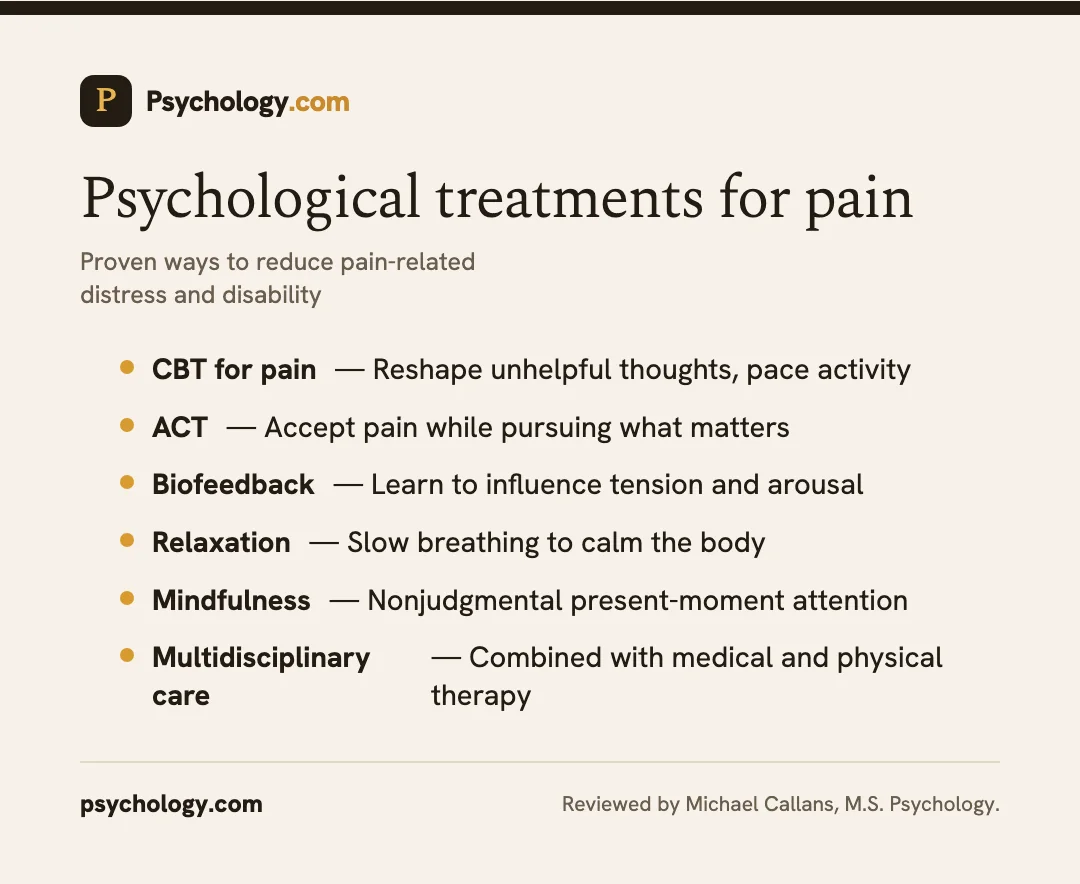
Psychological therapies do not ask you to ignore pain or pretend it is not there. They help you respond to it differently, reduce the suffering and disability that surround it, and reclaim parts of life that pain has taken. Evidence differs by approach and pain condition, so the choice should be tailored to your medical assessment and goals.
Cognitive behavioral therapy (CBT) for pain
CBT is the most researched psychological treatment for chronic pain. It helps you identify and reshape unhelpful thoughts such as catastrophizing, pace activity so you can do more without flaring symptoms, use relaxation skills, and gradually return to valued activities. The American Psychological Association (APA) notes that CBT can reduce pain intensity, improve mood, and increase day-to-day functioning, with benefits that often last after therapy ends.
Acceptance and commitment therapy (ACT)
ACT takes a different angle. Rather than focusing only on reducing pain, it helps you accept the presence of pain while committing to actions that matter to you. By loosening the struggle against unavoidable discomfort and clarifying personal values, ACT can improve quality of life and lower pain-related disability even when pain levels do not change much.
Biofeedback and relaxation
Biofeedback uses sensors to show you real-time information about body processes such as muscle tension, heart rate, or skin temperature, helping you learn to influence them. Paired with relaxation and slow breathing, it can reduce tension-related pain and the physical arousal that amplifies it. Mindfulness-based approaches, which train nonjudgmental attention to present-moment experience, have similar aims and a growing evidence base.
Multidisciplinary care
The most effective chronic pain care rarely relies on one provider or one tool. Multidisciplinary pain management combines medical treatment, physical therapy or graded exercise, and psychological support, often coordinated by a team. Within this model, a pain psychologist or therapist addresses the thoughts, emotions, sleep problems, and behavior patterns that drive suffering and disability, while physicians manage medication and procedures and physical therapists rebuild strength and movement. The goal is not always to erase pain completely, which is not always possible, but to reduce it where possible and to restore function, mood, and meaning. Working on the psychological side is not a last resort or a sign that the pain is not believed. It is a core, evidence-based part of good care.
Free tools and worksheets
Practical, printable exercises from our free library that people managing chronic pain often find useful. No signup needed.
Does this sound familiar? Take a moment to notice how pain has been shaping your days, without judging any answer.
Free, with an instant plain-language result and a PDF you can bring to a professional. Completion time varies. A screening is not a diagnosis; discuss overlapping pain, sleep, and mood symptoms with your clinician.
When to seek help
Reach out to your doctor or a mental health professional if pain is limiting your work, relationships, or daily activities, if it is disrupting your sleep, or if you notice persistent low mood, anxiety, hopelessness, or loss of interest in things you used to enjoy. Seek help immediately if you have thoughts of harming yourself. Asking for psychological support does not mean giving up on physical treatment. The two work best together, and getting help early makes recovery easier.
Frequently asked questions
Does psychological treatment mean the pain is all in my head?
Chronic pain is a real sensory and emotional experience shaped by the nervous system, physical health, stress, and daily circumstances. Psychological care helps with coping, sleep, mood, and activity alongside medical evaluation. A referral to a pain psychologist does not establish a psychological cause for your pain or rule out a condition that needs treatment.
Can therapy actually reduce physical pain?
Psychological therapy can help some people reduce pain intensity and improve daily functioning, mood, or sleep. Benefits vary by the pain condition and treatment, and meaningful progress may occur even when pain persists. CBT and ACT are options for chronic primary pain. Biofeedback evidence differs by condition, so ask which approach fits your diagnosis and goals.
Why are depression and anxiety so common with chronic pain?
Pain and mood share overlapping pathways in the brain, and living with constant pain is stressful and isolating. Pain can worsen mood, and low mood can amplify pain, so they often feed each other. Treating both together usually works better than treating either alone. A clinician can assess mood and sleep symptoms alongside medical causes of pain.
How long does pain need to last to be considered chronic?
Pain that persists or recurs for more than three months is commonly described as chronic. Some chronic pain continues after healing; other pain reflects an ongoing condition, nerve injury, or several contributors together. Duration alone cannot identify the cause. Ask for medical evaluation whenever pain is new, changing, or interfering with your life. NINDS.
What is pain catastrophizing?
Pain catastrophizing is a habit of mind in which pain triggers worst-case thinking: magnifying the threat, ruminating on the sensation, and feeling helpless to cope. It is common and not a character flaw, but research links it to higher pain intensity and greater disability. It is also changeable, and softening it is a central target of cognitive behavioral therapy for chronic pain.
What does a pain psychologist do?
A pain psychologist helps with coping, distress, sleep, and behavior patterns that affect life with pain. Sessions may cover pacing, relaxation, responding to catastrophic thoughts, and returning to meaningful activities. The psychologist works alongside medical care, with goals adapted to your condition and abilities. Ask how they coordinate care and measure progress beyond pain intensity.
Related
- Chronic Illness and Caregiving
- Depression
- Neurofeedback
Therapists who specialize in chronic pain
Connect with a licensed therapist on Psychology.com who works with chronic pain.
- Barbara L Edwards
- Biofeedback Associates of Northeast Florida
- Caring Counseling Center
- Cynthia J Jones
- Diane M. Berry
Finding the right help
When you are ready to take the next step, these guides walk you through finding and starting with the right therapist.
- Getting started with therapy
- How to find the right therapist
- Find a therapist who takes insurance
- Free & low-cost therapy
Preparing for a pain appointment
Bring a description of where pain occurs, what it feels like, when it changes, and which activities have become difficult. Include medications, treatment effects, sleep changes, and questions about movement. A stress diary can help record patterns; an association between stress and pain does not prove that stress caused the condition.
Our depression screen can organize mood concerns for discussion, but fatigue and sleep symptoms may overlap with pain or medical treatment. Explore the Conditions hub and guides to chronic illness and caregiving and mood disorders. Ask the clinician to agree on functional goals, such as a manageable household task or a valued social activity, and a plan for reassessing changes in pain.
References
- Centers for Disease Control and Prevention (CDC): Chronic Pain Among Adults, United States
- American Psychological Association (APA): Managing chronic pain
- International Association for the Study of Pain (IASP): Terminology and the definition of pain
- National Center for Complementary and Integrative Health (NCCIH): Chronic Pain
- National Institute of Neurological Disorders and Stroke (NINDS): Chronic Pain
- Cleveland Clinic: Chronic Pain
- World Health Organization: Low back pain
- NINDS: Pain, including chronic pain and mental health
- NICE: Chronic pain assessment and management guideline, hosted by NCBI Bookshelf
- NCCIH: Chronic Pain and Complementary Health Approaches: Usefulness and Safety
