 Reviewed by
In short
Biofeedback uses live measurements of body functions to help people practice self-regulation. Neurofeedback is a form of biofeedback that measures brain activity, usually with scalp sensors. Benefits depend on the condition and method. Evidence for neurofeedback as a stand-alone ADHD treatment is insufficient, so discuss established care options before committing.
Key facts
- Biofeedback measures signals such as breathing, muscle tension, and heart rate; neurofeedback measures brain activity. Mayo Clinic: biofeedback methods.
- Both use non-invasive sensors to support self-regulation practice. Biofeedback aims to help people use learned skills independently, although improvement varies. Mayo Clinic: what to expect.
- Biofeedback is used for stress and pain. For ADHD, a systematic review found no meaningful overall benefit from neurofeedback on probably blinded symptom ratings; this does not establish effectiveness for anxiety. Westwood and colleagues: neurofeedback evidence.
- Discuss these approaches as possible additions to established care. Mayo Clinic advises patients to consult their clinician before stopping existing medical treatment. Mayo Clinic: results and ongoing care.
What are neurofeedback and biofeedback?
The distinction matters when comparing providers: a study of muscle-tension feedback for headaches cannot establish that EEG neurofeedback improves attention. Ask which signal the provider measures, what change they hope to train, and how that change will be connected to symptoms that matter to you.
Biofeedback is a mind-body technique that uses sensors to measure a body function in real time, then shows you that information so you can learn to influence it. The signals might be heart rate, breathing, skin temperature, sweat-gland activity, or muscle tension. By seeing these signals on a screen, people can learn to calm their physiology on purpose.
Neurofeedback is a specific type of biofeedback that focuses on the brain. Sensors placed on the scalp measure electrical activity (brainwaves), usually through electroencephalography (EEG). The system gives feedback, often a sound, image, or simple video game, that responds to your brain activity, with the goal of helping you shift toward patterns associated with calm focus. The core idea behind both methods is the same: when you can observe something your body is doing, you can gradually learn to change it.
How they work
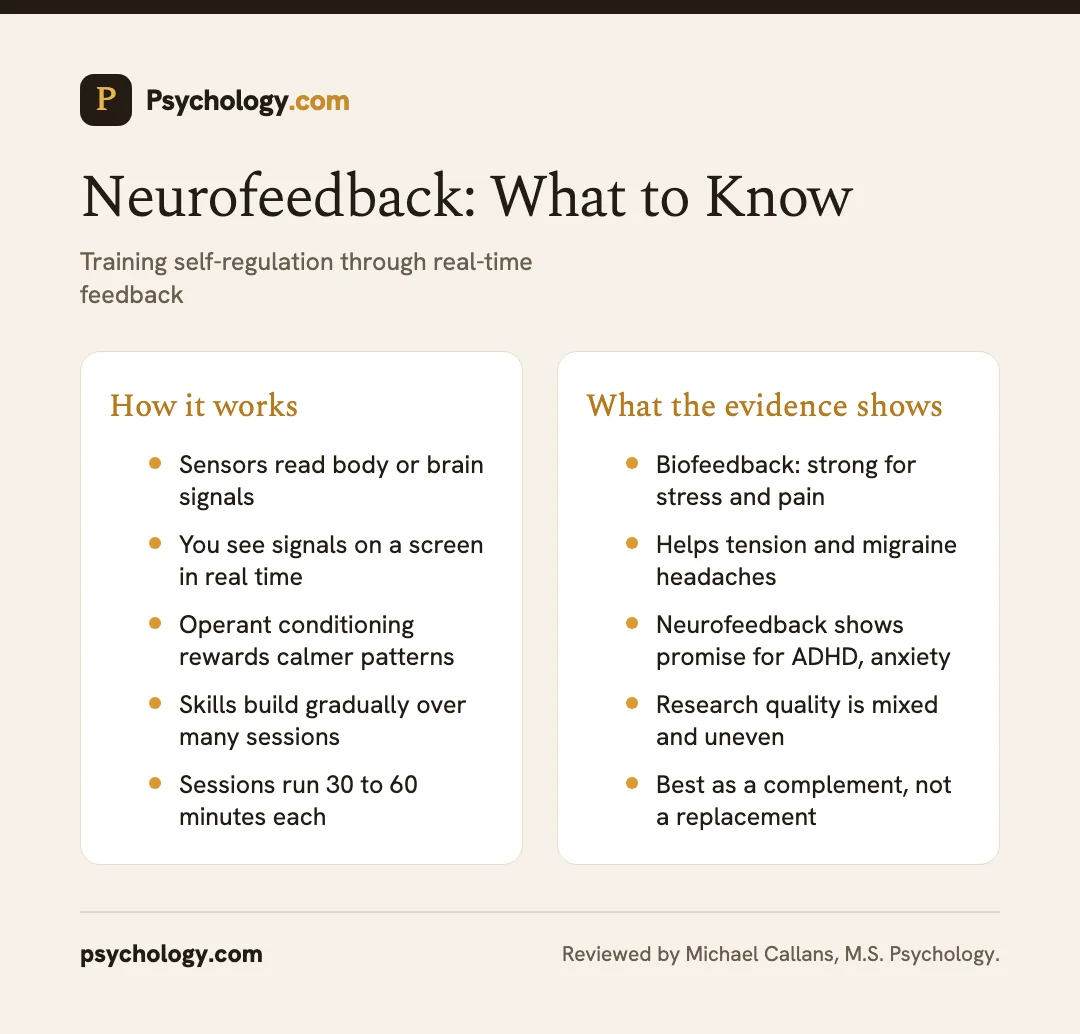
The proposed mechanism is learning through repeated feedback. Both techniques rely on a principle called operant conditioning. When your brain or body produces a desired pattern, the system rewards it with positive feedback, such as a pleasant tone or a game moving forward. Repeated practice aims to make the target pattern easier to produce, including away from the equipment; learning and lasting symptom improvement are outcomes that need to be measured. With biofeedback, you might practice slow breathing and watch your heart rate variability improve, building a skill you can later use anywhere. The feedback is the teacher; the lasting benefit comes from the self-regulation skills you build.
This is why both methods are usually described as training rather than treatment in the way medication is. You are actively practicing a skill with the help of precise, real-time information that you cannot normally sense. The same logic explains why results tend to build gradually and why home practice often matters. A useful way to picture it is learning to control your breathing the way an athlete learns a movement: at first you need feedback and coaching, and over time the skill becomes more automatic.
What they are used for
Biofeedback and neurofeedback are used for a range of concerns, with varying levels of evidence behind each:
- Stress and tension: biofeedback is widely used to teach relaxation and manage everyday stress.
- Chronic pain and headaches: biofeedback has good support for tension and migraine headaches and is used in some chronic pain programs.
- ADHD: neurofeedback is studied as a complementary approach to support attention.
- Anxiety: both methods are used to help regulate the physical arousal that drives anxiety.
- Other uses: biofeedback is also applied to high blood pressure, certain bladder conditions, and recovery in physical rehabilitation.
What a session looks like
A session is non-invasive and painless. A trained practitioner attaches sensors to your skin or scalp, depending on the method. Nothing is sent into your body; the sensors only read signals. You then sit comfortably while you watch or listen to feedback, such as a graph, a tone, or a simple on-screen game, that reflects your physiology in the moment. The practitioner guides you to notice what shifts the signal in the right direction, and you practice doing more of it.
Mayo Clinic describes biofeedback sessions lasting 30 to 60 minutes. Its guidance explains that course length depends on the concern and learning progress. Ask a neurofeedback provider for a separate estimate, a review point, and the total expected cost. Many providers also give you techniques to practice at home so the skills carry into daily life.
What the evidence shows
A systematic review published in JAMA Psychiatry found no significant overall improvement in ADHD symptoms on ratings made by people probably unaware of treatment allocation. Its conclusions do not support current neurofeedback methods as stand-alone ADHD treatment. These ratings help reduce the influence of expectations about receiving a new intervention.
An honest answer is that the evidence is mixed and depends heavily on the condition and the quality of the study. Biofeedback has reasonably strong support for some uses, including tension and migraine headaches, certain forms of chronic pain, and stress and relaxation, and it is recognized by mainstream clinical sources. Neurofeedback is more contested. Some studies and reviews suggest it may help with ADHD and anxiety, but many trials are small, poorly controlled, or do not clearly separate the treatment from a placebo response. Larger, well-designed studies have produced inconsistent results.
Decisions should reflect the evidence for the specific condition and method. These are low-risk, non-invasive approaches that some people find helpful, especially for stress, pain, and as a complement to other care. Continue discussing first-line, evidence-based treatments with your clinician, including therapy and medication. If a provider promises guaranteed results or describes neurofeedback as a stand-alone cure, treat that as a warning sign.
Finding a qualified provider
Because provider requirements and credentials vary, the credentials of your provider matter a great deal. Look for a licensed health professional (such as a psychologist, physician, or other clinician) who has specific training in biofeedback or neurofeedback. Certification from the Biofeedback Certification International Alliance (BCIA) is a useful marker of training and ethical standards. Ask how many sessions are likely, what the total cost will be, whether insurance covers it, and how progress will be measured. A good provider will set realistic expectations, recommend it as part of a broader plan, and be honest about the limits of the evidence.
Frequently asked questions
What is the difference between neurofeedback and biofeedback?
Biofeedback trains you to influence body signals like heart rate, breathing, and muscle tension. Neurofeedback is a specific type of biofeedback that focuses on brain activity, using sensors that measure brainwaves. Both rely on real-time feedback to help you learn self-regulation. Evidence for a particular biofeedback method applies to the condition and protocol studied.
Is neurofeedback proven to work?
Evidence for neurofeedback varies by condition and study design. A systematic review in JAMA Psychiatry found no significant overall ADHD symptom improvement using probably blinded ratings, and did not support stand-alone use for ADHD. Biofeedback has separate clinical uses, including headache management. Ask for research on the exact method and concern before choosing a program.
Does neurofeedback have side effects?
Neurofeedback and biofeedback use non-invasive recording sensors. Discuss any headache, fatigue, sleep change, or symptom worsening with the provider, and ask how they monitor unwanted effects. Suitability depends on your health and the equipment used. Cost, time, provider qualifications, and the risk of delaying established care also matter when deciding whether to proceed.
Can stress management worksheets replace biofeedback equipment?
Stress management worksheets can help you identify triggers, plan coping steps, and notice patterns in daily life. They do not measure physiological signals or provide the live feedback used in biofeedback. They may be useful alongside care or as a starting point for discussing stress with a clinician, depending on your needs.
Related conditions
Finding the right help
When you are ready to take the next step, these guides walk you through finding and starting with the right therapist.
- Getting started with therapy
- How to find the right therapist
- Find a therapist who takes insurance
- Free & low-cost therapy
Compare approaches in the therapies hub. If attention is your concern, an ADHD screening can organize symptoms for assessment; it cannot diagnose ADHD or predict neurofeedback response. For everyday stress, try the stress management worksheet and bring observations to your clinician.
References
- Cleveland Clinic: Biofeedback
- Mayo Clinic: Biofeedback
- MedlinePlus: Biofeedback
- American Psychological Association (APA): ADHD
- National Center for Complementary and Integrative Health (NCCIH): Relaxation techniques
- Biofeedback Certification International Alliance (BCIA)
- Westwood and colleagues: Neurofeedback for ADHD, systematic review and meta-analysis