

Key facts
- Career counseling helps you clarify direction, make decisions, and plan transitions using assessments and structured guidance. BLS career counselor duties.
- Changing careers is realistic at any age, including midlife and later. BLS career-transition support.
- Chronic work stress and burnout can affect mental and physical health. WHO burnout definition.
- If work pressure is harming your well-being, support for stress and mental health may matter as much as career planning. NIMH stress guidance.
- American Job Centers provide free employment assistance, including career and job-search resources. Ask your local center which services are available. CareerOneStop American Job Center Finder.
Overview
Career counseling is a guided process that helps you make sense of your working life and the choices in front of you. A career counselor, sometimes called a career coach or vocational counselor, helps you understand your interests, skills, values, and personality, then connect those to real options in the world of work. The aim is to build a direction that fits your interests, abilities, practical needs, and longer-term goals. A useful outcome is a decision you can explain and a next step you can test, such as exploring training requirements or speaking with someone in a potential field.
People seek career counseling at all stages: students choosing a path, early-career workers finding their footing, experienced professionals feeling stuck, parents returning to work, and people considering a major change later in life. Whatever the stage, the goal is the same. Replace confusion and avoidance with clarity and a plan you can act on.
Career counseling sits alongside therapy rather than replacing it. Some career counselors are licensed mental health professionals, while others specialize purely in career development. When emotional or psychological issues are driving the difficulty, working with a licensed therapist makes sense. For a fuller picture of talk therapy, see our overview of psychotherapy and counseling.
Common challenges
Career counseling tends to help with a recognizable set of situations:
- Feeling stuck or directionless. Not knowing what you want, or sensing you are in the wrong field.
- Major decisions. Choosing between offers, weighing further education, or deciding whether to leave a stable role.
- Career transitions. Switching industries, returning after a break, going freelance, or moving into leadership.
- Burnout and dissatisfaction. Exhaustion and disengagement that make it hard to keep going or see a way forward.
- Change at any age. Reinventing your working life in midlife or later, often tied to a broader midlife transition.
- Confidence and self-doubt. Feeling underqualified or afraid to pursue what you actually want.
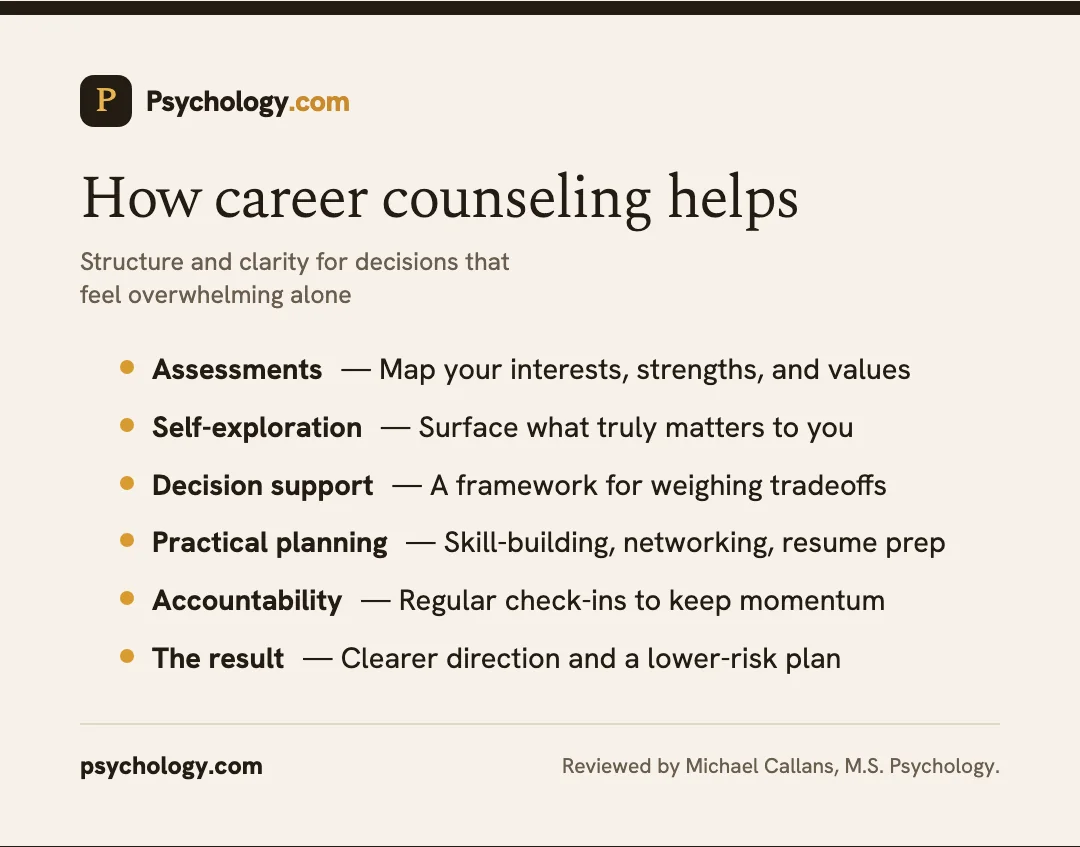
How career counseling helps
A good career counselor brings structure and objectivity to decisions that can feel overwhelming on your own. The work usually involves a few elements:
- Assessments. Validated tools that map your interests, strengths, values, and work style, giving you language and data to work with.
- Self-exploration. Conversations that surface what truly matters to you, beyond salary and status.
- Decision-making support. A framework for comparing options, weighing tradeoffs, and managing the uncertainty that comes with change.
- Practical planning. Concrete steps such as skill-building, networking, resume and interview preparation, and a realistic timeline.
- Accountability. Regular check-ins that keep you moving when momentum stalls.
The result is usually a clearer sense of direction and a plan that lowers the risk of any single move. Even when the destination stays the same, people often leave with more confidence in the choice they have made.
What to expect
A typical engagement begins with an intake conversation about your background, your current situation, and what you hope to get out of the process. From there, the counselor may use assessments and structured exercises, then meet with you over several sessions to interpret results, explore options, and build a plan. Some people need only a few sessions to get unstuck, while a bigger transition may call for ongoing support over months.
Career counseling is collaborative. The counselor helps you compare evidence, explore tradeoffs, and make your own decision with better information and a clearer head. Expect to do some reflection and homework between sessions, since the insight tends to come from the work you do, not just the time in the room.
Work stress and mental health
Career questions rarely live in isolation. Chronic stress at work is one of the most common pressures people carry, and over time it can take a real toll. The World Health Organization recognizes burnout as a syndrome resulting from chronic workplace stress that has not been successfully managed, marked by exhaustion, cynicism or detachment from the job, and reduced effectiveness.
Left unaddressed, work stress and burnout can contribute to anxiety, depression, sleep problems, and physical illness. The relationship runs both ways. Mental health conditions can make work harder, and a difficult job can wear down mental health. Because of this, career counseling and therapy often work well together. A career counselor can help you change your situation, while a therapist helps you manage the stress and any symptoms it has triggered. If work pressure is affecting your well-being, it is worth treating that with the same seriousness as the career decision itself.
Frequently asked questions
What does a career counselor actually do?
A career counselor helps you understand your interests, skills, and values, weigh options, and make and act on career decisions. They may use assessments, structured exercises, and a step-by-step process to clarify direction and plan a transition. Practical work can include reviewing training requirements, preparing a resume, practicing interviews, and deciding which next step is feasible.
Am I too old to change careers?
No. People change careers successfully at every age, including midlife and beyond. A career counselor can help you translate existing skills and experience into a new direction and plan a realistic, lower-risk transition. Discuss income needs, caregiving, training time, and local opportunities so your plan reflects the constraints you actually face.
Can work stress affect my mental health?
Yes. Chronic work stress and burnout can contribute to anxiety, depression, sleep problems, and physical illness. If work stress is affecting your well-being, a mental health professional can help alongside or instead of career counseling. Bring examples of how work affects sleep, concentration, relationships, or your ability to recover during time off.
Is career counseling worth it?
Career counseling may be useful when you keep revisiting a decision, feel unsure how your skills transfer, or need structure for a job search. Define the outcome you want before paying, such as comparing realistic options or building an application plan. Ask how progress will be reviewed and what work you will do between meetings. A counselor cannot guarantee employment.
How can I get free career counseling?
Start with an American Job Center, which provides free employment assistance and can explain local career resources. Students and alumni can also ask their school what career services are available to them. Check eligibility, appointment availability, and whether the service covers your particular transition. Ask about any separate charges for assessments or training before enrolling. CareerOneStop local help.
Related
Therapists who specialize in career counseling
Connect with a licensed therapist on Psychology.com who works with career counseling.
- Advance Thru Psychotherapy and Family Development
- Arlyn P. Stern LCSW
- Arthur M. Bodin
- Barbara L Edwards
- Beth Britton
Finding the right help
When you are ready to take the next step, these guides walk you through finding and starting with the right therapist.
- Getting started with therapy
- How to find the right therapist
- Find a therapist who takes insurance
- Free & low-cost therapy
References
- American Psychological Association (APA): Coping with stress at work
- World Health Organization (WHO): Burn-out an occupational phenomenon
- U.S. Bureau of Labor Statistics: School and career counselors and advisors
- HelpGuide: Burnout prevention and treatment
- National Institute of Mental Health (NIMH): So stressed out
Preparing for career counseling
Bring a current resume, examples of work you enjoyed and disliked, and the decision you want help making. List practical constraints such as income needs, schedule, location, caregiving, and willingness to retrain. Ask the counselor about experience with your situation, qualifications, fees, cancellation terms, and what you will leave with. Career coaching and licensed mental health care involve different qualifications, so confirm the provider’s scope when discussing anxiety or depression.
Use the career interests assessment to generate possibilities and the values clarification worksheet to compare what matters at work. Treat results as prompts for exploration alongside real job requirements. The guides to life coaching and midlife transitions, within the life and relationships hub, cover related decisions. End an initial appointment with a specific action you can try before committing to a major change.