
In short
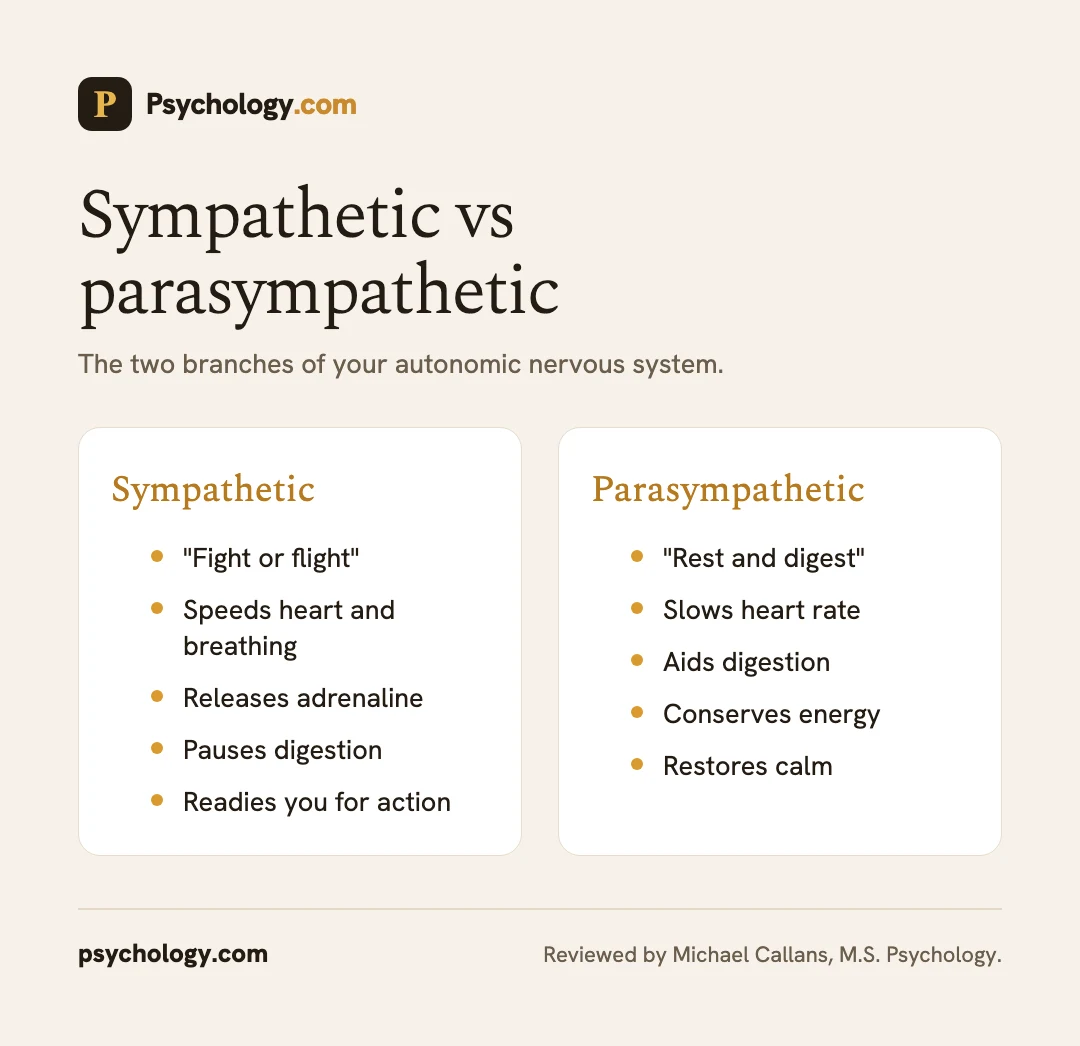
The sympathetic and parasympathetic nervous systems regulate involuntary organ functions. Sympathetic activity generally supports action, including faster heart rate; parasympathetic activity helps slow the heart and supports digestion. Their effects vary by organ. Fight-or-flight and rest-and-digest are useful summaries of more complex, continuously active control systems.
What is the difference?
The sympathetic nervous system generally mobilizes resources for activity, while the parasympathetic nervous system supports functions such as slowing the heart and stimulating digestion. Both regulate internal organs through autonomic pathways. Their activity varies with the situation and organ, so the body is rarely in a single uniform state.
Autonomic functions include regulation of heart muscle, smooth muscle, and glands. These processes usually operate without deliberate attention. The nervous system also contains networks within the gut, called the enteric nervous system, which work with autonomic inputs to coordinate digestive activity.
Fight-or-flight and rest-and-digest summarize familiar patterns. They do not describe every function of either pathway. Sympathetic activity is useful during ordinary activity as well as danger, and parasympathetic activity continues during many situations that involve alertness.
What the sympathetic nervous system does
Sympathetic pathways help the body meet increased demands. Effects can include a faster and stronger heartbeat, dilation of the pupils, sweating, and changes in blood flow. These responses support activity and temperature regulation.
The sympathetic system also stimulates the adrenal medulla to release epinephrine and norepinephrine into the bloodstream. These chemical signals help coordinate responses across organs. Neural pathways and circulating hormones therefore contribute through related mechanisms.
At a stressful presentation, someone may notice sweating and a racing heart. Similar bodily changes can also accompany exercise or excitement. The sensation alone cannot identify the cause or establish an anxiety disorder. Context and associated symptoms matter.
What the parasympathetic nervous system does
Parasympathetic pathways can slow the heart, constrict pupils, and stimulate digestive activity. They also contribute to functions such as salivation and bladder emptying. The effect depends on the target organ and its receptors.
The vagus nerve carries important parasympathetic signals to organs in the chest and abdomen. Other cranial nerves and sacral pathways also contribute. Describing the entire parasympathetic system as the vagus nerve leaves out those routes.
Rest-and-digest is a useful memory aid, but parasympathetic activity cannot be read directly from feeling calm. Someone can feel worried while digestion continues, and slowing the heart is only part of a coordinated bodily response.
How the anatomy and chemical signals differ
Sympathetic outflow originates in the thoracic and upper lumbar spinal cord. Parasympathetic outflow originates in the brainstem and sacral spinal cord. These anatomical origins explain the terms thoracolumbar and craniosacral found in textbooks.
Autonomic signals generally pass through a ganglion, a cluster of nerve-cell bodies outside the central nervous system, before reaching a target. Sympathetic ganglia are often near the spinal cord. Parasympathetic ganglia are generally near or within the target organ.
Acetylcholine carries signals at autonomic ganglia. Parasympathetic endings generally release acetylcholine at their targets, while most sympathetic endings release norepinephrine. Sympathetic supply to sweat glands is an important exception because it uses acetylcholine.
These details help explain why a medication can affect several organs and why the same chemical can have different effects at different receptors. They are background physiology; medication choices require an assessment of the person's condition and health history.
Why balance is an incomplete explanation
The pathways continually adjust their influence. Some organs receive both sympathetic and parasympathetic input, while others have mainly sympathetic innervation. They may oppose each other at a target, cooperate in a broader function, or change relatively independently.
The accelerator-and-brake analogy fits aspects of heart-rate regulation, but it becomes misleading when applied to every organ. Sweating, for example, is primarily controlled through sympathetic pathways. It does not require a matching parasympathetic process to reverse it.
Persistent stress symptoms deserve attention, but feeling tense does not demonstrate a specific autonomic defect. Clinicians consider symptoms, physical health, medications, sleep, and circumstances. A description such as a stuck nervous system can obscure these different possible explanations.
What relaxation can realistically do
Relaxation practices can help some people manage stress symptoms. NCCIH describes approaches including comfortable breathing, progressive muscle relaxation, and guided imagery. Their usefulness varies by person and condition, and the evidence does not support a guaranteed reset of the nervous system.
Try a practice in a comfortable setting and observe how you respond. With breathing, allow an easy pace rather than forcing large breaths or prolonged breath-holding. If the exercise increases dizziness or distress, stop and return to ordinary breathing.
Some people find focusing on internal sensations uncomfortable, especially during panic or after trauma. An external focus, such as noticing the room or listening to a familiar sound, may feel easier. A clinician can help adapt practices when symptoms make self-guided exercises difficult.
Evaluate a coping practice by whether it helps you participate in life. You might find it easier to return to a task, tolerate a stressful conversation, or settle into a routine. Monitoring every heartbeat can become another demand if it increases worry.
Polyvagal theory: what it claims and where it is contested
Polyvagal theory, proposed by Stephen Porges, describes the vagus nerve as having two separate branches: a newer ventral branch linked to calm social engagement and an older dorsal branch linked to shutdown or freeze responses. It is popular in trauma-focused writing and often used to explain terms like fight, flight, freeze, and fawn. Source: Porges, The polyvagal perspective.
The theory is also contested among physiologists. Grossman and Taylor's review examined the evidence behind polyvagal theory's core claims and found that common measures of vagal tone, including respiratory sinus arrhythmia, are less specific to the vagus nerve than the theory assumes, and that some of its evolutionary claims are not well supported. Source: Grossman, Taylor, Toward understanding respiratory sinus arrhythmia.
For readers, this means popular language about nervous system states, vagal tone, or which branch is active is a simplified framework, not a settled diagnostic tool. It can be a useful way to talk about feeling safe or shut down, but it should not be used to label a personal nervous system state with precision that the underlying research does not support.
When symptoms need assessment
For more background, explore the psychology concepts hub, the fight-or-flight response, and managing stress and anxiety. The stress self-check can organize perceived stress, while the mindful breathing worksheet offers a coping exercise. Neither measures autonomic nerve function.
Discuss persistent palpitations, fainting, or other unexplained physical symptoms with a medical professional. New severe chest pain or major breathing difficulty needs urgent medical attention. An explanation involving stress should follow appropriate assessment rather than replace it.
If worry, panic, or avoidance is affecting daily activities, a licensed therapist can help assess the pattern and discuss care. Bring examples of when symptoms occur, what you were doing, and what happened next. That information is more useful than trying to label every sensation sympathetic or parasympathetic.
| Feature | Sympathetic | Parasympathetic |
|---|---|---|
| Common shorthand | Fight or flight | Rest and digest |
| Heart rate | Generally increases | Generally decreases |
| Digestive activity | Often reduces motility and secretion | Generally supports motility and secretion |
| Pupils | Dilates | Constricts |
| Outflow origin | Thoracic and upper lumbar spinal cord | Brainstem and sacral spinal cord |
| Main target transmitter | Usually norepinephrine; sweat glands are an exception | Acetylcholine |
| Activity pattern | Ongoing, with changes according to demand | Ongoing, with changes according to demand |
Key takeaways
- Sympathetic activity generally increases heart rate; parasympathetic input can slow it. Source: McCorry, Physiology of the Autonomic Nervous System.
- Sympathetic outflow is thoracolumbar; parasympathetic outflow is craniosacral. Source: OpenStax, Divisions of the Autonomic Nervous System.
- Parasympathetic pathways include the vagus nerve and other cranial and sacral routes. Source: OpenStax, Divisions of the Autonomic Nervous System.
- Most sympathetic target endings release norepinephrine, while sympathetic sweat-gland endings release acetylcholine. Source: McCorry.
- Relaxation techniques include breathing, muscle relaxation, and imagery; responses and evidence vary by condition. Source: NCCIH, Relaxation Techniques.
Feeling stuck in a stress response?
Our free, clinician-reviewed self-tests can help you understand your stress and anxiety. No account needed.
Cite this source
Psychology.com. (2026, September 15). Parasympathetic vs Sympathetic Nervous System. Psychology.com. https://psychology.com/concepts/parasympathetic-vs-sympathetic
Frequently asked questions
What is the difference between sympathetic and parasympathetic?
Sympathetic activity generally helps mobilize the body for action, including increasing heart rate. Parasympathetic activity helps slow the heart and supports digestion. Both regulate internal organs, with effects that vary by target. Fight-or-flight and rest-and-digest are memory aids for broader patterns, rather than separate states that describe the entire body.
What does the sympathetic nervous system do?
The sympathetic nervous system helps coordinate responses to activity and challenge. It can increase heart rate, dilate pupils, stimulate sweating, and change blood flow. It also activates hormone release from the adrenal medulla. Sympathetic activity supports everyday functions, so noticing sweating or a faster pulse does not by itself establish danger or illness.
What does the parasympathetic nervous system do?
The parasympathetic nervous system contributes to slowing the heart, stimulating digestion and salivation, constricting pupils, and emptying the bladder. The vagus nerve carries important signals to chest and abdominal organs, alongside other cranial and sacral pathways. Its effects depend on the organ and should not be equated with a person's subjective feeling of calm.
How do you activate the parasympathetic nervous system?
Parasympathetic pathways are already active and continually regulated. Comfortable breathing or muscle relaxation may help reduce stress symptoms, but a self-guided exercise cannot guarantee a specific autonomic change. Choose a practice that feels manageable and stop if it causes dizziness or distress. Persistent symptoms deserve assessment rather than increasingly forceful attempts to control them.
Can the sympathetic and parasympathetic systems be active together?
Yes. Sympathetic and parasympathetic pathways can both be active, and their influence changes by organ and circumstance. They often have opposing effects on heart rate, while other functions involve different patterns of control. A whole-body on/off model misses this detail. Healthy regulation involves flexible responses to the body's changing needs.
Is anxiety caused by an overactive sympathetic nervous system?
Anxiety can involve sympathetic responses such as sweating or a racing heart, but these symptoms alone cannot establish its cause. Anxiety also involves thoughts, learning, context, and other biological processes. Similar physical symptoms can have medical causes. Seek assessment when symptoms persist, interfere with life, or include concerning physical changes.
Related concepts

References
- McCorry LK. Physiology of the autonomic nervous system. pubmed.ncbi.nlm.nih.gov
- OpenStax. Anatomy and Physiology: Divisions of the Autonomic Nervous System. openstax.org
- National Center for Complementary and Integrative Health. Relaxation Techniques: What You Need To Know. nccih.nih.gov
- National Institute of Mental Health. I'm So Stressed Out! Fact Sheet. nimh.nih.gov
- Porges SW. The polyvagal perspective. Biological Psychology. 2007;74(2):116-143. pmc.ncbi.nlm.nih.gov
- Grossman P, Taylor EW. Toward understanding respiratory sinus arrhythmia: relations to cardiac vagal tone, evolution and biobehavioral functions. Biological Psychology. 2007;74(2):263-285. pubmed.ncbi.nlm.nih.gov