
In short
The fight or flight response is an automatic reaction to perceived danger that prepares the body for action. Sympathetic nerve activity and adrenaline can speed your heartbeat and breathing and tense your muscles. Physical threats, conflict, and worry can trigger it. Recovery usually follows as the perceived threat eases.
What the fight or flight response is
The fight or flight response is an automatic reaction to perceived danger that prepares the body for action. Sympathetic nerve activity and adrenaline can speed your heartbeat and breathing and tense your muscles. Physical threats, conflict, and worry can trigger it. Recovery usually follows as the perceived threat eases.
The term was coined by the American physiologist Walter Cannon in the early twentieth century. Cannon observed that when an animal perceives danger, its body undergoes a coordinated set of changes that ready it for vigorous physical action. He saw this as part of the body's drive toward homeostasis: maintaining internal stability in the face of challenge.
Threat responses can also include freezing or becoming unusually still. People sometimes use fawning to describe appeasing another person during danger. These labels describe different experiences; they should not be treated as a complete physiological classification or used to infer someone's trauma history.
What happens in the brain
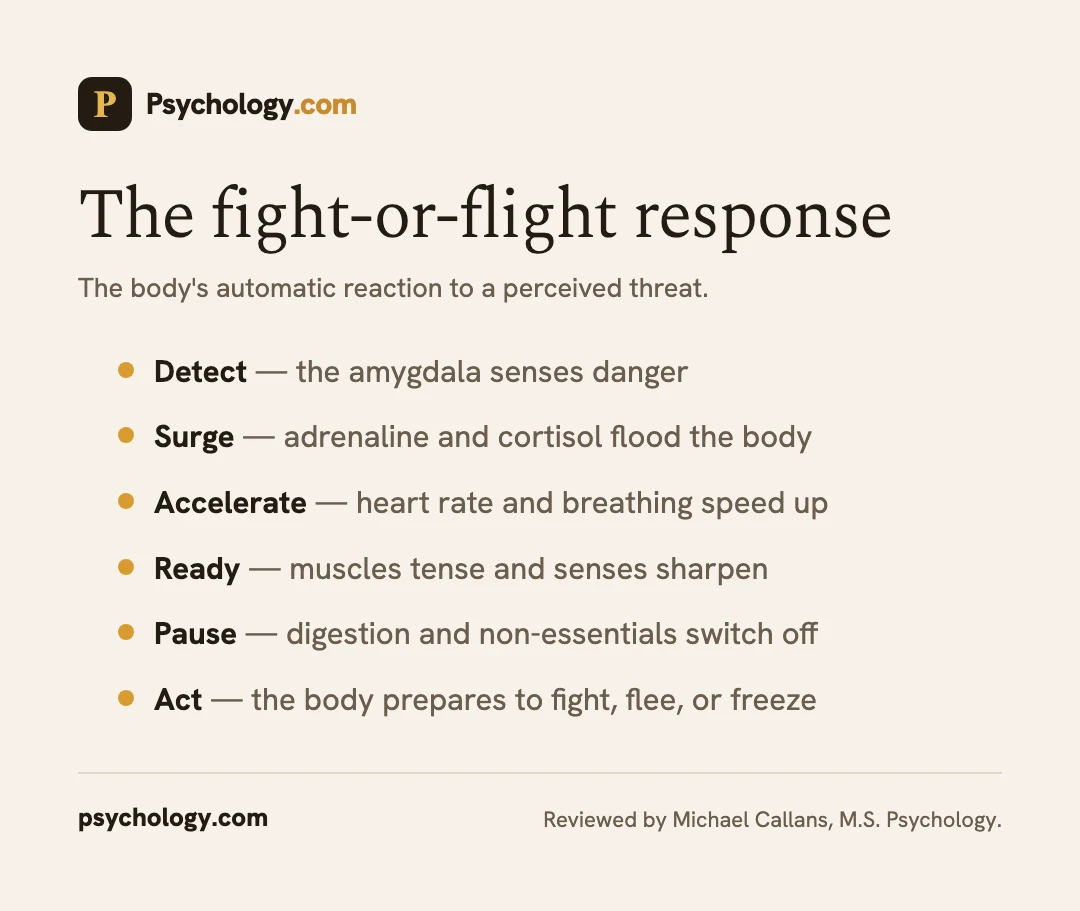
The response begins in the brain, often before conscious thought. The amygdala, a small structure involved in detecting threat, sounds the alarm. It can do so through a fast, rough pathway that reacts to danger before the thinking parts of the brain have fully assessed the situation, which is why we sometimes jump back from a stick that looks like a snake before we realize it is harmless.
The amygdala signals the hypothalamus, which activates the sympathetic nervous system and the body's stress hormone systems. This sets off the cascade of physical changes we experience as the fight or flight response, all orchestrated automatically and faster than deliberate reasoning could manage.
What happens in the body
Once triggered, the sympathetic nervous system signals the adrenal glands to release adrenaline (epinephrine). Within seconds, the heart beats faster and harder, breathing quickens to take in more oxygen, and blood is redirected to the large muscles needed for action.
The pupils dilate to sharpen vision, the airways widen, and stored glucose is released to fuel the muscles. Functions that are not essential in an emergency, such as digestion, are suppressed. The body also activates a slower hormonal pathway, the HPA axis, which releases cortisol to sustain the heightened state and keep energy available.
All of this prepares the body for intense physical effort. In a genuine emergency, these changes can be the difference between survival and harm, and they happen automatically, without any conscious decision.
When the system misfires
Psychological and social pressures can activate stress physiology. A difficult conversation, uncertain finances, or a demanding deadline may bring a racing heart or tense muscles. The intensity depends on context, past learning, and how threatening or manageable the situation feels.
Repeated stressors can make recovery difficult, especially when sleep is disrupted or the situation remains unresolved. Feeling persistently on edge does not prove that adrenaline or cortisol is continuously elevated. Hormone levels and physical symptoms require appropriate assessment when a medical problem is suspected.
Chronic stress is associated with health problems, including cardiovascular strain and difficulties with mood and sleep. Symptoms such as chest tightness, trembling, and palpitations also have other possible causes. New or severe chest pain, fainting, or major breathing difficulty needs urgent medical assessment.
How to calm it down
If you are safe, sit comfortably and let your breathing become slower and gentler without forcing a large breath. The NHS advises breathing as deeply as is comfortable. If concentrating on breathing increases discomfort, return to your usual breathing and focus on what you can see and feel around you.
Other approaches help too. Grounding techniques that focus attention on the senses can interrupt the spiral of threat-focused thinking. Physical activity gives the mobilized energy somewhere to go and helps the body return to baseline. Over time, practices such as regular exercise, adequate sleep, meditation, and addressing the sources of chronic stress build a greater capacity to recover.
A useful next step is to identify what still needs attention: an immediate safety concern, a practical problem, or a recurring fear. Calming skills may help with discomfort while you address the source. Frequent episodes that disrupt daily life deserve a conversation with a healthcare professional.
Everyday examples of the fight or flight response
The response is not limited to physical danger. A near miss in traffic, a raised voice during an argument, an unexpected loud noise, or stepping onto a stage to speak can all trigger the same cascade of a faster heartbeat, quicker breathing, and tense muscles.
Some triggers are obvious in the moment, such as a dog lunging toward you. Others build more quietly, like an inbox full of overdue messages or a conversation you have been dreading, and the body can still mobilize as though the threat were physical.
Recognizing your own common triggers, whether that is public speaking, conflict, or a specific memory, makes the sensations easier to interpret in the moment and easier to tell apart from a medical emergency.
A worksheet and next steps
The fight-or-flight worksheet explains common reactions and offers a printable resource. Use the stress self-check to reflect on recent stress; it cannot measure stress hormones. The sympathetic and parasympathetic comparison explains autonomic activity, while classical conditioning describes how cues can acquire threat associations. More explanations are in the psychology concepts hub.
If fear or avoidance keeps interfering with your life, find a licensed therapist to discuss the pattern and appropriate support.
Key takeaways
- Sympathetic activation helps initiate the rapid stress response, including adrenaline release from the adrenal glands. Source: Harvard Health Publishing, Understanding the stress response.
- The hypothalamic-pituitary-adrenal axis supports a slower hormonal response involving cortisol. Source: Harvard Health Publishing, Understanding the stress response.
- Repeated stress activation can contribute to wear on the body, described as allostatic load. Source: McEwen, Stress, adaptation, and disease.
- Breathing practice should stay comfortable and unforced. Source: NHS, Breathing exercises for stress.
Feeling stuck in a stress response?
Our free, clinician-reviewed self-tests can help you understand your anxiety and stress. No account needed.
Cite this source
Psychology.com. (2026, September 15). The Fight or Flight Response. Psychology.com. https://psychology.com/concepts/fight-or-flight-response
Frequently asked questions
What is the fight or flight response?
The fight or flight response prepares the body to act when danger is perceived. Heartbeat and breathing may accelerate, muscles tense, and alertness increase. These changes can occur during physical danger or psychological stress. Symptoms alone cannot confirm the cause, so unfamiliar or severe physical symptoms deserve medical attention.
Is fight or flight sympathetic or parasympathetic?
The sympathetic nervous system helps drive the immediate fight-or-flight response. Parasympathetic activity supports functions associated with rest and recovery. Both belong to the autonomic nervous system and regulate organs continuously. The familiar accelerator-and-brake comparison is a simplification; the body does more than switch between a completely stressed state and a completely relaxed state.
How do I calm my fight or flight response?
Begin by checking whether you are safe and need practical help. In a safe setting, try comfortable, gentle breathing, loosen tense muscles, and notice your surroundings. Avoid forcing very deep breaths. If episodes recur or cause avoidance, a healthcare professional can assess possible causes and help you choose appropriate support.
Why do I feel stuck in fight or flight?
Repeated stress, unresolved threats, poor sleep, or anxiety can leave you feeling continually on edge. That feeling does not establish a hormone imbalance or a permanently activated nervous system. Note triggers, sleep changes, and how symptoms affect your day. A clinician can assess persistent symptoms and consider psychological and physical explanations.
Where can I find a fight or flight response PDF?
Psychology.com's fight-or-flight tool provides a printable worksheet explaining the stress response. Find it through the worksheet link in this article. You can use it to record situations, body sensations, and coping responses before discussing patterns with a professional. A worksheet supports reflection and cannot determine the medical cause of physical symptoms.
Is fight or flight the same as a panic attack?
They are related but not identical. Fight or flight is the automatic physical response, the racing heart, fast breathing, and muscle tension, that your body produces when it detects danger. A panic attack is a sudden surge of that same physiology along with intense fear, often without an obvious trigger, that peaks within minutes. If panic attacks recur, a panic disorder screening can help clarify the pattern before you discuss it with a clinician.
Related concepts

References
- Cannon WB. Bodily Changes in Pain, Hunger, Fear and Rage. D. Appleton; 1915.
- LeDoux JE. The Emotional Brain: The Mysterious Underpinnings of Emotional Life. Simon & Schuster; 1996.
- Sapolsky RM. Why Zebras Don't Get Ulcers. 3rd ed. Holt Paperbacks; 2004.
- McEwen BS. Stress, adaptation, and disease: allostasis and allostatic load. Annals of the New York Academy of Sciences. 1998;840:33-44. pubmed.ncbi.nlm.nih.gov
- Harvard Health Publishing. Understanding the stress response. health.harvard.edu
- NHS. Breathing exercises for stress. nhs.uk