
In short
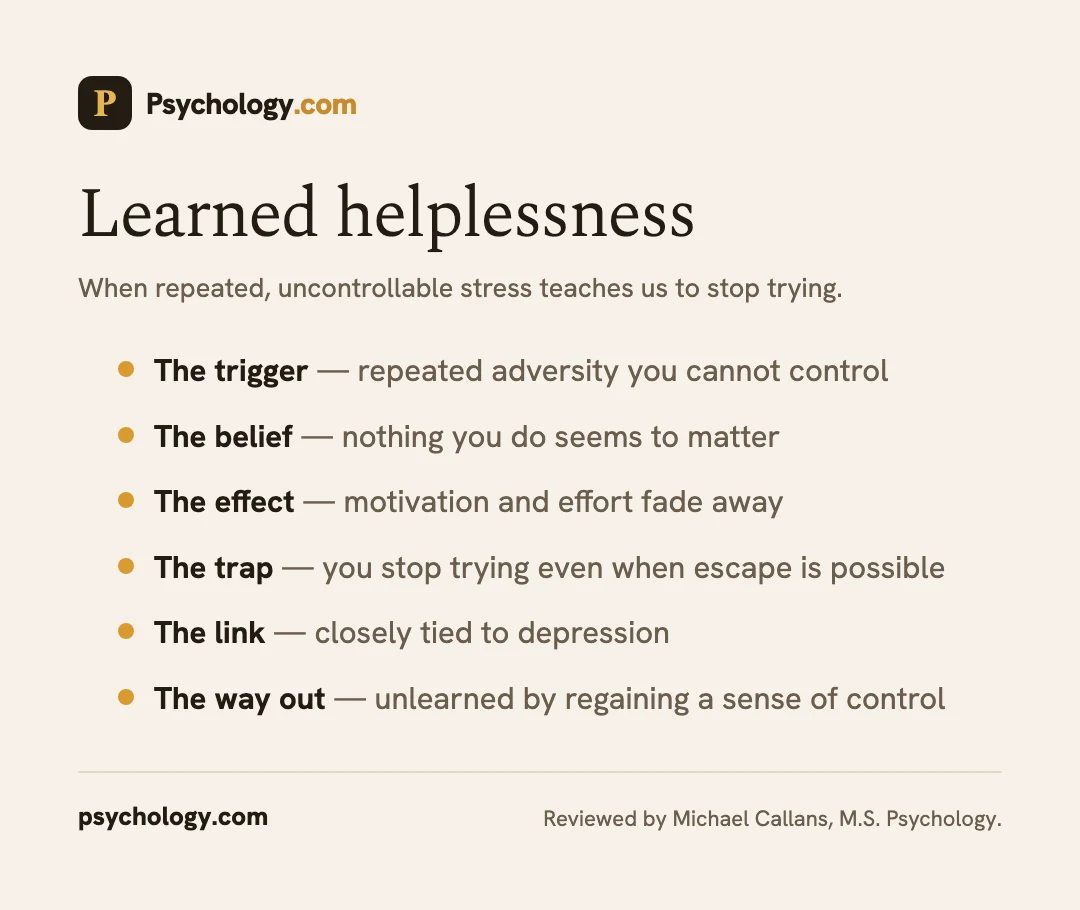
Learned helplessness describes reduced attempts to change an adverse situation after experiencing a lack of control, even when options later become available. The concept comes from animal research and has informed theories of depression. In people, apparent passivity can also reflect exhaustion, danger, or practical barriers that need direct attention.
What learned helplessness is
Learned helplessness describes reduced attempts to change an adverse situation after experiencing a lack of control, even when options later become available. The concept comes from animal research and has informed theories of depression. In people, apparent passivity can also reflect exhaustion, danger, or practical barriers that need direct attention.
Martin Seligman and Steven Maier developed the concept through experiments comparing controllable and uncontrollable stress. The original interpretation emphasized learning that actions did not influence outcomes. Their later account revised that explanation and emphasized what the nervous system learns when control is available.
The original experiments
Seligman and Maier worked with dogs in a series of experiments that are now classic, if ethically troubling by modern standards. In the first phase, some dogs received electric shocks they could stop by performing an action, while others received the same shocks with no way to control them.
In the second phase, all the dogs were placed in an apparatus from which they could easily escape the shock simply by jumping over a low barrier. The dogs that had earlier been able to control the shocks quickly learned to escape. But many of the dogs that had earlier experienced uncontrollable shocks did not even try; they passively endured the shock they could now have avoided.
The comparison suggested that control over the earlier stressor mattered for later escape behavior. Seligman and Maier initially interpreted this as learning that action was ineffective. These were animal experiments; applying the findings to a person's circumstances requires additional evidence and care.
The link to depression
The learned-helplessness model helped researchers ask how expectations of low control might contribute to reduced motivation and hopelessness. Such experiences can occur in depression, alongside changes in mood, sleep, energy, and interest.
Depression has multiple interacting influences, and helplessness is a partial explanatory model. A person who feels unable to act may also face ongoing threats, discrimination, financial barriers, illness, or inadequate support. Those conditions deserve attention.
When low mood or loss of interest disrupts life, a clinician can assess depression and other possible explanations. NIMH describes psychotherapy and medication among treatments, selected according to the person's needs. Improvement cannot be promised through a change in thinking alone.
The reformulation: explanatory style
The original theory had a gap: not everyone who faces uncontrollable adversity becomes helpless or depressed. To explain this, Seligman and colleagues reformulated the model in 1978 around the idea of explanatory style, or how people habitually explain the causes of events.
The reformulation considered whether a person explains a setback as internal (about themselves), stable (likely to persist), or global (affecting many parts of life). For example, a disappointing exam result might be interpreted as a lasting personal failure or as a specific problem to investigate. These are theoretical dimensions, not a diagnostic checklist.
Abramson, Seligman, and Teasdale used these distinctions to explain features such as the persistence and generalization of helplessness and its relationship with self-esteem. They provide questions to explore about an explanation's accuracy and scope without assuming the person caused their adversity.
What later neuroscience changed
Maier and Seligman's later review emphasized animal evidence that prolonged aversive stimulation can produce passive responses without learning that nothing works. In their revised account, learning that an action controls an outcome engages circuitry that can inhibit this response.
This research refines the original interpretation. It does not show that every human difficulty reflects a failure to learn control, or that a worksheet changes a particular brain circuit. Human choices depend on actual options, relationships, health, and safety as well as expectations.
Rebuilding a realistic sense of control
Start by distinguishing what is outside your control from actions that could influence a specific outcome. If repeated job rejections have discouraged you, a manageable step might be asking a trusted person to review an application. The observable result is receiving feedback, while a hiring decision remains outside your control.
Choose an action small enough to attempt, predict what might happen, and record the result. If the attempt fails, examine the task, resources, and circumstances before drawing a conclusion about your abilities. Professional support may help when hopelessness or low energy makes even small actions difficult.
In an abusive or coercive situation, direct action can carry real risks. Seek confidential support and safety planning. Describing someone's circumstances as learned helplessness should never imply that leaving is easy or that remaining is a personal failure.
A worksheet, self-check, and related concepts
Use the circle of control worksheet to separate constraints from possible actions. Write the situation, an action within reach, the help you need, and what you observe afterward. The depression self-check can support a conversation about symptoms; it does not test for learned helplessness or diagnose depression.
Operant conditioning explains how consequences influence behavior, while fight or flight covers acute threat reactions. Browse the psychology concepts hub for more background. If you are in emotional crisis or have suicidal thoughts, call or text 988 in the United States; seek emergency help for immediate danger.
Key takeaways
- The original Seligman and Maier experiments compared the effects of controllable and uncontrollable shock on later escape behavior in dogs. Source: Failure to escape traumatic shock.
- The human reformulation distinguishes internal versus external, stable versus unstable, and global versus specific explanations. Source: Abramson, Seligman, and Teasdale, Learned helplessness in humans.
- Later animal research led Maier and Seligman to emphasize learning control in their revised account. Source: Learned helplessness at fifty: insights from neuroscience.
- Depression care can include psychotherapy, medication, or both, according to clinical needs. Source: NIMH, Depression.
Feeling stuck or powerless?
Talking with a licensed therapist can help you rebuild a sense of agency. Search our directory for free.
Cite this source
Psychology.com. (2026, September 13). Learned Helplessness. Psychology.com. https://psychology.com/concepts/learned-helplessness
Frequently asked questions
What is learned helplessness?
Learned helplessness describes reduced attempts to improve an adverse situation after experiences of low control, even when useful options later appear. It originated in animal research and influenced theories of depression. For people, the explanation needs context: exhaustion, ongoing danger, and limited resources can restrict action independently of expectations about control.
What is an example of learned helplessness?
A student who repeatedly struggles with assignments may stop asking for help even after tutoring becomes available. That could illustrate an expectation that effort will make no difference. Before applying the label, check whether the help is accessible and whether learning needs, fatigue, or fear of embarrassment are making participation difficult.
Is there a learned helplessness quiz?
A general online quiz cannot establish why you feel powerless or whether learned helplessness explains your situation. Reflective questions may help identify expectations about control. If low mood, loss of interest, or low energy accompanies the feeling, a depression screening can support discussion with a clinician. It cannot diagnose learned helplessness.
Is there a learned helplessness worksheet PDF?
The circle of control worksheet linked in this article is a printable resource for exploring situations where you feel stuck. Use it to identify constraints, actions within reach, and support you need. Record what happens after an attempt. The worksheet is a reflection aid and cannot establish the cause of helplessness or replace clinical care.
How can you overcome learned helplessness?
Begin with an achievable action tied to a specific outcome, and check what actually happens. Seek practical help with barriers and examine sweeping conclusions such as expecting every future effort to fail. Progress depends on circumstances. If hopelessness persists or disrupts daily life, a clinician can assess your needs and discuss appropriate care.
Is learned helplessness the same as depression?
Learned helplessness is an explanatory concept, while depression is a clinical condition assessed through symptoms, duration, and effects on functioning. Feelings of low control may contribute to depression for some people. Depression can also involve other influences and requires a broader assessment. Effective care addresses the person's symptoms and circumstances.
Related concepts

References
- Seligman MEP, Maier SF. Failure to escape traumatic shock. Journal of Experimental Psychology. 1967;74(1):1-9. pubmed.ncbi.nlm.nih.gov
- Abramson LY, Seligman MEP, Teasdale JD. Learned helplessness in humans: critique and reformulation. Journal of Abnormal Psychology. 1978;87(1):49-74. pubmed.ncbi.nlm.nih.gov
- Seligman MEP. Helplessness: On Depression, Development, and Death. W.H. Freeman; 1975.
- Maier SF, Seligman MEP. Learned helplessness at fifty: insights from neuroscience. Psychological Review. 2016;123(4):349-367. pmc.ncbi.nlm.nih.gov
- National Institute of Mental Health. Depression. nimh.nih.gov
- SAMHSA. Crisis help. samhsa.gov