
In short
Defense mechanisms are mostly unconscious ways of managing anxiety and painful feelings. Denial, projection, and displacement can make distress easier to bear in the moment. When these patterns repeatedly distort events or damage relationships, recognizing the feeling underneath can help a person respond more deliberately.
What defense mechanisms are
Defense mechanisms are mostly unconscious ways of managing anxiety and painful feelings. Denial, projection, and displacement can make distress easier to bear in the moment. When these patterns repeatedly distort events or damage relationships, recognizing the feeling underneath can help a person respond more deliberately.
The idea originated with Sigmund Freud, who saw defenses as the ego's way of managing conflict between the demands of instinct, conscience, and reality. His daughter, Anna Freud, developed the concept much further in her 1936 book The Ego and the Mechanisms of Defence, cataloguing the main defenses and bringing them to the center of psychoanalytic thinking.
Defenses can help people stay functional during stress. They become costly when they repeatedly prevent someone from acknowledging a problem, accepting responsibility, or responding to another person's needs. A defense label describes a possible process; understanding its role requires context.
Repression and denial
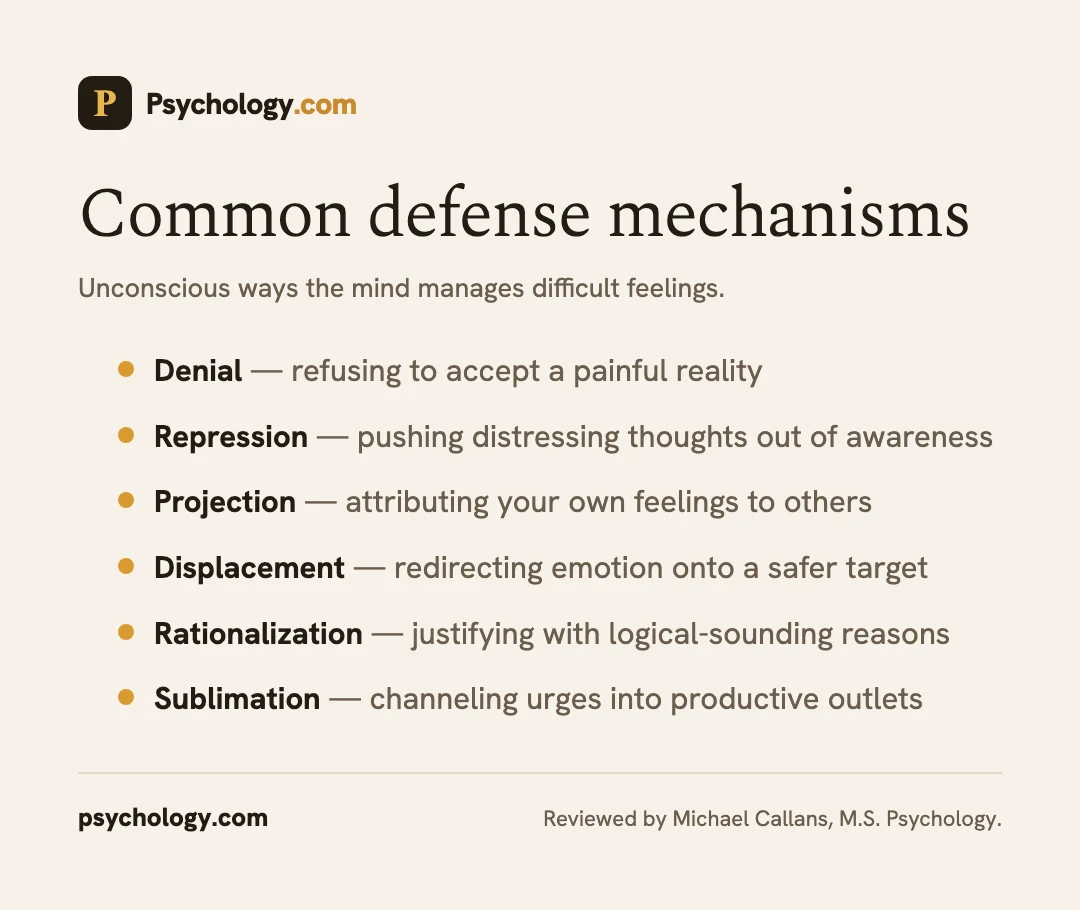
Repression is the psychoanalytic concept of keeping distressing thoughts or impulses outside conscious awareness. Suppression is a deliberate decision to put a concern aside temporarily. A memory gap by itself cannot establish repression or prove that a particular event occurred; avoid using this concept to infer hidden trauma.
Denial is the refusal to accept a painful reality, treating it as if it were not happening. A person told they have a serious illness might insist there has been a mistake, or a person with a drinking problem might flatly deny that any problem exists. Denial blocks the threat at the level of perception itself.
Projection and displacement
Projection involves attributing one's own unacceptable feelings or impulses to someone else. A person who feels hostile toward a colleague but cannot accept that in themselves may become convinced that the colleague is hostile toward them. The uncomfortable feeling is disowned and placed onto another.
Displacement is redirecting an emotion from its real target, which feels too threatening, onto a safer one. The classic example is someone who is angry at their boss but cannot express it, so they come home and snap at their family instead. The feeling is real, but it is aimed at a substitute.
Rationalization, reaction formation, and regression
Rationalization is offering a logical-sounding but false explanation for behavior whose real motive is uncomfortable. Someone rejected for a job might decide they never really wanted it, protecting themselves from the sting of disappointment.
Reaction formation is converting an unacceptable impulse into its opposite, often in an exaggerated form. A person with feelings they find shameful might behave with conspicuous, excessive opposition to those very feelings.
Regression is retreating to behavior typical of an earlier stage of development when under stress. An adult overwhelmed by pressure might become clingy, sulk, or seek comfort in childlike ways. These defenses all manage anxiety by reshaping how an impulse is expressed.
Sublimation and the mature defenses
Sublimation channels an uncomfortable impulse into a socially acceptable activity. For example, a person might direct competitive or aggressive feelings into sport. In psychodynamic theory, this is considered a mature defense because it gives the impulse an outlet while allowing the person to stay engaged with reality.
Later theorists, notably the psychiatrist George Vaillant, organized defenses along a spectrum of maturity. At the mature end sit defenses like sublimation, humor, altruism, and anticipation, which handle stress in flexible, reality-respecting ways. At the immature end sit defenses like denial, projection, and acting out, which distort reality more heavily. Vaillant's long-term research found that people who relied on mature defenses tended to fare better in life.
How defenses are viewed today
Although they grew out of Freudian theory, much of which has not held up to modern scientific scrutiny, the broad observation behind defense mechanisms has proved durable. People really do protect themselves from distressing emotions through largely automatic mental maneuvers, and this is now studied under headings such as emotion regulation and coping as well as in psychodynamic therapy.
In psychotherapy, exploring habitual defenses can reveal feelings a person struggles to acknowledge. A useful starting point is a recent interaction: what happened, what feeling arose, and what did the response accomplish? The aim is greater flexibility and awareness, with enough emotional support to face difficult experiences.
Recognizing a pattern in daily life
After a tense exchange, write down what you observed separately from what you assumed. For example: "My manager criticized the draft; I felt embarrassed; I snapped at my roommate." That sequence may suggest displacement. Treat it as a question to explore, and take responsibility for the effect of snapping.
The feelings wheel can help name an emotion before explaining it away. The stress self-check offers a snapshot of perceived stress; it cannot identify your defenses. Explore cognitive dissonance for belief conflicts and the fight-or-flight response for physical threat reactions, or browse the psychology concepts hub.
Key takeaways
- Defense mechanisms are unconscious responses to inner conflict in classical psychoanalytic theory. Source: APA Dictionary of Psychology, Defense mechanism.
- Projection attributes one's own feelings or impulses to someone else. Source: APA Dictionary of Psychology, Projection.
- Suppression involves a conscious effort to put a thought aside; repression is described as unconscious. Source: APA Dictionary of Psychology, Suppression.
- Defense classifications distinguish patterns by how much they distort reality, with sublimation considered a mature defense. Source: APA Dictionary of Psychology, Defense mechanism.
Wondering what you might be avoiding?
Talking with a licensed therapist can help you understand your patterns. Search our directory for free.
Cite this source
Psychology.com. (2026, September 13). Defense Mechanisms. Psychology.com. https://psychology.com/concepts/defense-mechanisms
Frequently asked questions
What are defense mechanisms in psychology?
Defense mechanisms are largely unconscious ways of reducing distress associated with uncomfortable thoughts, feelings, or conflicts. The term comes from psychoanalytic theory. Denial, projection, displacement, and rationalization are common examples. Understanding a defense means considering what feeling it protects against and how it affects the person's actions and relationships.
What is an example of a defense mechanism?
Displacement is a defense mechanism in which an emotion is redirected toward a safer target. For example, someone who feels angry after criticism at work may snap at a family member. The example illustrates a possible pattern, so it is worth asking what happened before the anger rather than assuming you know its cause.
What is the difference between repression and suppression?
Repression describes unconscious exclusion of distressing thoughts or impulses in psychoanalytic theory. Suppression is a conscious choice to set a concern aside, such as postponing a difficult conversation until after work. The APA Dictionary makes this distinction. Forgetting an event alone does not establish repression or reveal why the memory is missing.
Are defense mechanisms healthy or unhealthy?
The usefulness of a defense depends on its flexibility and consequences. Humor may help someone tolerate embarrassment while still addressing a mistake. Persistent denial may prevent action on a serious problem. Consider whether the response helps you face the situation, maintain relationships, and take responsibility when your behavior affects someone else.
How can I recognize my defense mechanisms?
Start with a recent moment of defensiveness and describe the event, your feelings, and your response. Ask whether you redirected anger, dismissed evidence, or supplied an explanation that avoided disappointment. These are possibilities to explore. A therapist can help examine recurring patterns without treating a single reaction as proof of a personality trait.
Related concepts

References
- Freud A. The Ego and the Mechanisms of Defence. Hogarth Press; 1937. (Original German 1936.)
- Freud S. The Neuro-Psychoses of Defence. In: The Standard Edition of the Complete Psychological Works of Sigmund Freud. Vol 3. Hogarth Press; 1894.
- Vaillant GE. Adaptation to Life. Harvard University Press; 1977.
- Cramer P. Protecting the Self: Defense Mechanisms in Action. Guilford Press; 2006.
- American Psychological Association. Defense mechanism. APA Dictionary of Psychology. dictionary.apa.org
- American Psychological Association. Projection. APA Dictionary of Psychology. dictionary.apa.org
- American Psychological Association. Suppression. APA Dictionary of Psychology. dictionary.apa.org