
In short
Classical conditioning links a cue with an event that already produces a response. Food naturally elicits salivation; a sound associated with food can later elicit salivation too. Identify the cue, original event, and response to understand an example. Predictive relationships matter, and extinction can reduce responding without permanently erasing learning.
What classical conditioning is
Classical conditioning is learning about a relationship between events. A previously neutral cue begins to produce a response after predicting something that already elicits a reaction. For example, a sound associated with food can later trigger salivation. This form of learning helps explain some automatic responses to everyday cues.
Classical conditioning concerns relationships among events and the responses they elicit. It can help explain reflexes and some emotional reactions that arise without a deliberate decision.
Ivan Pavlov studied conditioned salivary responses in dogs as part of his physiological research. His work distinguished responses to food from responses to signals associated with it, establishing a method for studying learned reflexes.
Pavlov's dogs
Pavlov measured salivation when dogs received food. He also observed salivation in response to signals associated with feeding, such as the approach of someone who brought food. The dogs had learned cues that predicted its arrival.
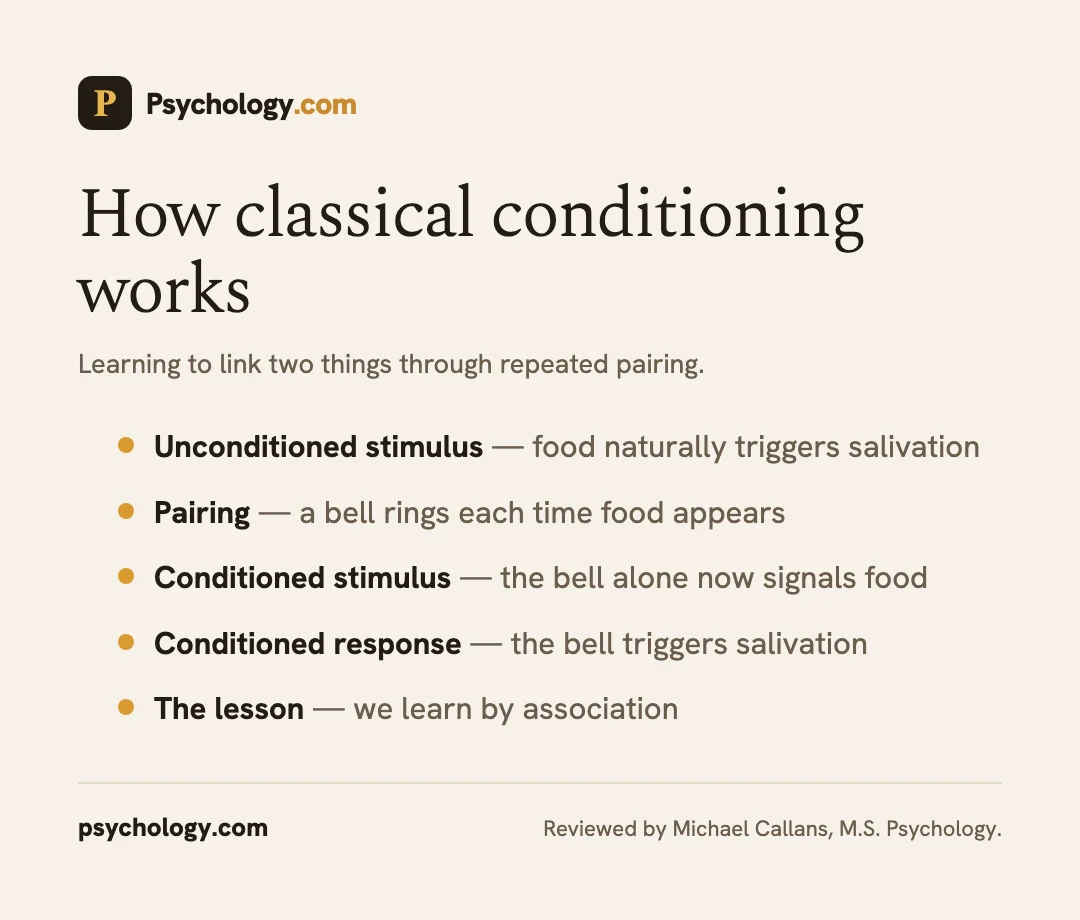
A simplified demonstration uses a sound before food. Food initially elicits salivation, while the sound has no food-related meaning. After learning the relationship, the dog can salivate when the sound occurs before food arrives. Pavlov's research involved varied sensory cues; the familiar bell is a teaching shorthand.
The important question is what the cue predicts. Rescorla's account of Pavlovian conditioning emphasized that learning depends on information about relationships among events, beyond the fact that they occur close together.
The four key terms
Classical conditioning is described with four terms. The unconditioned stimulus (UCS) is something that naturally and automatically produces a response. In Pavlov's study, the food is the UCS.
The unconditioned response (UCR) is the natural, unlearned reaction to the UCS. Salivating in response to food is the UCR.
The conditioned stimulus (CS) is the originally neutral signal that, after pairing with the UCS, comes to trigger a response. The bell becomes the CS.
The conditioned response (CR) is the learned response to the conditioned stimulus. Salivating to the bell alone is the CR. Note that the CR and UCR are often the same behavior; what changes is what triggers it.
Acquisition, extinction, and related effects
Acquisition is the initial phase of learning, when the CS and UCS are paired and the conditioned response gradually strengthens. Conditioning generally works best when the neutral signal appears shortly before the UCS and predicts it reliably.
Extinction occurs when the conditioned cue is repeatedly presented without the expected event and the conditioned response declines. Presenting a food-associated sound without food can reduce salivation to the sound. A later return of responding shows why extinction should not be treated as complete erasure.
Several other effects fill out the picture. In spontaneous recovery, an extinguished response can briefly reappear after a rest period. In stimulus generalization, responses transfer to signals similar to the original CS, such as a tone of a slightly different pitch. In stimulus discrimination, the organism learns to respond only to the specific CS and not to similar ones.
Classical conditioning in everyday life
Although it began with dogs and saliva, classical conditioning shapes a great deal of human experience. A particular song that played during a painful breakup can later trigger sadness on its own. The smell of a hospital can provoke anxiety in someone who has had frightening experiences there. The sound of a notification can trigger a small jolt of anticipation.
Learned associations can contribute to fear and cravings. A person may feel tense on entering a room associated with a frightening event. People can also learn fears through observation or information, so a fear does not prove that a specific conditioning experience occurred.
Exposure-based treatment draws on learning principles. Craske and colleagues describe an inhibitory learning approach that helps people learn that an expected threat may fail to occur or be manageable. Treatment is tailored to the person's difficulties and circumstances; simply waiting for fear to disappear is an incomplete account.
Classical conditioning vs. operant conditioning
Classical conditioning concerns cues predicting events. Operant conditioning concerns actions and their consequences. Hearing a food-associated sound and salivating illustrates classical conditioning. Learning to perform an action because it earns food illustrates operant conditioning. Both can operate in the same situation.
The Bobo doll experiment concerns learning from a model, another useful comparison. The psychology concepts hub connects these learning explanations.
If learned fear is affecting daily life, the phobia self-check can help organize symptoms. The trigger identification worksheet helps record cues, reactions, and context. These reflection tools cannot establish the cause of a fear.
Key takeaways
- Pavlov distinguished salivation elicited by food from salivation elicited by signals associated with food. Source: Ivan Pavlov, Nobel Lecture.
- The UCS naturally elicits the UCR; the CS evokes a learned CR after conditioning. Source: Pavlov, Conditioned Reflexes.
- A cue's predictive relationship with other events matters for conditioning. Source: Rescorla, Pavlovian conditioning.
- An inhibitory learning account of exposure emphasizes new learning about feared outcomes; fear can return after extinction. Source: Craske and colleagues, Maximizing exposure therapy.
Struggling with a fear or anxiety that feels automatic?
Evidence-based therapy can help retrain these responses. Search our directory of licensed therapists for free.
Frequently asked questions
What is classical conditioning in simple terms?
Classical conditioning means learning that a cue predicts an event. A cue that initially has little meaning begins to trigger a response because of that relationship. In a simplified Pavlov example, a sound predicts food and eventually elicits salivation. The learning concerns the relationship between the cue and what follows.
What is an everyday example of classical conditioning?
Imagine becoming tense when you hear a sound that has repeatedly preceded an unpleasant procedure. The procedure originally produced tension, and the sound later starts to evoke it on its own. This illustrates a learned cue-response relationship. Real emotional reactions often have several influences, so an example cannot establish the cause of someone's anxiety.
What do UCS, UCR, CS, and CR mean?
UCS means unconditioned stimulus, such as food. UCR means unconditioned response, such as salivating to food. CS means conditioned stimulus, such as a sound associated with food. CR means conditioned response, such as salivating to that sound. The abbreviations distinguish what elicits the response and whether the relationship was learned.
How is classical conditioning different from operant conditioning?
Classical conditioning involves learning that a cue predicts an event, such as a sound predicting food. Operant conditioning involves learning how an action changes its consequences, such as performing a task to receive a reward. Both processes can operate together. Identifying whether the example centers on a predictive cue or an action helps distinguish them.
What is extinction in classical conditioning?
Extinction is a reduction in a conditioned response when the cue occurs without the expected event. A food-associated sound presented without food may gradually elicit less salivation. The response can return after time passes or circumstances change, so reduced responding does not necessarily mean the original learning has been permanently erased.
Related concepts

References
- Pavlov IP. Conditioned Reflexes: An Investigation of the Physiological Activity of the Cerebral Cortex. Anrep GV, trans. Oxford University Press; 1927.
- Watson JB, Rayner R. Conditioned emotional reactions. Journal of Experimental Psychology. 1920;3(1):1-14.
- Rescorla RA. Pavlovian conditioning: It's not what you think it is. American Psychologist. 1988;43(3):151-160.
- Domjan M. The Principles of Learning and Behavior. 7th ed. Cengage Learning; 2015.
- Ivan Pavlov. Nobel Lecture. nobelprize.org
- Rescorla RA. Pavlovian conditioning: It's not what you think it is. pubmed.ncbi.nlm.nih.gov
- Craske MG, et al. Maximizing exposure therapy: an inhibitory learning approach. pubmed.ncbi.nlm.nih.gov