

Key facts
- NLP developed as a communication and personal-development approach. Its history and proposed techniques are described in a systematic review of health outcomes. Sturt and colleagues: NLP review.
- NLP claims about eye movements and thinking lack reliable support. Experiments testing eye movements as a lie-detection method also failed to support that claim. Wiseman and colleagues: eye movements.
- A systematic review found little evidence that NLP improves health outcomes. Limited study quantity and quality prevented firm effectiveness conclusions. Sturt and colleagues: review findings.
- Established options depend on the concern. Cognitive behavioral therapy is a research-supported treatment for generalized anxiety disorder, delivered within a clinical care plan. NIMH: anxiety treatment.
What is NLP?
In psychology and self-help contexts, NLP refers to neuro-linguistic programming. The same abbreviation is also used for natural language processing in computing. When choosing support, check which meaning a provider intends and whether they are offering personal-development exercises or making claims about treating a diagnosed condition.
Neuro-linguistic programming, almost always shortened to NLP, is an approach to communication and personal development created by Richard Bandler and John Grinder, as described in the systematic review by Sturt and colleagues. The basic idea is that there are connections between how we think (neuro), the language we use (linguistic), and patterns of behavior we have learned (programming), and that by changing language and mental patterns, people can change how they feel and act.
NLP uses neuroscience-related vocabulary, but its name does not establish a scientific mechanism or clinical effectiveness. An NLP training certificate alone does not establish a clinical license. It grew out of observations of a few well-known therapists, and over time it became a large self-help and training industry. Many people find parts of it appealing because it promises fast, practical techniques for confidence, communication, and habit change. Those promises deserve scrutiny of the relevant research and the provider's professional qualifications.
Techniques and claims
NLP includes a collection of techniques and concepts, often presented at workshops and in books. Common ones include:
- Representational systems: the claim that people favor a visual, auditory, or kinesthetic style, sometimes supposedly revealed by eye movements.
- Anchoring: linking a touch, word, or gesture to a desired emotional state so it can be triggered later.
- Mirroring and rapport: matching another person's posture and language to build connection and influence.
- Reframing: changing the meaning you attach to an event to change how you feel about it.
- The fast phobia cure: a brief technique claimed to remove fears and phobias quickly.
Some of these ideas overlap with concepts that do have support elsewhere. Reframing, for example, resembles a technique used in cognitive behavioral therapy, and building rapport is a real part of good communication. The problem is the specific, often bold claims NLP attaches to these techniques, and the lack of evidence that the NLP model itself adds anything beyond what established methods already offer.
Where people encounter it
Most people meet NLP outside of clinical mental-health care. It is common in life coaching, sales and business training, leadership courses, public-speaking workshops, and self-help books and seminars. Practitioners may hold an NLP certificate, but there is no single recognized governing body and no requirement to be a licensed mental-health professional. That matters: someone can market themselves as an NLP practitioner without the training, oversight, or ethical accountability that comes with being a licensed therapist or counselor.
You may also encounter NLP framed as a treatment for specific problems, such as fears, low confidence, or unwanted habits, sometimes promising results in a single session. Marketing like this can be persuasive, especially when it borrows the language of neuroscience and therapy. Knowing where NLP actually sits, as a self-help and communication system rather than a clinical treatment, helps you weigh those promises realistically and ask better questions before signing up.
An honest look at the evidence
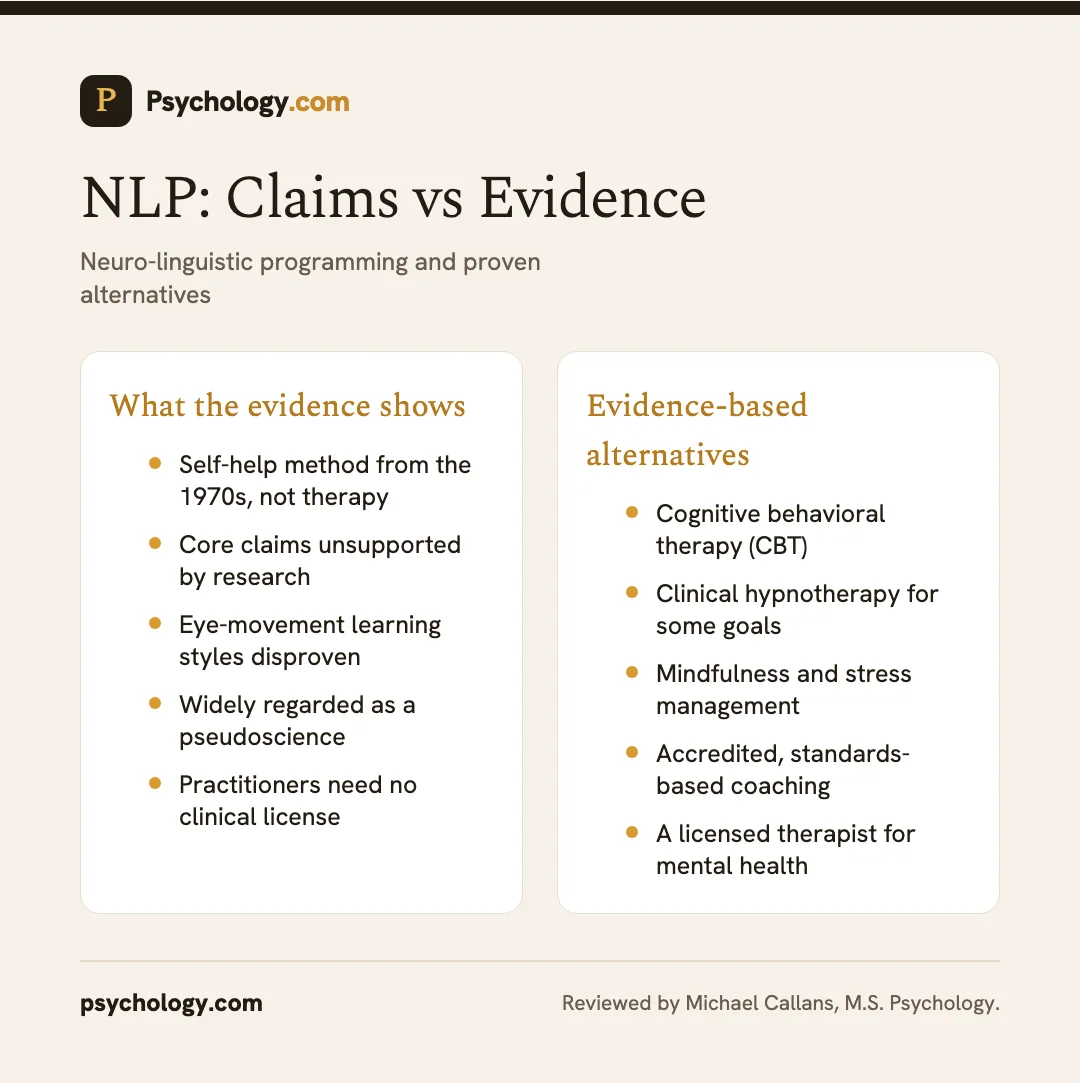
Sturt and colleagues reviewed NLP studies of health outcomes and found little supporting evidence, with substantial limitations in the available research. Their conclusion reflects uncertainty caused by study quality and quantity. It does not establish that every exercise is ineffective. A useful exercise, a convincing explanation, and a clinically effective treatment require different kinds of evidence.
The scientific evidence base for NLP is limited, and studies testing specific claims have frequently produced unsupportive results. Reviews of the research have repeatedly failed to find reliable support for NLP's core claims. The idea that eye movements reveal a person's preferred sensory style, one of NLP's signature concepts, lacks reliable support. Wiseman and colleagues summarize earlier work on this claim and report experiments that failed to support eye movements as a lie-detection tool.
For these reasons, NLP is widely described in academic and clinical sources as a pseudoscience, meaning it presents itself as scientific without meeting scientific standards. The UK's NHS and professional psychology bodies do not list NLP among evidence-based treatments for mental-health conditions. People may feel more motivated after an engaging, supportive workshop. That experience can matter personally while leaving questions about clinical effectiveness unresolved. But that general boost is very different from a proven, specific treatment, and NLP should not be relied on for a mental-health condition such as anxiety, depression, or trauma.
Evidence-based alternatives
The good news is that alternatives can be chosen according to the specific goal and the evidence for that concern:
- Cognitive behavioral therapy (CBT): strong evidence for anxiety, depression, phobias, and more, with the same focus on changing unhelpful thinking that NLP claims.
- Hypnotherapy: for selected concerns, clinical hypnotherapy delivered by a trained professional has evidence that varies by condition. Ask about research for your specific goal.
- Mindfulness and stress management: well-studied tools for stress, focus, and emotional regulation.
- Accredited coaching: for performance, confidence, and career goals, a qualified coach following professional standards is a sounder choice than an unregulated NLP practitioner. See general counseling for professional mental health support; counseling and coaching have different scopes.
How to decide
If you are drawn to NLP, it is reasonable to be curious, but go in with clear eyes. Be cautious of anyone who promises rapid, guaranteed fixes, uses technical-sounding language to imply scientific backing, or discourages you from seeking professional help. For a mental-health concern, start with a licensed therapist or your doctor. For personal-development goals, a credentialed coach or an evidence-based course is a safer investment of your time and money. Asking a provider about their qualifications, the evidence behind their methods, and what results are realistic will tell you a lot.
Frequently asked questions
Is NLP scientifically proven?
Neuro-linguistic programming has insufficient reliable evidence to establish effectiveness for health conditions. A systematic review found little supporting evidence and important weaknesses in the studies available. Experiments also failed to support eye-movement claims used for lie detection. Feeling encouraged by a workshop can be valuable, but it does not establish a specific treatment effect.
Is NLP the same as therapy?
NLP is most often offered in coaching, business training, and self-help. An NLP certificate alone does not establish a mental health license or competence to treat a disorder. Some licensed clinicians may also use NLP techniques. Ask about their underlying license, the evidence for their proposed care, and the alternatives for your concern.
What are evidence-based alternatives to NLP?
The alternative depends on your goal. Cognitive behavioral therapy has research support for anxiety and depression, and mindfulness-based approaches may help with stress. A licensed clinician can recommend care for symptoms. For career or performance goals, check a coach's training and scope; coaching credentials alone do not qualify someone to provide mental health treatment.
Can anxiety journal prompts help me challenge unhelpful thoughts?
Anxiety journal prompts can help you describe a situation, the prediction that worried you, the feelings it triggered, and a possible next step. A structured thought record also invites you to consider evidence and a balanced response. These exercises can support reflection or therapist-guided work. Persistent anxiety and avoidance deserve individualized assessment.
Related approaches
- Hypnotherapy
- Life Coaching
- General Counseling
Finding the right help
When you are ready to take the next step, these guides walk you through finding and starting with the right therapist.
- Getting started with therapy
- How to find the right therapist
- Find a therapist who takes insurance
- Free & low-cost therapy
Compare options in Therapies & Approaches. The anxiety screening can help organize symptoms for a clinician, while the thought record and journal prompts offer structured reflection. A screening cannot diagnose a condition or establish whether NLP would help you.
References
- American Psychological Association (APA): Understanding psychotherapy
- NHS: Cognitive behavioral therapy (CBT)
- American Psychological Association (APA): What is cognitive behavioral therapy?
- HelpGuide: Finding a therapist who can help you heal
- Mayo Clinic: Anxiety disorders, diagnosis and treatment
- Sturt and colleagues: NLP systematic review of health outcomes
- Wiseman and colleagues: The Eyes Don't Have It, lie detection and NLP
- NIMH: Generalized Anxiety Disorder, treatment options