
In short
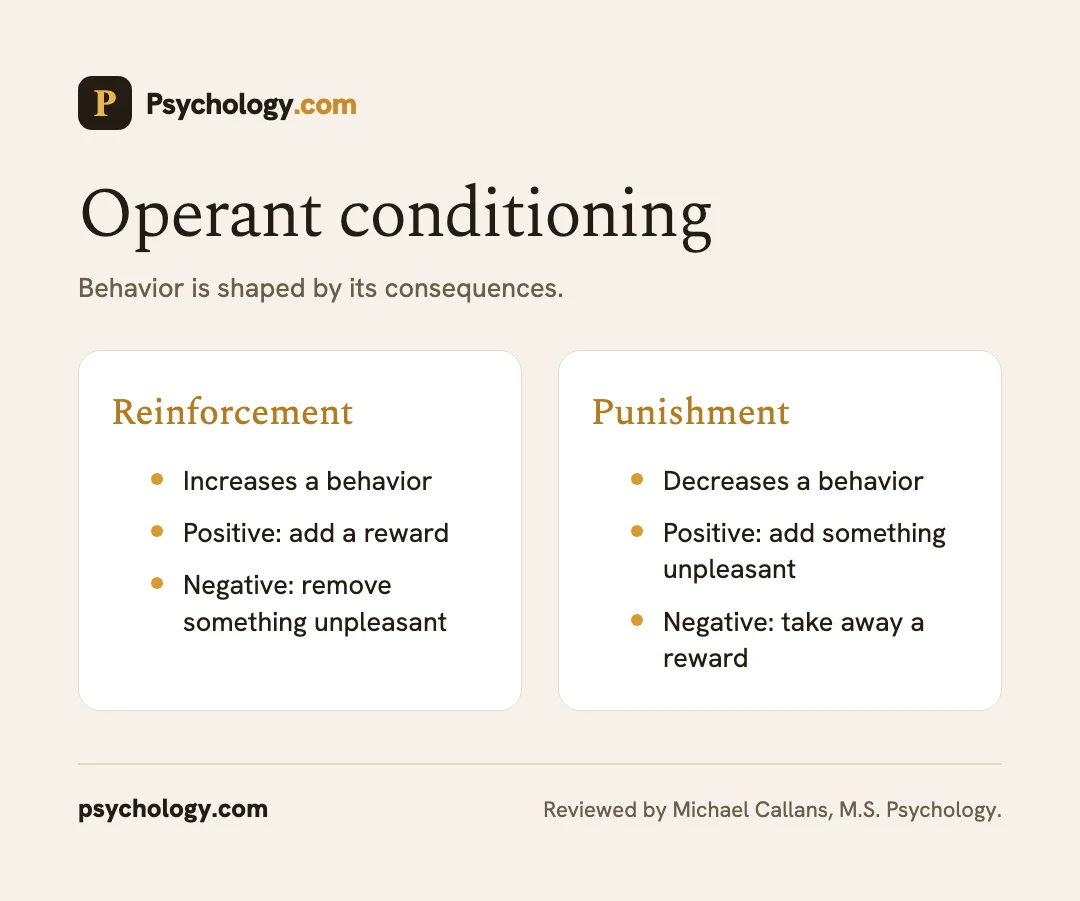
Operant conditioning is a form of learning in which consequences change how often behavior occurs. Reinforcement increases behavior, while punishment decreases it. Positive and negative describe adding or removing something. Whether a consequence functions as reinforcement or punishment depends on its observed effect on future behavior.
What operant conditioning is
Operant conditioning is learning in which the consequences of an action change its likelihood in the future. Reinforcement increases responding, and punishment decreases it. Positive means something is added; negative means something is removed. The classification depends on the change in behavior, rather than the intention behind the consequence.
Edward Thorndike's law of effect helped establish the idea that consequences influence later actions. B. F. Skinner developed systematic ways to study that relationship. The practical question is what happens to a defined behavior under particular conditions.
The American psychologist B.F. Skinner is the figure most associated with operant conditioning. Building on Thorndike's work, Skinner studied behavior with carefully controlled experiments and gave the field its central vocabulary of reinforcement and punishment.
Skinner and the operant chamber
Skinner devised a controlled apparatus, often called a Skinner box or operant chamber, to study learning precisely. A typical chamber contained a lever or key an animal could press, a mechanism to deliver food, and sometimes a floor that could deliver a mild electric shock.
Inside, an animal such as a rat or pigeon would explore and, by chance, perform a target action like pressing a lever. If the press delivered a food pellet, the animal pressed more often. If pressing the lever switched off an unpleasant shock, the animal again learned to press. By varying these consequences, Skinner could shape behavior reliably and measure it over time.
Skinner also described shaping: reinforcing successive approximations toward a target behavior. For example, a trainer might reinforce approaching a station before requiring an animal to stand there. Each step builds toward the target. The animal's current abilities and responses determine when the next step is appropriate.
Reinforcement and punishment
Reinforcement and punishment are defined by their effects on future behavior. Something intended as a reward is a reinforcer only if it increases the behavior it follows. Praise might encourage a person in one setting and feel uncomfortable in another.
Positive reinforcement adds a consequence that increases behavior. If appreciative feedback after sharing an idea leads an employee to contribute more often, the feedback is functioning as reinforcement. Negative reinforcement removes or prevents something aversive and increases behavior, as when fastening a seatbelt stops an alarm and encourages buckling up.
Positive punishment adds a consequence that decreases behavior. A speeding fine qualifies if speeding subsequently decreases. Negative punishment removes something valued and decreases behavior, such as losing access to a game following rule-breaking when that behavior becomes less frequent.
To classify an example, identify the behavior, the consequence, whether something was added or removed, and what happened afterward. A consequence's name or emotional tone is insufficient. Calling every pleasant event reinforcement obscures the need to observe an actual change.
Schedules of reinforcement
A reinforcement schedule specifies when a response produces reinforcement. Continuous reinforcement follows every target response. Intermittent reinforcement follows some responses. These arrangements can affect the rate and persistence of responding.
Fixed-ratio schedules require a set number of responses. Variable-ratio schedules change the required response count around an average. Ratio schedules therefore depend on responding, and variable-ratio arrangements can support high, steady response rates.
Fixed-interval schedules reinforce the first response after a set interval has elapsed. Variable-interval schedules change the interval. Time alone is insufficient: the response after the interval produces reinforcement. Interval schedules can therefore be confused with simply delivering something on a clock.
Variable-ratio schedules can support persistent responding, but calling them universally the strongest schedule is too broad. The behavior, reinforcer, prior learning, and alternatives all matter. A person's gambling or app use also involves factors beyond a reinforcement schedule.
Operant conditioning in everyday life
Operant principles appear in skill learning, classroom routines, work feedback, and everyday habits. A token system gives a symbolic consequence that can later be exchanged for something valued. Its effect depends on whether the target behavior changes and whether the arrangement is understandable and acceptable to the person.
Consequences can also maintain behavior unintentionally. Suppose repeatedly checking a message briefly relieves uncertainty, and checking becomes more frequent. Relief may be functioning as negative reinforcement. That is a possible explanation to investigate, rather than a conclusion that every checking habit has the same cause.
Punishment can suppress behavior without teaching a useful alternative. When helping someone learn, consider what skill they need, how to make it feasible, and how to recognize progress. A behavior plan should respect consent, dignity, communication, disability, and access to basic needs.
Shaping, extinction, and the role of context
Shaping reinforces progress toward a target. Extinction means that a previously reinforced response stops producing that reinforcer. A behavior may decline, but the course can vary and responding can return when the context changes.
For a simple learning example, imagine practicing a new keyboard shortcut because it saves effort. If a software update removes the shortcut's effect, attempts may gradually decrease. The example identifies the response and its consequence without requiring a claim about motivation or character.
The circumstances before an action matter too. A cue can signal that a response is likely to pay off. The same action may therefore occur in one setting and rarely in another. A complete account considers the cue, behavior, consequence, and relevant history.
Extinction should not be used as a blanket instruction to ignore a person's distress or requests for help. What looks like a behavior problem may communicate pain, overload, confusion, or a missing skill. High-risk behavior needs qualified assessment and an appropriate support plan.
Compare learning processes and reflect on habits
Visit the psychology concepts hub and compare classical conditioning, which concerns associations between events, with the Little Albert experiment. An event can involve several forms of learning, so identifying the relationship being studied is more useful than labeling all behavior voluntary or involuntary.
The habit builder worksheet can help specify a target action, cue, and consequence. If repeated phone checking is your concern, the phone-use self-check can prompt reflection on its impact. The result cannot determine which learning process maintains the behavior or provide a diagnosis.
Choose a small, observable action, such as putting the phone away during a chosen activity. Note what makes that easier, what interrupts it, and what follows success. If the plan repeatedly stalls, reconsider the context and practical barriers before increasing demands.
| Feature | Reinforcement (strengthens behavior) | Punishment (weakens behavior) |
|---|---|---|
| Positive (something added) | Add a reward, e.g. praise for chores | Add something unpleasant, e.g. a speeding fine |
| Negative (something removed) | Remove something unpleasant, e.g. alarm stops once buckled | Remove something pleasant, e.g. losing screen time |
| Effect on behavior | More likely to recur | Less likely to recur |
| How to verify | Observe an increase in the target behavior | Observe a decrease in the target behavior |
Key takeaways
- Reinforcement increases the future likelihood of a behavior; punishment decreases it. Source: Skinner, Science and Human Behavior.
- Positive and negative refer to adding and removing consequences. Source: OpenStax, Operant Conditioning.
- Shaping reinforces successive approximations toward a target behavior. Source: Skinner, Science and Human Behavior.
- Ratio schedules depend on response counts; interval schedules reinforce a response after time has elapsed. Source: OpenStax, Operant Conditioning.
- Extinction occurs when a previously reinforced response stops producing reinforcement. Source: Skinner, Science and Human Behavior.
Trying to change a habit that won't budge?
A therapist can help you apply behavior-change principles to your own life. Search our directory for free.
Frequently asked questions
What is operant conditioning in simple terms?
Operant conditioning means learning from the consequences of an action. Reinforcement makes the action more likely in the future, while punishment makes it less likely. The consequence must actually change behavior to earn that label. B. F. Skinner developed methods for studying these relationships and the effects of different reinforcement schedules.
What are the four types of operant conditioning?
The usual categories are positive reinforcement, negative reinforcement, positive punishment, and negative punishment. Positive means adding something; negative means removing something. Reinforcement increases behavior, while punishment decreases it. To classify an example, identify what happened after the behavior and whether the behavior subsequently became more or less likely.
What is the difference between negative reinforcement and punishment?
Negative reinforcement increases a behavior by removing or preventing something aversive. Fastening a seatbelt may become more likely because doing so stops an alarm. Punishment decreases behavior through an added or removed consequence. The key distinction is the direction of behavior change; the word negative describes removal in the reinforcement example.
What is an everyday example of operant conditioning?
If appreciative feedback after a person contributes an idea leads them to contribute more often, that feedback functions as positive reinforcement. The example requires a change in future behavior. If the feedback leaves participation unchanged, its pleasant intention alone is insufficient to classify it as a reinforcer for that behavior.
What are the schedules of reinforcement?
Continuous reinforcement follows every target response; intermittent reinforcement follows some responses. Common intermittent schedules are fixed ratio, variable ratio, fixed interval, and variable interval. Ratio schedules depend on response counts. Interval schedules reinforce a response after time has elapsed. Fixed means a consistent requirement, while variable means that the requirement changes.
How is operant conditioning different from classical conditioning?
Operant conditioning concerns learning about the consequences of an action. Classical conditioning concerns learning an association between events, such as a sound predicting something startling. They can occur within the same experience. Distinguishing the relationship being learned is more accurate than assuming that all operant behavior is consciously chosen.
Related concepts

References
- Skinner BF. Science and Human Behavior. Available through the B. F. Skinner Foundation. bfskinner.org
- OpenStax. Psychology: Operant Conditioning. openstax.org
- Thorndike EL. Animal Intelligence: Experimental Studies. Macmillan; 1911.
- Ferster CB, Skinner BF. Schedules of Reinforcement. Appleton-Century-Crofts; 1957.