
In short
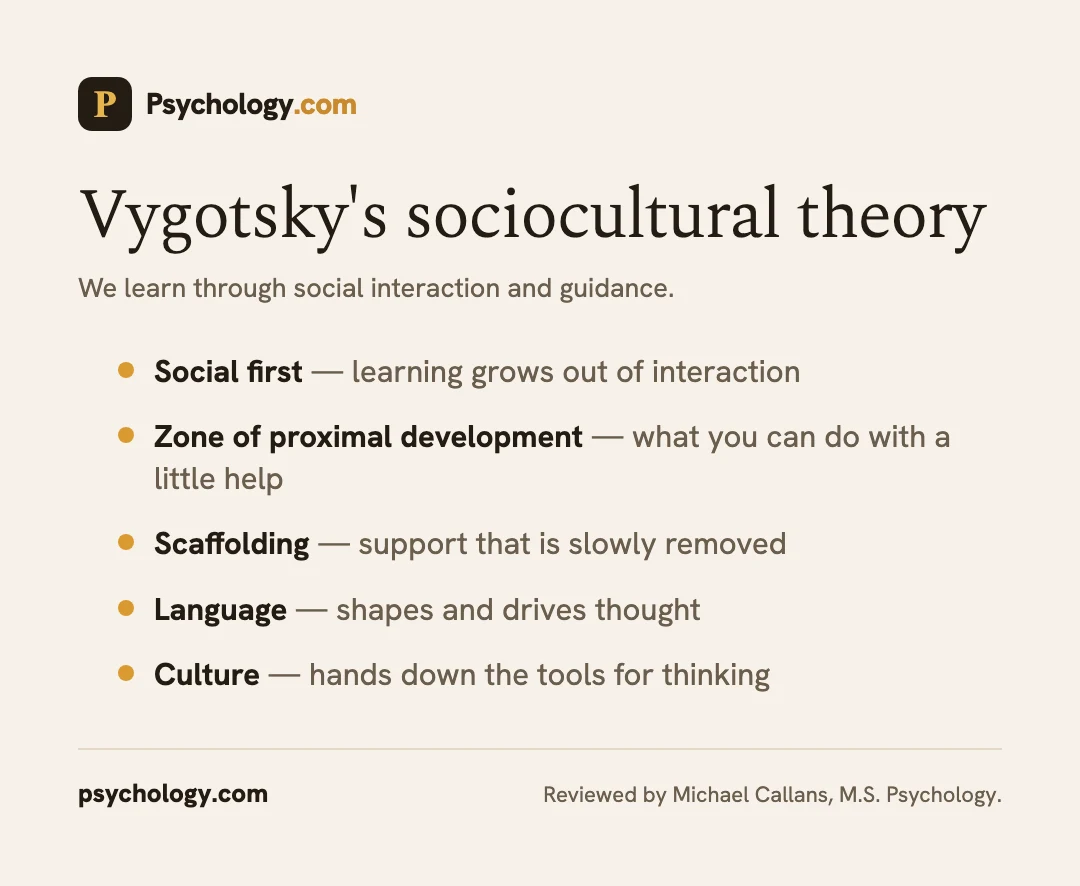
Vygotsky's sociocultural theory proposes that children's thinking develops through interaction with people and the tools of their culture. Guided participation helps learners attempt tasks beyond their independent ability, within the zone of proximal development. Language supports this process as children use shared explanations to guide their own thinking and actions.
What sociocultural theory is
Vygotsky's sociocultural theory proposes that children's thinking develops through interaction with people and the tools of their culture. Guided participation helps learners attempt tasks beyond their independent ability, within the zone of proximal development. Language supports this process as children use shared explanations to guide their own thinking and actions.
Cultural tools include spoken and written language, number systems, diagrams, and familiar ways of solving problems. A child learning to count objects is also learning a culturally shared method for representing quantity. A conversation about how to approach a task can become a strategy the learner later uses alone.
The theory is a framework for understanding development and instruction. It does not assign every child a fixed sequence of sociocultural stages or predict a universal age for mastering a skill. To apply it, examine the task, the learner's current performance, and the help available.
The zone of proximal development
The zone of proximal development, often abbreviated ZPD, concerns the difference between independent performance and performance with capable assistance. Vygotsky used that distinction to argue that assessment should consider developing abilities as well as skills a child already demonstrates alone.
A useful classroom question is what changes when you provide a relevant hint or demonstration. If a learner can use the support to continue, the activity may be within reach. If the adult must complete nearly everything, simplify the task or check prerequisite knowledge before adding more demands.
The ZPD is specific to the activity and assistance involved. A student may solve a reading problem with a prompt while needing much more support with arithmetic. A test score alone cannot describe all those possibilities. Guided performance also needs follow-up: can the learner apply the strategy on a fresh task?
The more knowledgeable other
The phrase more knowledgeable other is common in contemporary explanations of Vygotsky's theory. It describes someone with relevant knowledge of the task, such as a teacher, caregiver, or peer. Vygotsky's account of the ZPD includes adult guidance and collaboration with more capable peers.
Expertise is task-specific. A child who knows how to use a classroom program may help a classmate who is a stronger reader. Useful guidance depends on understanding where the learner is stuck and responding in a way they can use. Simply placing students in a group does not establish that this learning process will occur.
Scaffolding
Scaffolding is temporary instructional support adjusted to a learner's needs. Wood, Bruner, and Ross introduced the term in their 1976 paper, The Role of Tutoring in Problem Solving. It became associated with Vygotsky's theory later; treating it as his own terminology confuses the history.
Support can include narrowing the task, highlighting a relevant feature, or demonstrating an approach. As the learner takes responsibility, the helper adjusts the assistance. The distinction is between the ZPD as a way of describing learning potential and scaffolding as a way of organizing help.
Language and thought
In Thinking and Speech, Vygotsky examined how language and thought develop in relation to each other. Private speech is audible self-directed talk, such as a child saying what to do next during a puzzle. He interpreted this speech as serving a planning and self-guiding function.
Inner speech is the internal use of language in thinking. The account connects social communication with the development of self-directed thought. It does not require every thought to be verbal, and it should not be used to rank children's intelligence by how much they talk aloud.
Influence and comparison with Piaget
Vygotsky emphasized how instruction and collaboration can support emerging abilities. Piaget emphasized children's active construction and reorganization of knowledge. Reducing the comparison to social learning versus a child always learning alone obscures both accounts: children act on their surroundings and engage with people.
Theories guide the questions an educator asks, while classroom decisions also need observation. A Vygotskian question is how performance changes with assistance. A question influenced by Piaget is how the child currently understands the problem. Both can draw attention to the learner's reasoning.
A practical limitation is deciding what counts as useful assistance. A correct response after an adult supplies most of the answer offers limited evidence of independent understanding. Record the kind of help offered and check transfer to a different example. Cultural familiarity, language access, and disability-related accommodations also affect what an assessment reveals.
Criticisms and limitations of sociocultural theory
Vygotsky died in 1934, in his late thirties, after publishing his major ideas over a short window. He did not have the chance to develop them into as systematic and testable a framework as a stage theory like Piaget's. Scholars who have reconstructed his work note that central concepts, such as cultural tools and internalization, are harder to define precisely and measure than a fixed sequence of stages.
Because the theory emphasizes tools and practices that are specific to a culture, applying a finding from one setting to another needs care. A scaffolding approach that works well in one classroom culture may need real adaptation in another, and cross-cultural replication of specific claims is more limited than claims about a universal developmental sequence.
Translation and interpretation add another layer of difficulty. Vygotsky wrote in Russian and left several major works unfinished, so English-language readers rely on translations and later scholarly reconstructions that can differ in emphasis. Anyone checking a specific claim about the theory should note which translation or secondary source it comes from.
An example of sociocultural theory in the classroom
Imagine a student who can read a short passage but struggles to explain a character's motive. The teacher asks the student to point to what the character said and did. Together, they connect that evidence with a possible explanation. The teacher then gives a fresh passage and asks the student to try the same approach.
The shared discussion provides language and a method for reasoning about the text. If the student later asks those questions independently, the strategy is becoming usable without the teacher's prompt. This is an illustration of guided learning, rather than evidence that a particular lesson guarantees development.
An adult can adapt the same approach at home. When a child gets stuck assembling something, ask where the difficulty is, show a relevant action if needed, and leave room for the child to try. Adjust the support to the response. Taking over immediately can hide what the child is capable of doing with a smaller amount of help.
For a learner who uses a communication device or needs written instructions, accessible support may remain essential. Increasing independence can mean using an appropriate tool effectively. Removing every aid is an unsuitable goal when the aid provides access to the task.
Related learning concepts and resources
Compare Piaget's stages of cognitive development with social learning theory for other accounts of how children acquire knowledge and behavior. The psychology concepts hub brings these theories together.
The parenting-style self-check can prompt reflection on how you offer support and set expectations. It cannot measure a child's ZPD or diagnose a developmental concern. Our parenting worksheets can help caregivers plan everyday interactions. For distress affecting family relationships, the therapist directory provides a starting point for finding support; learning concerns may also need discussion with the child's school or pediatric clinician.
Key takeaways
- Vygotsky distinguished independent problem solving from performance with adult guidance or capable peers in his account of the zone of proximal development (Mind in Society).
- Private speech serves a self-guiding function in Vygotsky's account of the relationship between language and thought (Thinking and Speech, Thought and Word).
- Wood, Bruner, and Ross introduced instructional scaffolding in a 1976 study of tutoring during a construction task (The Role of Tutoring in Problem Solving).
- Vygotsky died in 1934 before finishing several major works, which later scholars have translated and reconstructed in different ways (Wertsch, Vygotsky and the Social Formation of Mind).
- Sociocultural theory does not specify a fixed universal sequence of stages the way Piaget's theory does, which makes some of its central concepts harder to test directly (Wertsch, Vygotsky and the Social Formation of Mind).
Reflect on the support you offer
Use the parenting-style self-check to consider everyday patterns of guidance and expectations.
Cite this source
Psychology.com. (2026, September 15). Vygotsky's Sociocultural Theory. Psychology.com. https://psychology.com/concepts/vygotsky-sociocultural-theory
Frequently asked questions
What is Vygotsky's theory?
Vygotsky's sociocultural theory explains cognitive development through social interaction and culturally available tools, including language. Children participate in shared activities and develop ways to guide their own thinking. A central idea is the zone of proximal development: the difference between what a learner can accomplish independently and what they can do with relevant assistance.
What is the zone of proximal development?
The zone of proximal development describes the difference between a learner's independent performance and performance with adult guidance or capable peers. For example, a student may solve a problem after a relevant hint. Observing the assistance required helps a teacher plan instruction and check whether the learner later uses the strategy independently.
What is scaffolding in Vygotsky's theory?
Scaffolding means adjusting instructional support as a learner gains skill, such as moving from a demonstration to a brief prompt. It is closely associated with Vygotsky's zone of proximal development. Wood, Bruner, and Ross introduced the term in their later tutoring research; Vygotsky did not use it as the name of his theory.
What is an example of Vygotsky's sociocultural theory?
A teacher helps a student explain a story by asking about the character's words and actions. The student later uses those questions independently with another passage. The example shows how a shared conversation can provide a thinking strategy. Whether the student can transfer the strategy matters when judging what was learned.
How is Vygotsky's theory different from Piaget's?
Vygotsky emphasized the role of social interaction, language, and culture in the development of thinking. Piaget emphasized children's active construction and reorganization of knowledge. The contrast concerns their explanatory emphasis. Both approaches can inform questions about a learner's reasoning, and neither comparison justifies ignoring children's independent activity or their relationships.
What is the more knowledgeable other?
A more knowledgeable other is someone with greater knowledge of the task a learner is attempting. The phrase is common in modern explanations of sociocultural theory. The helper may be a teacher, caregiver, or peer. Their role is to provide usable guidance, with expertise depending on the activity rather than age alone.
Related concepts

References
- Vygotsky LS. Mind in Society: The Development of Higher Psychological Processes. Harvard University Press; 1978. hup.harvard.edu
- Vygotsky LS. Thought and Language. MIT Press; 1962.
- Wood D, Bruner JS, Ross G. The role of tutoring in problem solving. Journal of Child Psychology and Psychiatry. 1976;17(2):89-100. pubmed.ncbi.nlm.nih.gov
- Wertsch JV. Vygotsky and the Social Formation of Mind. Harvard University Press; 1985. hup.harvard.edu
- Vygotsky LS. Thinking and Speech. The Development of Scientific Concepts in Childhood. English translation. marxists.org
- Vygotsky LS. Thinking and Speech. Thought and Word. English translation. marxists.org