
In short
Erikson's stages of psychosocial development describe eight lifelong challenges involving trust, independence, initiative, competence, identity, intimacy, contribution, and acceptance. Each stage pairs a social task with a possible difficulty. The theory offers a framework for understanding development; its age ranges are approximate, and people can revisit earlier concerns throughout life.
What Erikson's theory proposes
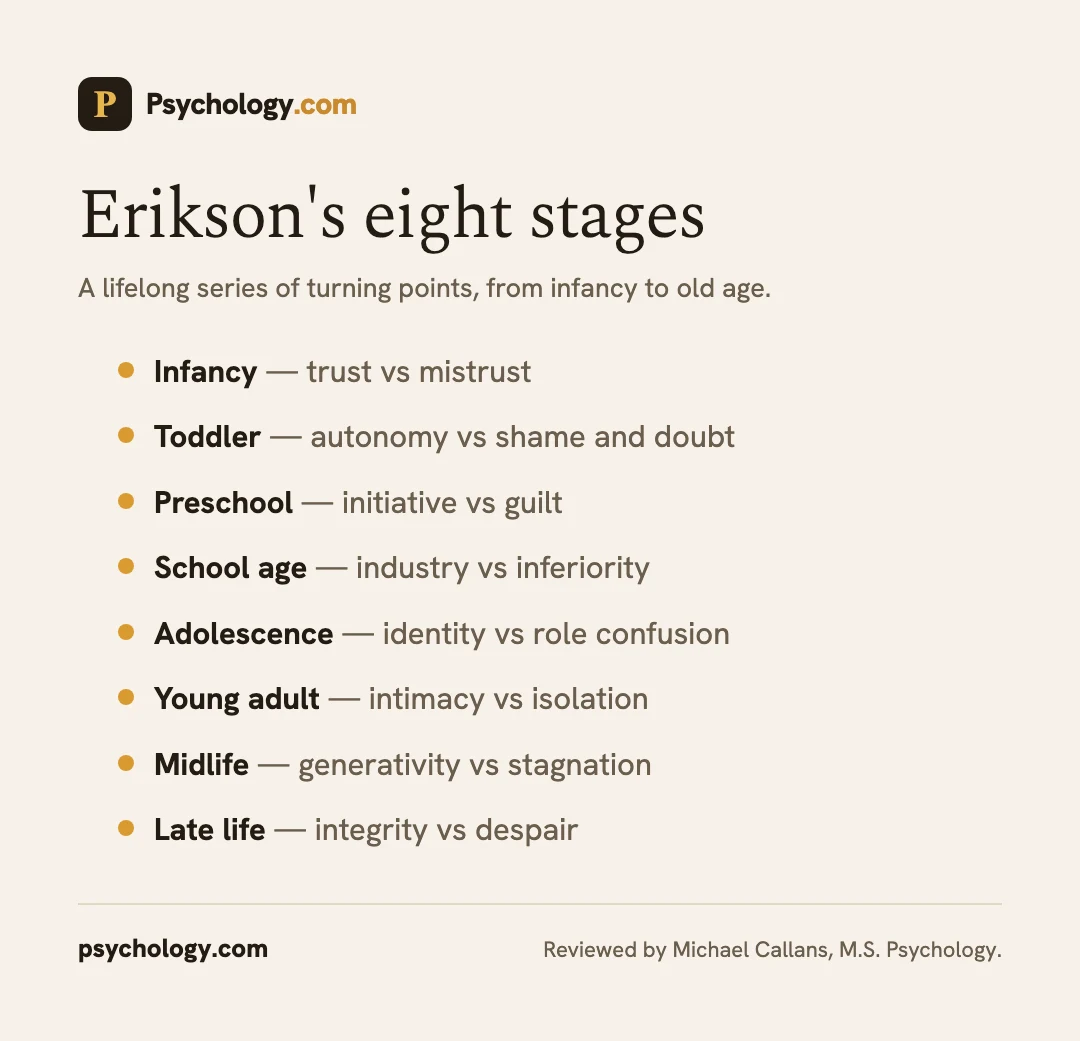
Erikson's stages of psychosocial development describe eight lifelong challenges involving trust, independence, initiative, competence, identity, intimacy, contribution, and acceptance. Each stage pairs a social task with a possible difficulty. The theory offers a framework for understanding development; its age ranges are approximate, and people can revisit earlier concerns throughout life.
His theory, set out most fully in his 1950 book Childhood and Society, describes eight stages from birth to old age. Each stage presents a central conflict or crisis, a tension between two ways of meeting that period's challenges. The word crisis here means a turning point rather than a catastrophe.
In Erikson's theory, working through a conflict can strengthen a capacity such as hope or care. Difficulties may leave concerns that return in new situations. Most people experience aspects of both sides of a conflict. The framework should allow for changing circumstances, supportive relationships, and opportunities to develop later.
The first four stages: infancy through childhood
The life phases below locate each conflict in the theory without imposing a birthday deadline. Published summaries use different age boundaries; a child's circumstances and opportunities also influence which challenges are most pressing.
Trust versus mistrust (infancy) is the first stage. Whether an infant's basic needs are met consistently and warmly shapes a foundational sense of whether the world is safe and people can be relied on. The virtue is hope.
Autonomy versus shame and doubt (toddlerhood) centers on the toddler's growing independence: feeding, dressing, toilet training, and asserting choices. Supportive encouragement builds a sense of autonomy and the virtue of will, while excessive control or criticism fosters shame and doubt.
Initiative versus guilt (the preschool years) emerges as children begin to plan activities, invent games, and take the lead in play. Being allowed to initiate builds purpose, the virtue of this stage; being frequently shut down or made to feel that their efforts are a nuisance fosters guilt.
Industry versus inferiority (the school years) unfolds at school, where children compare themselves with peers and develop competence in academic and social skills. Success and encouragement build a sense of industry and the virtue of competence, while repeated failure or harsh comparison breeds inferiority.
Adolescence and the search for identity
Identity versus role confusion (adolescence) is perhaps the most famous of Erikson's stages, and the one he is credited with introducing into popular thought as the identity crisis. During adolescence, the central task is to form a coherent sense of who one is: values, beliefs, goals, and a place in the world.
Adolescents explore different roles, relationships, and identities, trying things on to see what fits. A successful resolution produces a stable identity and the virtue of fidelity, the ability to commit to and stay true to chosen values and relationships. A poor resolution leaves role confusion, an unclear or fragmented sense of self.
Erikson saw this stage as a hinge between childhood and adulthood, and he argued that some exploration and even temporary confusion are a healthy part of arriving at a genuine identity rather than simply adopting one handed down by others.
The three adult stages
Intimacy versus isolation (early adulthood) follows. Having formed an identity, the young adult faces the task of forming close, committed relationships and genuine intimacy. Success brings the virtue of love; difficulty here can lead to isolation and emotional distance.
Generativity versus stagnation (middle adulthood) is the challenge of middle adulthood. Generativity is the concern for contributing to the next generation and to the wider world, through raising children, mentoring, work, or community. Its virtue is care. The opposite is stagnation, a sense of being stuck, self-absorbed, or without lasting contribution.
Integrity versus despair (later adulthood) is the final stage. Looking back on life, the older adult seeks a sense that it has been meaningful and well lived. A sense of wholeness and acceptance yields ego integrity and the virtue of wisdom. Regret and the feeling that time has run out without a life well lived produce despair.
Strengths and criticisms
Erikson's theory has endured because it offers something many earlier models lacked: a view of development across the whole lifespan, with adulthood and old age treated as periods of genuine psychological growth rather than mere decline. It also foregrounds social and cultural context, not just biology.
It has limits. The stages and their age ranges are broad and somewhat loose, and the theory describes development more than it explains the precise mechanisms behind it. Critics note that it can be hard to test rigorously and that the neat sequence may not fit every culture or individual life course.
Even so, as a framework for reflecting on the central tasks of each life phase, it remains widely taught and clinically useful. Many therapists find it a helpful lens for understanding what a person may be grappling with at a given point in life.
Using the stages without grading a life
Consider a student who avoids an unfamiliar assignment. An industry-versus-inferiority lens suggests offering a manageable task, specific feedback, and a chance to practice. It does not establish why the student is struggling. Learning needs, stress, classroom conditions, and relationships deserve attention in their own right.
For adult identity questions, the Who am I? worksheet can organize reflections on roles and values. The self-esteem self-check concerns current self-perception and cannot assign an Erikson stage. Compare Piaget's cognitive stages and Kohlberg's moral stages, or browse the psychology concepts hub.
Key takeaways
- Erikson's model contains eight stages extending from infancy into later adulthood. Source: Erikson, Childhood and Society; OpenStax, Lifespan Theories.
- Identity versus role confusion concerns developing a sense of self during adolescence in the model. Source: Erikson, Identity: Youth and Crisis.
- Generativity includes mentoring and community contributions as well as parenting. Source: OpenStax, Lifespan Theories.
- Hope, will, purpose, competence, fidelity, love, care, and wisdom are the strengths associated with the stages. Source: Erikson, The Life Cycle Completed.
Navigating a difficult life transition?
A therapist can help you make sense of where you are. Browse licensed professionals in our directory for free.
Frequently asked questions
What are Erikson's eight stages of development?
Erikson's stages are trust versus mistrust, autonomy versus shame and doubt, initiative versus guilt, industry versus inferiority, identity versus role confusion, intimacy versus isolation, generativity versus stagnation, and integrity versus despair. They describe psychosocial challenges across life. The model helps organize questions about relationships, independence, and meaning without determining an individual's future.
What ages are Erikson's stages?
Erikson's stages roughly correspond to infancy, toddlerhood, preschool, school years, adolescence, early adulthood, middle adulthood, and later adulthood. Textbooks differ in their numerical boundaries. These phases locate the theory's central concerns; they should not become deadlines for identity, intimacy, or contribution. People may face several of these concerns at the same time.
What happens if you fail an Erikson stage?
Difficulty with an Erikson conflict may describe an ongoing concern, such as mistrust or feeling inadequate. A stage label cannot establish permanent damage or predict your relationships. Later experiences can offer opportunities to build confidence and connection. If a concern causes distress, focus on the present difficulty and the support available to address it.
What is an example of industry versus inferiority?
A child learning to write may feel capable after practice and specific encouragement, or discouraged by repeated comparisons with classmates. This illustrates industry versus inferiority in Erikson's model. Adults can offer tasks suited to the child's skills and recognize progress. Persistent difficulty also deserves attention to learning needs and the classroom environment.
How is Erikson's theory different from Piaget's?
Erikson's theory emphasizes social relationships and identity across the lifespan. Piaget's theory focuses on how children's thinking changes, including their understanding of objects, logic, and abstract ideas. A child struggling at school might raise questions relevant to both frameworks. Neither theory alone provides a clinical assessment or a complete explanation of development.
Related concepts

References
- Erikson EH. Childhood and Society. W.W. Norton; 1950.
- Erikson EH. Identity: Youth and Crisis. W.W. Norton; 1968.
- Erikson EH, Erikson JM. The Life Cycle Completed. Extended ed. W.W. Norton; 1997.
- Marcia JE. Development and validation of ego-identity status. Journal of Personality and Social Psychology. 1966;3(5):551-558.
- OpenStax. Psychology 2e: Lifespan Theories. openstax.org