
In short
Piaget proposed four stages of cognitive development: sensorimotor, preoperational, concrete operational, and formal operational. They describe changes from learning through action to symbolic, concrete, and abstract thinking. The ages are approximate, and performance varies across tasks and contexts. The framework cannot diagnose a child's development or determine readiness by age alone.
What Piaget's theory is
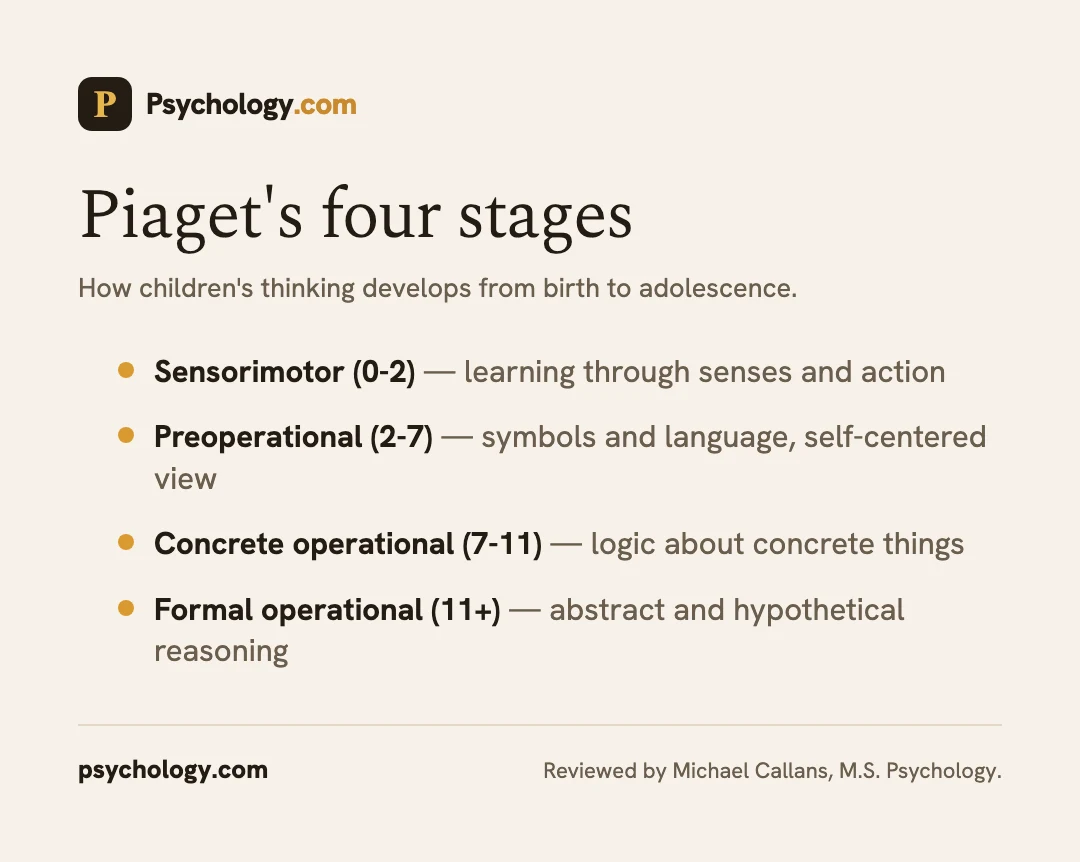
Piaget's stages of cognitive development describe changes in how children understand the world: sensorimotor, preoperational, concrete operational, and formal operational. The proposed progression moves from action and perception toward symbolic representation, concrete logic, and abstract reasoning. These categories organize a theory of thinking; their approximate ages are not diagnostic deadlines.
Jean Piaget emphasized children as active learners who construct and revise their understanding through experience. His theory proposed qualitative changes in reasoning. It is useful to distinguish what the theory predicts from what a particular task reveals about an individual child.
The age labels below follow the summary in OpenStax's Lifespan Theories. Different summaries place the transition to formal operations around early adolescence. These boundaries are approximations, and a child's performance can vary with knowledge, language, attention, and familiarity.
How thinking changes: schemas, assimilation, accommodation
A schema is an organized way of understanding or acting on experience. A young child might have a category for dogs based on familiar features. That category guides what they expect when encountering another animal.
Assimilation means interpreting something new through an existing schema. A child might call an unfamiliar animal a dog. Accommodation means changing the schema when the experience does not fit, such as learning a separate category for cats.
Piaget used equilibration to describe the process of coordinating existing understanding with new information. A surprising result can prompt a child to reconsider an expectation. These ideas concern how understanding changes, while the stages describe broad patterns proposed across development.
For an everyday illustration, a child might believe that all heavy things sink. Trying different objects can reveal a mismatch between that idea and what happens. Asking what they predict and what they notice can make their reasoning easier to understand.
Sensorimotor stage: birth to about 2 years
In the sensorimotor stage, Piaget described learning through seeing, hearing, touching, reaching, and other actions. Infants explore relationships between what they do and what happens, gradually coordinating their behavior in more purposeful ways.
Object permanence means understanding that an object continues to exist when it is hidden. Piaget used search tasks to investigate this. Later research by Baillargeon used looking-time methods and found evidence of expectations about hidden objects earlier than search behavior alone suggested.
An example is watching how a baby responds when a familiar toy is partly covered. This can be a playful interaction with safe materials. A single response cannot establish a developmental level because reaching, attention, and interest also affect what the baby does.
Preoperational stage: about 2 through 6 years
In the preoperational stage, children increasingly use words, images, and pretend play to represent things. Piaget described limits in coordinating perspectives and mentally reversing transformations. These are features of his account of reasoning, rather than judgments about a child's intelligence.
Egocentrism refers to difficulty representing another person's viewpoint. A child may assume that someone else sees what they see. The term describes a perspective-taking problem in a task, rather than selfishness or lack of concern for others.
Centration means focusing on a striking feature of a situation. In a liquid-conservation task, a child may judge a tall, narrow container as holding more because the liquid reaches higher. Asking the child to explain can show which feature they are using.
Concrete operational stage: about 7 through 11 years
Concrete operations involve more coordinated logical reasoning about tangible situations. Piaget associated this stage with conservation, classification, ordering, and reversibility. Children become better able to consider how different aspects of a transformation fit together.
Conservation is understanding that a quantity can remain the same despite a change in appearance. For example, spreading a row of counters farther apart changes its length while preserving the number of counters. Reversibility involves mentally undoing the change.
Hands-on examples can make reasoning visible. Ask a child to arrange objects in categories or explain whether a rearrangement changes the amount. Performance depends on the instructions and materials, so an informal activity should support conversation rather than become a test of whether the child is on schedule.
Formal operational stage: about 12 years onward
Formal operations concern abstract and hypothetical reasoning. A learner can consider possibilities, evaluate logical relationships, and plan a systematic test of an idea. Piaget associated this with adolescence, while later work emphasizes variability in when and where such reasoning appears.
For example, a learner might ask which factor affects how quickly an object moves, then plan to change a factor while keeping the others consistent. The point is the structure of the reasoning, rather than whether the learner already knows the correct scientific answer.
People can reason abstractly in familiar areas while relying on concrete examples elsewhere. Education, practice, task demands, and context affect performance. Reaching an age does not guarantee consistent formal reasoning across subjects, and struggling with an unfamiliar task is insufficient to identify a developmental stage.
Critiques and lasting influence
Piaget helped make children's reasoning a subject of systematic study. His emphasis on active exploration remains useful in education. Asking how a child arrived at an answer can reveal more than marking it right or wrong.
Later research challenged aspects of the timing and stage boundaries. Baillargeon's work on hidden objects illustrates how changing the task can change the apparent age at which an ability is detected. Looking-time and search tasks also place different demands on memory and action.
Development includes variation across domains, cultures, opportunities, and individual children. The stage framework is therefore an incomplete description of a particular learner. It should be used alongside evidence about the task and the child's wider development.
If you are concerned about development or a loss of skills, speak with the child's healthcare provider. CDC recommends sharing concerns and asking about developmental screening. An educational account of Piaget's theory cannot replace that process.
Related theories and resources for caregivers
Browse the psychology concepts hub and compare Vygotsky's sociocultural theory on learning through interaction with Bronfenbrenner's ecological systems theory on developmental settings. They address questions that extend beyond Piaget's account of individual reasoning.
The parenting-style self-check supports reflection on caregiver responses. It does not assess a child's cognitive stage. The parenting worksheets can help organize routines and communication. For concerns involving emotional or family difficulties, a licensed therapist can discuss appropriate support alongside pediatric care.
Key takeaways
- Piaget proposed sensorimotor, preoperational, concrete operational, and formal operational stages. Source: OpenStax, Lifespan Theories.
- OpenStax summarizes approximate ages as birth to 2, 2 through 6, 7 through 11, and 12 onward. These are theory summaries rather than screening thresholds. Source: Lifespan Theories.
- Assimilation applies an existing schema; accommodation changes a schema in response to experience. Source: OpenStax, Lifespan Theories.
- Looking-time studies found evidence about hidden-object understanding that search tasks alone had missed. Source: Baillargeon, Object Permanence in Young Infants.
- Developmental concerns should be discussed with the child's healthcare provider, including whether screening is appropriate. Source: CDC, Concerned About Your Child's Development?
Curious how your own thinking developed?
Our free, clinician-reviewed self-tests can help you understand how your mind works today. No account needed.
Cite this source
Psychology.com. (2026, September 13). Piaget's Stages of Cognitive Development. Psychology.com. https://psychology.com/concepts/piaget-stages-of-cognitive-development
Frequently asked questions
What are Piaget's four stages of cognitive development?
Piaget's stages are sensorimotor, preoperational, concrete operational, and formal operational. They describe a proposed progression from learning through senses and actions to symbolic thought, concrete logic, and abstract reasoning. The sequence belongs to Piaget's theory. Children's performance varies across tasks, and the stages should not be used as a clinical assessment.
What ages are Piaget's stages?
OpenStax summarizes the stages as sensorimotor from birth to about 2, preoperational around 2 through 6, concrete operational around 7 through 11, and formal operational around 12 onward. Other summaries use slightly different transition ages. These ranges are approximate descriptions of the theory, rather than deadlines for an individual child.
What is object permanence in Piaget's theory?
Object permanence is understanding that objects continue to exist when hidden. Piaget studied it through infants' search behavior and associated its development with the sensorimotor stage. Later looking-time research suggested earlier expectations about hidden objects. A baby's response also depends on the task's attention, memory, and movement demands, so an informal game cannot diagnose development.
What is conservation in Piaget's theory?
Conservation means understanding that a quantity can stay the same when its appearance changes. A row of counters still contains the same number after being spread apart. Piaget associated this reasoning with concrete operations. The child's explanation helps reveal their reasoning, while wording and task familiarity can affect the answer.
What is the difference between assimilation and accommodation?
Assimilation means interpreting a new experience using an existing schema. Accommodation means modifying the schema when the experience does not fit. A child who calls an unfamiliar animal a dog is assimilating it into a known category; learning a separate category illustrates accommodation. Piaget used these processes to explain changes in understanding.
Is Piaget's theory still accepted?
Piaget's theory remains influential as a framework for discussing children's reasoning and active learning. Research has challenged its precise timing and sharp stage boundaries, including evidence from infant object-permanence tasks. Educators can use concrete examples and ask children to explain their thinking while avoiding assumptions based on age alone. Developmental concerns require appropriate screening.
Related concepts

References
- Piaget J. The Origins of Intelligence in Children. International Universities Press; 1952.
- Piaget J, Inhelder B. The Psychology of the Child. Basic Books; 1969.
- OpenStax. Psychology: Lifespan Theories. openstax.org
- Baillargeon R, DeVos J. Object permanence in young infants: further evidence. pubmed.ncbi.nlm.nih.gov
- Centers for Disease Control and Prevention. Concerned About Your Child's Development? cdc.gov