
In short
Social learning theory, associated with Albert Bandura, explains learning through observation and modeling. People attend to others' actions, remember them, and may reproduce them when they have the ability and motivation. The theory distinguishes acquiring a behavior from displaying it and explains how observed consequences can influence later choices.
What social learning theory is
Social learning theory explains how people learn behavior by observing models, such as parents, peers, teachers, or people on a screen. Albert Bandura emphasized attention, memory, ability, and motivation. A person can learn what someone does before deciding whether to copy it, even without receiving a reward for watching.
Bandura developed this account through research on modeling and described it in his book Social Learning Theory. The approach brought observational learning and cognitive processes into explanations of behavior change. Direct experience remains relevant: what happens when you try a behavior can influence whether you repeat it.
Think of watching a colleague handle a difficult conversation. You may remember their wording, infer why it worked, and try a version later. The observation gives you information, while your skill, goals, and workplace circumstances affect what you can do with it. This is an everyday illustration of the theory.
Observational learning and modeling
A model is someone whose behavior provides information to an observer. Modeling can be live, such as a parent demonstrating how to apologize, or symbolic, such as a recorded demonstration. The observer may learn a specific action, a general strategy, or an expectation about what usually happens next.
Vicarious reinforcement means that consequences observed happening to someone else influence your motivation to act similarly. Seeing a teammate thanked for sharing information may encourage you to share. Seeing a behavior punished may discourage displaying it, even when you have remembered how it is done.
The model's relevance and the observer's attention matter. A realistic demonstration of coping with mistakes may provide more usable information than a polished performance whose steps are hidden. In teaching, ask the learner what they noticed rather than assuming observation produced the intended understanding.
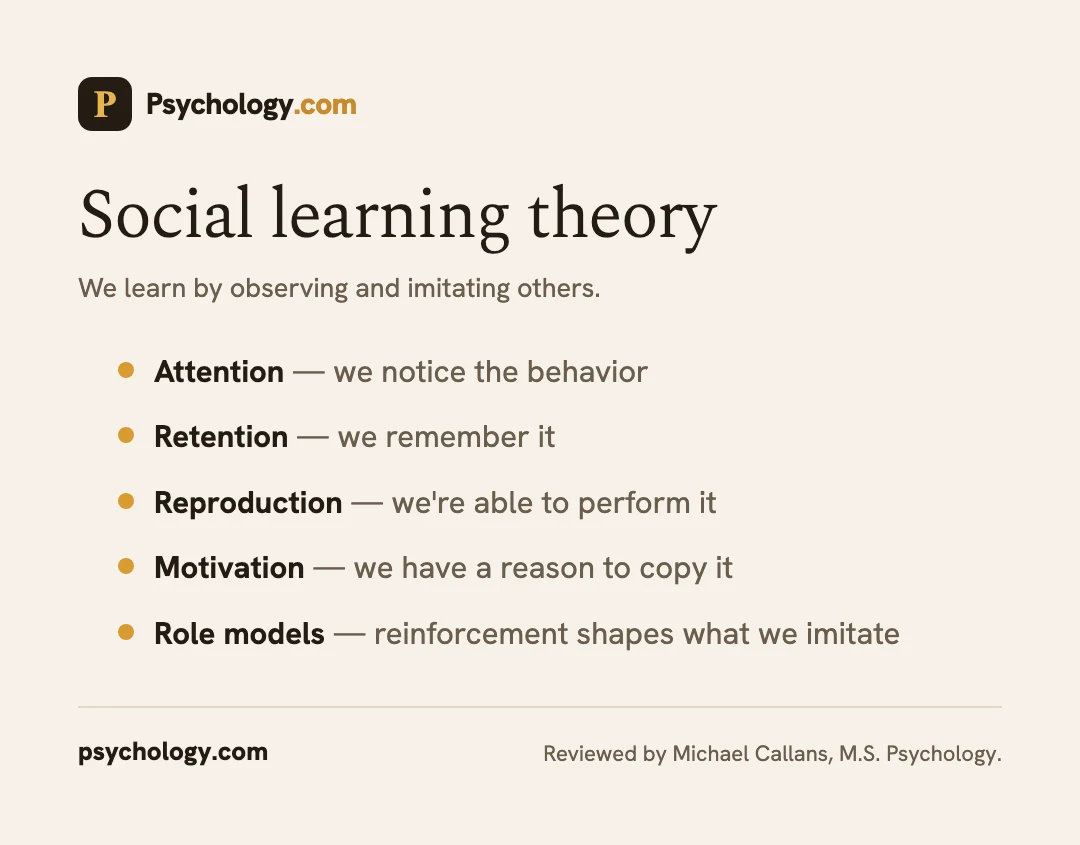
The four processes of observational learning
Attention: the learner notices relevant features of the model's behavior. In a demonstration of a conversation, this could include wording, tone, timing, and how the speaker responds to disagreement. Too many competing details can make the important features harder to notice.
Retention: the learner remembers the behavior in a form that can guide later action. Describing the sequence in your own words or mentally rehearsing it can help clarify what you observed. Remembering a broad impression may leave out a step needed for performance.
Reproduction: the learner translates the remembered information into action. This requires appropriate skills and opportunities to practice. Someone may understand how an expert handles a task while still needing feedback to perform it themselves.
Motivation: expected consequences, personal goals, and standards influence whether the learner performs the behavior. The distinction between learning and performance is central to Bandura's account. A person can acquire information while choosing to wait, practice privately, or avoid copying the behavior.
The Bobo doll studies
In the 1961 study by Bandura, Dorothea Ross, and Sheila Ross, children observed an aggressive or nonaggressive adult model, or experienced a comparison condition without a model. The researchers then observed the children's behavior. Exposure to an aggressive model was followed by more imitation of the modeled aggressive actions.
A separate 1965 experiment examined consequences for a filmed model. Children saw aggression followed by reward, punishment, or no consequences. Initially, children who observed punishment displayed less imitation. When incentives were offered for reproducing the actions, the differences between conditions diminished, supporting a distinction between acquisition and performance.
These studies address different questions: imitation and the role of observed consequences. Their short laboratory tasks support conclusions about immediate behavior. Long-term effects on real-world violence require separate evidence.
From social learning to social cognitive theory
Bandura later developed social cognitive theory, giving greater emphasis to agency, self-regulation, and the interaction of behavior, personal factors, and environment. This reciprocal influence means that people help shape the situations that then affect their choices. Someone who practices a skill may seek different opportunities and receive different feedback.
Self-efficacy is a belief about your ability to carry out a particular action. Bandura's 1977 paper describes how these expectations relate to effort and persistence. Self-efficacy is task-specific: feeling able to lead a meeting can coexist with uncertainty about learning a sport. It differs from global self-esteem or the belief that an action would be useful.
Self-efficacy was already part of Bandura's work during the social learning period. Describing it as an idea that appeared only after the name changed obscures that history. A person's confidence also interacts with actual skills, resources, and barriers; confidence alone cannot make every task achievable.
Examples in classrooms, parenting, and skill practice
In a classroom, a teacher can solve a problem aloud, making the decisions visible before students practice. In parenting, an adult can demonstrate a repair after losing patience: acknowledge what happened, apologize, and show a different response. These examples apply modeling to actions the learner can observe.
For your own practice, choose a specific behavior and a suitable model. Notice what the person does, describe the important steps, try a manageable version, and ask for feedback. If practice stalls, consider whether the difficulty involves remembering the steps, having the necessary skill, or finding a reason and opportunity to act.
Social learning is part of a wider explanation of behavior. Development, direct experience, biology, and social conditions also matter. Observing a helpful behavior does not guarantee improvement, and seeing an unhelpful behavior does not determine a person's future.
Related learning concepts and reflection tools
Read the Bobo doll experiment for the study details and operant conditioning for learning through the consequences of your own behavior. The psychology concepts hub connects these approaches with other learning theories.
The behavior tracker can help record a skill you are practicing and the circumstances around it. The growth mindset self-test offers reflection on beliefs about improvement; it does not measure Bandura's theory or provide a clinical assessment.
If patterns you have learned are causing distress or impairing daily life, a licensed therapist can help assess the concern and identify an appropriate way to work on it.
Criticisms of social learning theory
Social learning theory has drawn several standing criticisms. Critics have argued that its focus on observation and modeling underweights biological factors, such as temperament and physiological arousal, that also shape how a person responds to a model. Others have questioned how testable some of its broader claims are outside a controlled laboratory setting, since a person's home, culture, and history offer far more competing models than a single study can capture.
A separate line of criticism concerns the Bobo doll studies specifically. The aggressive behavior measured was hitting an inflatable toy designed to be struck, and some researchers argue that setup encouraged imitation rather than measuring spontaneous aggression on its own. The studies also tracked imitation over minutes, not sustained real-world behavior, so claims that they alone prove lasting real-world effects go beyond what the original data showed. Bandura's later social cognitive theory addressed some of these gaps by adding self-regulation and reciprocal causation, but the core observation, that people learn a great deal by watching others, has held up well across decades of research.
Social learning theory and media violence
The debate over whether violent media increases aggression is often framed in terms of social learning theory because the original Bobo doll studies used a filmed model. Bandura's designs showed that children exposed to a filmed aggressive model imitated more of the specific actions they saw than children in a nonaggressive or no-model condition. That result supports observational learning as a mechanism, but a laboratory measure of imitating a specific gesture is not the same as evidence that video games or television cause aggression in daily life.
Modern discussions extend the same mechanism to screens, video games, and social media, since each presents models whose behavior a viewer can attend to, remember, and potentially reproduce. What determines whether observation turns into an actual behavior change is still the same four processes: whether the viewer notices the behavior, remembers it, has the ability to perform it, and has a reason to. Researchers continue to debate how strongly media exposure predicts aggression outside the laboratory, and reasonable conclusions should rest on that wider body of evidence rather than on the Bobo doll studies alone.
Key takeaways
- Bandura describes attention, retention, reproduction, and motivation as processes involved in observational learning and performance. Source: Social Learning Theory.
- The 1961 Bobo doll study examined children's imitation after exposure to adult models. Source: Bandura, Ross, and Ross, Transmission of Aggression Through Imitation of Aggressive Models.
- A 1965 experiment varied consequences for a filmed model and later offered observers incentives, helping distinguish learning from performance. Source: Bandura, Influence of Models' Reinforcement Contingencies.
- Bandura's self-efficacy paper was published in 1977, during the social learning period. Source: Self-Efficacy: Toward a Unifying Theory of Behavioral Change.
- Critics have noted that the Bobo doll studies measured imitation of a specific modeled action over a short laboratory session, a narrower claim than lasting real-world aggression. Source: Bandura, Ross, and Ross, Transmission of Aggression Through Imitation of Aggressive Models.
Want to understand your own habits and patterns?
Our free, clinician-reviewed self-tests can help you make sense of how you think and act. No account needed.
Cite this source
Psychology.com. (2026, September 15). Social Learning Theory. Psychology.com. https://psychology.com/concepts/social-learning-theory
Frequently asked questions
What is social learning theory in simple terms?
Social learning theory explains how people learn by watching models and noticing what happens to them. A learner may remember a behavior and use it later, depending on ability and motivation. Albert Bandura emphasized that acquiring information through observation and choosing to perform the behavior are distinct parts of the process.
What are the four steps of social learning theory?
Bandura's observational learning processes are attention, retention, reproduction, and motivation. You notice a model's behavior, remember it, have the skills to perform it, and have a reason to do so. They help explain why watching a demonstration may produce understanding before the learner can or chooses to show the behavior.
What is an example of social learning theory?
A child watches a parent acknowledge a mistake, apologize, and make a repair. Later, the child tries a similar response after an argument. The parent serves as a model, and the child uses information from observation. Practice, the child's abilities, and the reactions of others can influence whether the response continues.
What is vicarious reinforcement?
Vicarious reinforcement happens when observing someone else receive a reward influences your motivation to behave similarly. For example, seeing a classmate praised for helping may encourage helpful behavior. The reward is delivered to the model. This differs from direct reinforcement, where your own behavior is followed by a consequence that increases its recurrence.
How is social learning theory different from operant conditioning?
Operant conditioning explains how consequences following your behavior affect whether it recurs. Social learning theory emphasizes information gained by observing other people, along with memory and expectations. Both processes can operate together: you may watch someone demonstrate a skill, try it yourself, and then learn from feedback on your own performance.
How is social learning theory different from social cognitive theory?
Social cognitive theory is Bandura's broader account of agency and the reciprocal influence of behavior, personal factors, and environment. Observational learning remains central. Self-efficacy and self-regulation help explain what people attempt and how they respond to setbacks. Self-efficacy was already present in Bandura's earlier work, so the historical transition was gradual.
Related concepts

References
- Bandura A. Social Learning Theory. Prentice Hall; 1977.
- Bandura A, Ross D, Ross SA. Transmission of aggression through imitation of aggressive models. Journal of Abnormal and Social Psychology. 1961;63(3):575-582. pubmed.ncbi.nlm.nih.gov
- Bandura A. Self-efficacy: toward a unifying theory of behavioral change. Psychological Review. 1977;84(2):191-215. pubmed.ncbi.nlm.nih.gov
- Bandura A. Social Foundations of Thought and Action: A Social Cognitive Theory. Prentice Hall; 1986.
- Bandura A. Influence of models' reinforcement contingencies on the acquisition of imitative responses. Journal of Personality and Social Psychology. 1965;1:589-595. doi.org
- Bandura A. Social cognitive theory: an agentic perspective. Annual Review of Psychology. pubmed.ncbi.nlm.nih.gov