
In short
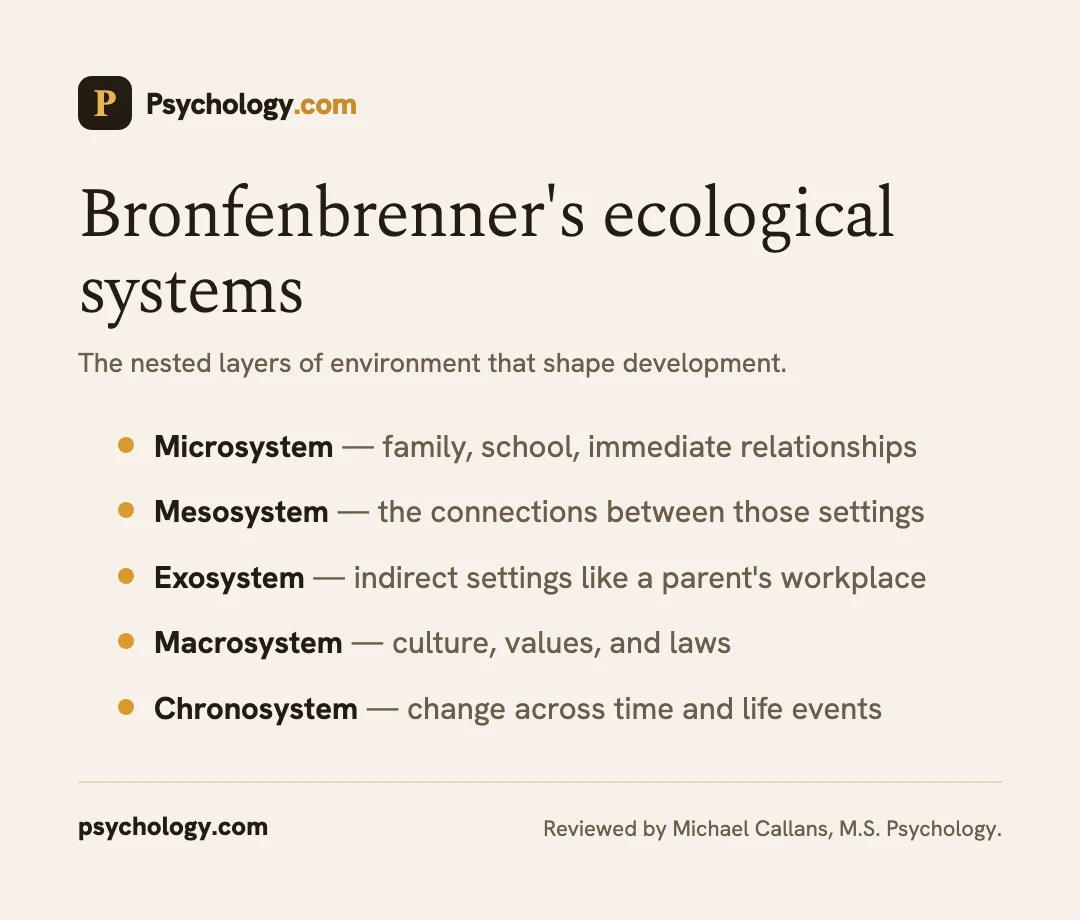
Urie Bronfenbrenner's ecological systems theory connects development with everyday relationships and wider circumstances. Home and school are microsystems; their connections form the mesosystem. A parent's workplace can be part of a child's exosystem, while cultural patterns belong to the macrosystem. The chronosystem captures timing and change across these contexts.
What ecological systems theory is
Bronfenbrenner's ecological systems theory explains human development through ongoing interaction between a person and the settings around them. Immediate relationships, connections between settings, indirect influences, and cultural conditions all matter. Time adds another dimension: a change at home or school can have different effects at different points in development.
Bronfenbrenner argued that you cannot understand a developing person without understanding the environment surrounding them, and that this environment is layered. Each layer influences the child, the layers influence one another, and the child in turn acts back on them. Development, in this view, is the product of an ongoing exchange between a person and the nested systems they live within.
The familiar nested-circle diagram summarizes environmental context. The chronosystem adds change and continuity over time, so it is better understood as a time dimension across the settings. Bronfenbrenner's later work gave greater attention to the processes occurring within those contexts.
The microsystem
The microsystem is the innermost layer: the settings the person directly takes part in and the immediate relationships within them. For a child this typically means the family, the classroom, a peer group, a sports team, or a place of worship.
Relationships within a microsystem are bidirectional. A caregiver's responses affect a child, and the child's interests, reactions, and temperament also affect the interaction. To apply the idea, describe what the people actually do together and how that pattern changes.
The mesosystem
The mesosystem consists of connections between settings the person directly participates in. A parent and teacher discussing classroom support is an example of a link between home and school.
When a child's parents are involved with their teachers, the home and school reinforce each other, and the child usually benefits. When those settings are in conflict, or have no contact at all, the child can be caught between inconsistent expectations. The quality of the links between settings, not just the settings themselves, affects development.
The exosystem
The exosystem includes settings outside the person's direct participation that affect daily life through connections with immediate settings.
A parent's workplace is the classic example. A child does not go to their parent's job, yet a stressful schedule, a layoff, or a supportive employer reaches into the home and changes daily life. Other examples include a school board, local government services, a sibling's network of friends, or the availability of community resources.
The classification depends on whose development you are examining. A workplace may belong to a parent's microsystem because the parent participates there directly, while belonging to the child's exosystem through its effects on home life. Applying Bronfenbrenner's definitions means naming the focal person first, then tracing how a setting reaches their everyday activities. A building or institution does not have a fixed system label for everyone.
The macrosystem
The macrosystem is the outermost cultural layer: the shared values, customs, laws, economic conditions, and ideologies of the society a person lives in. It is less a specific setting than the overarching pattern within which all the inner systems operate.
Cultural beliefs about childhood, gender roles, education, and family structure all sit here, as do broad conditions like poverty or affluence. Two children with similar families can grow up very differently depending on the cultural and economic context that surrounds those families.
The chronosystem
Bronfenbrenner later added a fifth dimension, the chronosystem, to capture the role of time. It accounts for change and continuity across the lifespan and across history.
This includes major life transitions such as starting school, a parental divorce, or the birth of a sibling, as well as the historical moment a person lives through, like a pandemic, a recession, or a technological shift. The same event can affect a person differently depending on when in their development it arrives.
In the later bioecological model, Bronfenbrenner and Pamela Morris emphasized proximal processes: recurring, increasingly complex interactions with people, objects, and symbols in the immediate environment. Their Process-Person-Context-Time framework, abbreviated PPCT, considers how those interactions vary with the person, surrounding conditions, and time.
For a practical PPCT example, consider a caregiver and child reading together regularly. The process is their back-and-forth attention and discussion; the person includes the child's interests and abilities; the context includes available books and a place to read; time includes how the interaction continues and becomes more complex. This illustrates Bronfenbrenner and Morris's framework without assuming that access to books alone describes the developmental process.
Why it still matters
The theory encourages educators and clinicians to consider practical constraints surrounding a difficulty. A student missing homework may be affected by confusing instructions, limited study space, caregiving responsibilities, or changes in a parent's work schedule. These are possible influences to investigate.
A useful application identifies a specific interaction and a feasible change. For example, a school and caregiver might agree on a predictable way to share assignments. The ecological framework organizes the questions; evaluating whether a particular intervention works requires evidence about that intervention.
A map of environmental layers is a starting point for investigation. To examine a proposed explanation, describe the interaction, the expected developmental change, and how you would observe both over time. Bronfenbrenner and Morris emphasize research designs that examine relationships among process, person, context, and time. Simply assigning a difficulty to a system does not establish its cause or identify which support will help.
An example across the systems
Imagine a child adjusting after a family move. Daily interactions in the new classroom are part of the microsystem. Communication between the caregiver and teacher is part of the mesosystem. A caregiver's employer changing work hours is an exosystem influence. Housing policies and cultural expectations sit within the macrosystem. The timing of the move and adjustment over time illustrate the chronosystem. Start with the psychology concepts hub. Compare attachment theory, which focuses on close bonds, with Vygotsky's sociocultural theory, which emphasizes socially supported learning. Adults exploring their own circumstances can use the Stress Level Test self-assessment and Circle of Control Worksheet to distinguish possible actions from constraints requiring outside support. A self-check cannot assess a child's developmental environment. For personal difficulties, use the Psychology.com therapist directory to find a licensed professional.Key takeaways
- Bronfenbrenner's ecological model distinguishes immediate settings, connections between them, indirect settings, and wider cultural patterns. Source: Ecological models of human development.
- The chronosystem concerns change and continuity in the person and environment over time. Source: Bronfenbrenner, Ecological models of human development.
- The later bioecological model has four principal components: process, person, context, and time. Source: Bronfenbrenner and Morris, The bioecological model of human development.
- Proximal processes involve recurring interactions in the immediate environment, with effects that depend on personal and contextual characteristics and time. Source: Bronfenbrenner and Morris, The bioecological model of human development.
Want to understand what is shaping how you feel?
Our free, clinician-reviewed self-tests can help you make sense of your own patterns. No account needed.
Cite this source
Psychology.com. (2026, September 15). Bronfenbrenner's Ecological Systems Theory. Psychology.com. https://psychology.com/concepts/bronfenbrenner-ecological-systems-theory
Frequently asked questions
What are the five systems in Bronfenbrenner's theory?
The commonly taught systems are the microsystem, mesosystem, exosystem, macrosystem, and chronosystem. They describe immediate settings, connections between those settings, indirect influences, cultural patterns, and change over time. The chronosystem cuts across the other systems as a time dimension. Together they help organize questions about a person's developmental context.
What is an example of a microsystem?
A child's classroom is a microsystem because the child participates directly in its activities and relationships. Home, a peer group, or a sports team can also qualify. The key is direct involvement. Researchers or practitioners would examine actual interactions, such as how a teacher responds when the child asks for help.
What is the difference between the mesosystem and exosystem?
The mesosystem links settings a person directly participates in, such as communication between a child's home and school. The exosystem includes a setting outside the person's direct participation that affects their life. A parent's workplace changing shifts can affect the child's routines even though the child never attends that workplace.
What is a chronosystem example?
A family move illustrates the chronosystem when you consider its timing and effects over time. Moving during an already difficult school transition may differ from moving during a settled period. Historical changes, such as a recession, also belong here. The focus is how circumstances and developmental experiences unfold and interact over time.
What is the bioecological model or PPCT?
The bioecological model is Bronfenbrenner's later framework, developed with Pamela Morris. PPCT stands for Process-Person-Context-Time. It emphasizes recurring interactions, called proximal processes, alongside the person's characteristics, surrounding conditions, and timing. A useful application examines what people do together regularly and how those interactions change, extending beyond a diagram of environmental layers.
What are the limitations of ecological systems theory?
Ecological systems theory helps organize influences on development, but identifying those influences does not establish which caused an outcome. A diagram can also leave out the actual interactions occurring within each setting. Bronfenbrenner and Morris's later model calls attention to recurring processes, personal characteristics, context, and time. Applications need observations and evidence suited to the specific explanation being proposed.
Related concepts

References
- Bronfenbrenner U. The Ecology of Human Development: Experiments by Nature and Design. Harvard University Press; 1979.
- Bronfenbrenner U. Ecological models of human development. In: International Encyclopedia of Education. 2nd ed. Vol 3. Elsevier; 1994:1643-1647.
- Bronfenbrenner U, Morris PA. The bioecological model of human development. In: Handbook of Child Psychology. 6th ed. Wiley; 2006:793-828.
- Bronfenbrenner U. Toward an experimental ecology of human development. American Psychologist. 1977;32(7):513-531.
- Bronfenbrenner U. Ecological models of human development. columbia.edu
- Bronfenbrenner U, Morris PA. The bioecological model of human development. onlinelibrary.wiley.com