
In short
The halo effect occurs when an overall impression influences judgments of separate traits. A charming job applicant, for example, may seem more capable before their work is assessed. It often involves positive impressions; the negative version is commonly called the horn effect. The central problem is judging unrelated qualities together.
What the halo effect is
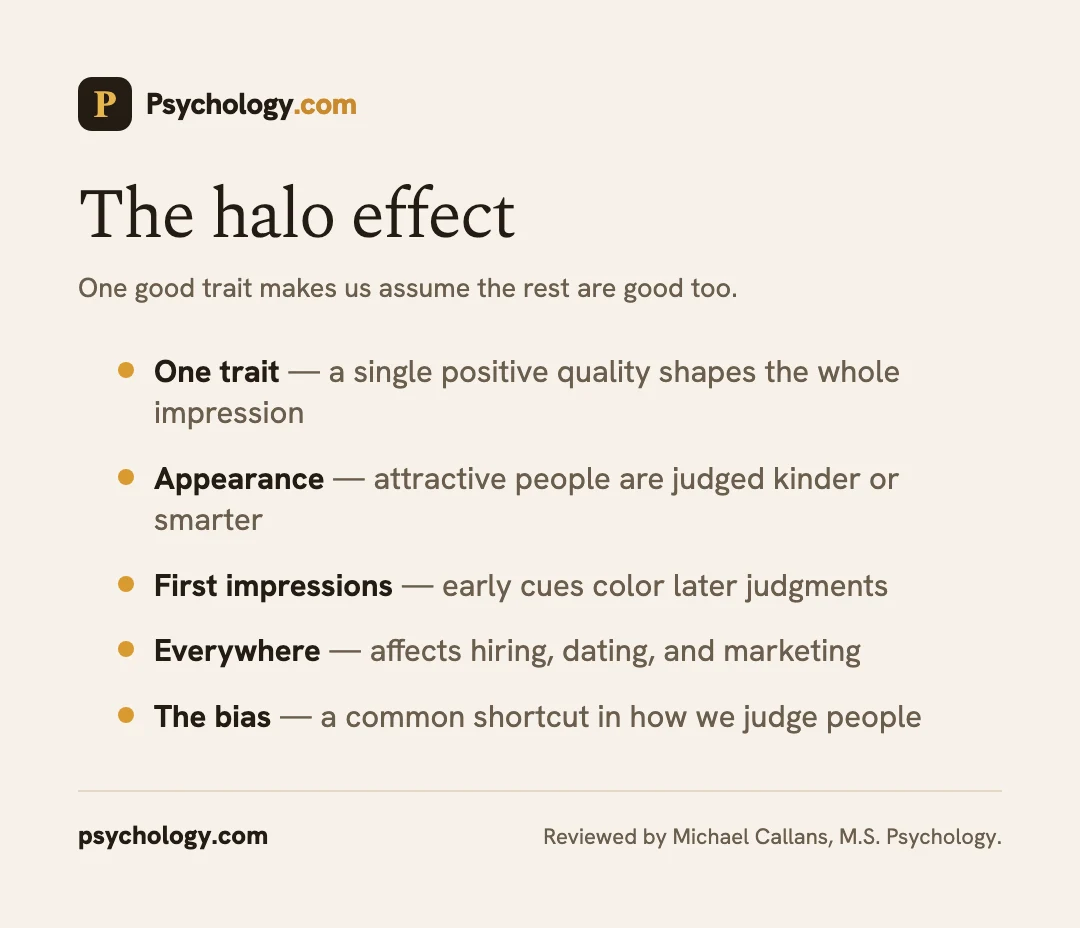
The halo effect occurs when an overall impression influences judgments of separate traits. A charming job applicant, for example, may seem more capable before their work is assessed. It often involves positive impressions; the negative version is commonly called the horn effect. The central problem is judging unrelated qualities together.
If we find someone physically attractive, for example, we are inclined to assume they are also intelligent, trustworthy, kind, and capable. The single favorable trait casts a kind of glow, a halo, over our perception of the whole person. The bias usually operates without our awareness, which is part of what makes it so influential.
Edward Thorndike described the halo in his 1920 paper, A Constant Error in Psychological Ratings. He examined ratings of employees, military personnel, and teachers, arguing that impressions of general merit were influencing judgments of separate qualities. Correlations between ratings suggested a problem, although correlations alone cannot establish how much each judgment was biased.
The attractiveness halo
Attractiveness is a widely researched example of the halo effect. In their 1972 study, Karen Dion, Ellen Berscheid, and Elaine Walster examined how judgments of personality and likely life outcomes varied with the attractiveness of people shown in photographs.
In their study, people judged physically attractive individuals to have more desirable personalities and to be likely to lead happier, more successful lives, despite having no information beyond appearance. Attractiveness, an irrelevant cue for most of these judgments, shaped them anyway.
Langlois and colleagues' review found that attractive children and adults were generally judged and treated more positively. These group-level findings describe tendencies across studies. They do not establish someone's character from appearance or show that every evaluator will make the same judgment.
Where the halo effect shows up
The halo effect reaches far beyond looks. In the workplace, a manager who sees an employee excel at one task may rate them highly across the board, while a single strength in an interview, like confidence or a polished presentation, can inflate the perception of a candidate's whole ability.
In marketing, the halo effect explains why a brand known for one excellent product is assumed to make good products in other categories, and why a likable celebrity endorser can lift our opinion of whatever they promote. In education, a teacher who believes a student is bright may unconsciously judge that student's work more favorably.
The common thread is that a salient positive feature, looks, charm, reputation, success, or fame, gets generalized into an overall positive impression that influences specific judgments it should not.
The horn effect: the negative side
The halo effect has a mirror image, sometimes called the horn effect or reverse halo effect. Here a single negative impression spreads to color everything else. If we find one unflattering trait in a person, we may assume their other qualities are also poor.
For instance, a person judged as unattractive or who makes one awkward impression may be unfairly assumed to be less competent or less trustworthy. The two effects are two sides of the same underlying tendency: our difficulty in evaluating a person's separate qualities independently, and our preference for a consistent overall impression.
Why it happens and how to guard against it
An overall impression can provide an organizing frame for later judgments. When someone seems likable, ambiguous behavior may be interpreted favorably. That offers a possible explanation for the halo effect, while identifying the mechanism in a particular decision requires more than observing that ratings are similar.
It matters when impressions influence decisions about opportunities, performance, or trust. Recognizing the possibility gives you a reason to inspect your evidence. Awareness alone is an uncertain safeguard: an impression can still feel convincing after you learn the name of the bias.
Before reviewing a person or product, decide what qualities matter for the decision. Assess each against relevant observations. In hiring, that might mean comparing work samples against the same criteria and recording each rating before a group discussion. These are practical ways to make judgments reviewable; they cannot guarantee freedom from bias.
A practical example: separate the observation from the inference
Imagine interviewing a candidate who speaks confidently and makes you feel at ease. Your observation is that they communicated clearly during the interview. The inference might be that they will also manage deadlines, resolve conflict, and produce accurate work. Those additional abilities need their own evidence.
Write down the decision you actually need to make. For accuracy, look at a relevant work sample. For reliability, ask about a completed project and how the person handled delays. Leave a quality undecided if you lack enough information. A blank judgment is more honest than extending a favorable impression into an unsupported rating.
The same approach applies to an unfavorable impression. If a candidate seems nervous, ask whether interview fluency is essential to the role and whether their work provides a different picture. Evidence of a real problem still matters. The aim is to keep the conclusion tied to the behavior you observed.
Treat examples involving brands, classrooms, and relationships as illustrations of the mechanism. Each setting has other influences, including prior experience, relevant expertise, stereotypes, and actual differences in performance. Calling a decision a halo effect requires a reason to think an overall impression has spilled into a separate judgment.
How the halo effect differs from other biases
The fundamental attribution error concerns explaining behavior through personal qualities while giving too little weight to circumstances. The halo effect concerns one impression spreading across judgments. A quiet colleague might be judged as unfriendly because their workload is overlooked, then also judged as unhelpful because that negative impression spreads.
Cognitive dissonance describes discomfort involving conflicting beliefs or actions. It can help explain why revising an impression feels difficult, but the concepts describe different processes. Explore the psychology concepts hub for related explanations.
For reflection on how broadly you describe yourself, try the personality self-test. It does not measure halo bias or establish another person's traits. The check the facts worksheet offers a place to separate an observation from an interpretation. If recurring relationship judgments are causing distress, the therapist directory can help you look for professional support.
The halo effect in online reviews and social media
Online platforms create ideal conditions for the halo effect because a viewer usually sees one salient signal, a star rating, a follower count, a polished photo, before assessing anything else. A product with several five star reviews can look better made even to someone who has not tried it, and a social media account with a large following can seem more credible on topics that have nothing to do with why it became popular.
Influencer marketing relies on a similar transfer: an audience's positive feelings about a personality can spread to whatever product that person endorses, independent of the product's actual quality. The same mechanism works in reverse for online reputation. A single negative review or an awkward video clip can trigger the horn effect, coloring a reader's view of a business or a public figure well beyond the specific incident described.
The halo effect vs stereotyping
The halo effect and a stereotype both let one piece of information stand in for a fuller picture, but they work from different starting points. A stereotype assigns expected traits to someone based on their membership in a group, before any individual impression is formed. The halo effect starts with an impression of a specific person, often from one trait or behavior, and lets that impression color unrelated judgments of the same individual.
The two can combine. A stereotype might shape someone's first impression, and that impression can then produce a halo that spreads to other judgments of the same person. Separating them in a real situation means asking whether a belief came from something about this individual or from an assumption about a category they belong to.
Key takeaways
- Thorndike's 1920 paper described overall impressions spilling into separate ratings of employees, military personnel, and teachers (Thorndike, A Constant Error in Psychological Ratings).
- An experiment found that a warm or cold presentation by the same instructor changed students' ratings of his appearance, mannerisms, and accent (Nisbett and Wilson, The Halo Effect, 1977).
- A research review found more positive judgments and treatment of attractive children and adults across studies (Langlois and colleagues, Maxims or Myths of Beauty?, 2000).
- A 1972 study found that people rated physically attractive individuals as likely to have more desirable personalities and happier lives, based on photographs alone (Dion, Berscheid, and Walster, What is Beautiful is Good, 1972).
Reflect on your impressions
Explore how you describe your own traits. A personality self-test cannot measure halo bias.
Cite this source
Psychology.com. (2026, September 15). The Halo Effect. Psychology.com. https://psychology.com/concepts/the-halo-effect
Frequently asked questions
What is the halo effect in psychology?
The halo effect is a bias in which an overall impression influences ratings of separate qualities. A friendly person may seem more competent even before you see their work. The error occurs when your evidence for one judgment spreads into another judgment that needs its own support.
What is an example of the halo effect?
A hiring manager may assume that a confident, likable applicant will also be accurate and dependable. Confidence can be observed during an interview, while accuracy and dependability require other evidence. The halo effect occurs when that positive interview impression fills the gaps before the manager checks relevant work or behavior.
Who discovered the halo effect?
Edward Thorndike described the halo effect in his 1920 paper on psychological ratings. He argued that a general impression of merit influenced judgments of separate qualities in workplace, military, and educational evaluations. Later experiments, including Nisbett and Wilson's instructor study, examined how an overall impression could change more specific evaluations.
What is the difference between the halo effect and the horn effect?
The halo effect commonly refers to favorable impressions spreading across judgments. The horn effect describes an unfavorable impression spreading in a similar way, such as assuming that someone who seems awkward is also unreliable. Both terms concern how a general impression can distort the assessment of separate qualities.
How can you avoid the halo effect?
Define the qualities relevant to your decision and gather evidence for each separately. For example, evaluate a work sample for accuracy before discussing how likable the applicant seemed. Record uncertainty where evidence is missing. These habits make a judgment easier to examine, although knowing about the halo effect cannot guarantee an unbiased decision.
Is the halo effect the same as stereotyping?
The halo effect and stereotyping both let limited information stand in for a fuller picture, but they are not identical. A stereotype attaches expected traits to someone based on group membership, often before any individual impression forms. The halo effect starts with an impression of a specific person, then lets that impression spread to unrelated judgments about the same individual. The two can reinforce each other in a single encounter.
Related concepts

References
- Thorndike EL. A constant error in psychological ratings. Journal of Applied Psychology. 1920;4(1):25-29. doi.org
- Dion K, Berscheid E, Walster E. What is beautiful is good. Journal of Personality and Social Psychology. 1972;24(3):285-290. pubmed.ncbi.nlm.nih.gov
- Nisbett RE, Wilson TD. The halo effect: evidence for unconscious alteration of judgments. Journal of Personality and Social Psychology. 1977;35(4):250-256. doi.org
- Langlois JH, Kalakanis L, Rubenstein AJ, et al. Maxims or myths of beauty? A meta-analytic and theoretical review. Psychological Bulletin. 2000;126(3):390-423. pubmed.ncbi.nlm.nih.gov
- Thorndike EL. A constant error in psychological ratings. Original paper scan. gwern.net