
In short
The Big Five describes personality using openness, conscientiousness, extraversion, agreeableness, and neuroticism. Scores summarize tendencies across situations, with room for change and exceptions. Use a profile to identify preferences and practical goals, such as planning work or managing social demands. It cannot diagnose a mental disorder or determine your future.
What the Big Five is
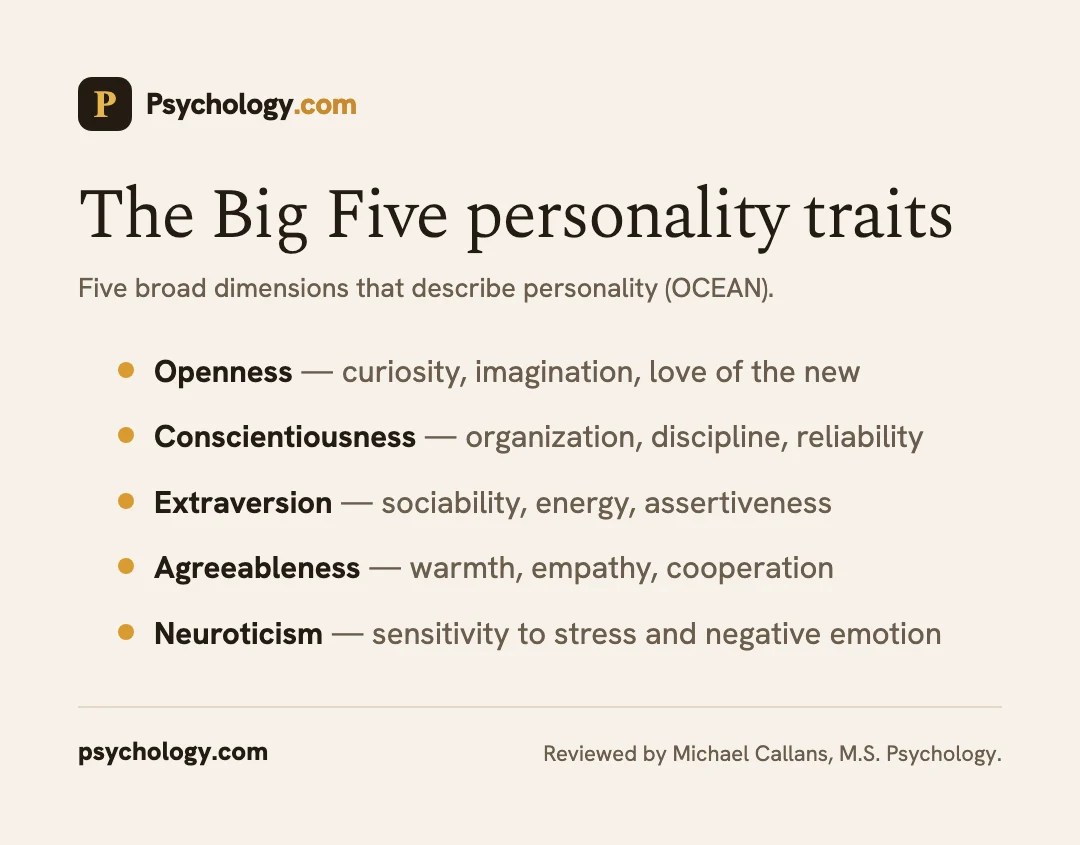
The Big Five is a personality model with five broad dimensions: openness, conscientiousness, extraversion, agreeableness, and neuroticism. The acronym OCEAN names those dimensions. A person has a position on every trait, giving a profile of tendencies that can help explain everyday preferences, habits, and emotional responses.
Each trait is a continuous dimension. A questionnaire estimates your standing on each dimension from your responses. Interpreting a score requires knowing how that questionnaire is scored and which group, if any, provides the comparison.
The model did not begin with a theory of human nature. It emerged from the bottom up, through statistical analysis of the vast number of words languages contain for describing personality, an approach known as the lexical hypothesis: the idea that important personality characteristics become encoded in everyday language.
Openness to experience
Openness reflects curiosity, imagination, and a willingness to engage with new ideas, art, and experiences. People high in openness tend to be inventive, intellectually curious, and drawn to variety and novelty.
People low in openness tend to prefer the familiar, the practical, and the conventional. They may be more comfortable with routine and tradition. Openness is the trait most associated with creativity and with interest in abstract and aesthetic pursuits.
Conscientiousness
Conscientiousness reflects organization, dependability, self-discipline, and a tendency to plan rather than act on impulse. People high in conscientiousness are typically reliable, careful, and goal-directed.
Lower conscientiousness can involve less planning and a more spontaneous approach. A useful application is to identify where structure helps: a checklist, a visible deadline, or a smaller next step. A broad score cannot establish the reason someone struggles with organization.
Extraversion
Extraversion reflects sociability, energy, assertiveness, and a tendency to seek stimulation from the outside world and from other people. People high in extraversion are typically outgoing, talkative, and energized by social contact.
People low in extraversion, often called introverts, tend to be more reserved and to find too much social stimulation draining, preferring quieter settings and smaller groups. Extraversion is linked to the experience of positive emotion and to a preference for active, social environments.
Agreeableness
Agreeableness reflects warmth, compassion, cooperativeness, and trust. People high in agreeableness tend to be kind, considerate, and willing to compromise, and they place a high value on getting along with others.
Lower agreeableness can involve greater skepticism, competitiveness, or willingness to challenge others. The value of a response depends on the situation. Cooperation can help a team, while direct disagreement can be useful when an agreement would compromise a boundary.
Neuroticism
Neuroticism reflects the tendency to experience negative emotions such as anxiety, sadness, irritability, and emotional instability. People high in neuroticism are more prone to worry, stress, and mood swings, and they react more strongly to setbacks.
Lower neuroticism is often described as greater emotional stability. A higher score describes a tendency to experience negative emotions; clinical assessment requires information about symptoms, duration, functioning, and context. Someone experiencing persistent anxiety or low mood can seek help regardless of a personality score.
What the research shows
The Big Five has substantial research support, and established instruments assess both broad traits and narrower facets. Soto and John's Big Five Inventory-2, for example, measures 15 facets within the five domains. Different tests can use different wording and scoring, so their results require their own interpretation.
The model's cross-cultural reach has limits. Gurven and colleagues did not recover a robust Big Five structure in their study of Tsimane forager-farmers in the Bolivian Amazon. Language, measurement, and social context deserve consideration when a questionnaire is used beyond the populations in which it was studied.
Personality can show both stability and change. A meta-analysis by Roberts, Walton, and Viechtbauer found average changes in traits across the life course, including increases in conscientiousness and emotional stability in young adulthood. Group averages cannot specify how an individual will change.
Treat a profile as a description to check against real examples. If you score low on extraversion, ask which settings feel comfortable and which feel demanding. Avoid turning a score into a rule about the work, friendships, or relationships you can pursue.
Use your profile for a practical next step
The Big Five personality test offers a starting point for reflection. Choose a habit you want to work on and use the goal-setting worksheet to define a manageable action.
Visit the psychology concepts hub. The halo effect explains how impressions can distort judgments, while attachment styles concern expectations about closeness. These concepts describe different aspects of experience.
If distress or difficulties with daily functioning are your concern, find a therapist for an individualized assessment.
Key takeaways
- Soto and John's Big Five Inventory-2 measures five broad domains and 15 narrower facets. Source: The next Big Five Inventory (BFI-2).
- Longitudinal research finds average personality changes across adulthood, including increases in conscientiousness and emotional stability in young adulthood. Source: Roberts, Walton, and Viechtbauer, Patterns of mean-level change in personality traits.
- A study among Tsimane forager-farmers did not find a robust Big Five structure, limiting claims of universality. Source: Gurven and colleagues, How universal is the Big Five?
Curious about your own personality profile?
Our free, clinician-reviewed self-tests can help you understand your traits and tendencies. No account needed.
Cite this source
Psychology.com. (2026, September 13). The Big Five Personality Traits (OCEAN). Psychology.com. https://psychology.com/concepts/big-five-personality-traits
Frequently asked questions
What are the Big Five personality traits?
The Big Five traits are openness to experience, conscientiousness, extraversion, agreeableness, and neuroticism. Together they describe broad patterns in curiosity, organization, social engagement, cooperation, and emotional sensitivity. Everyone has a position on each dimension. A score summarizes a tendency and leaves room for different behavior in different situations.
What does OCEAN stand for in personality?
OCEAN stands for openness, conscientiousness, extraversion, agreeableness, and neuroticism. It is a memory aid for the Big Five model. Some questionnaires use related labels such as open-mindedness or negative emotionality. Check the explanation supplied with your test because labels, item wording, and score formats can differ across instruments.
Is a Big Five test an introvert or extrovert personality test?
A Big Five test includes extraversion as part of a broader personality profile. Lower extraversion often involves a more reserved style, while higher extraversion involves greater sociability or assertiveness. The other dimensions concern different tendencies. A dedicated introversion and extraversion test focuses more narrowly on social preferences and related experiences.
What is a good Big Five personality score?
There is no single ideal Big Five profile. A trait can be useful in some settings and challenging in others, depending on your goals and circumstances. Compare your result with concrete examples from your life. Percentiles, when provided, indicate a comparison with a reference group rather than a grade for personal worth.
Can your Big Five personality traits change?
Big Five traits can change over time. Longitudinal research finds average shifts across adulthood, alongside differences in how individuals develop. A temporary mood or change in how you interpret questions can also affect a result. Look for sustained changes in behavior across situations before concluding that a repeat score reflects lasting personality change.
Related concepts

References
- McCrae RR, Costa PT. Personality in Adulthood: A Five-Factor Theory Perspective. 2nd ed. Guilford Press; 2003.
- Goldberg LR. The structure of phenotypic personality traits. American Psychologist. 1993;48(1):26-34.
- John OP, Srivastava S. The Big Five trait taxonomy: history, measurement, and theoretical perspectives. In: Handbook of Personality. 2nd ed. Guilford Press; 1999:102-138.
- Roberts BW, Walton KE, Viechtbauer W. Patterns of mean-level change in personality traits across the life course. Psychological Bulletin. 2006;132(1):1-25.
- Soto CJ, John OP. The next Big Five Inventory (BFI-2): Developing and assessing a hierarchical model with 15 facets. pubmed.ncbi.nlm.nih.gov
- Roberts BW, Walton KE, Viechtbauer W. Patterns of mean-level change in personality traits across the life course. pubmed.ncbi.nlm.nih.gov
- Gurven M, et al. How universal is the Big Five? Testing the five-factor model of personality variation among forager-farmers in the Bolivian Amazon. pubmed.ncbi.nlm.nih.gov