
In short
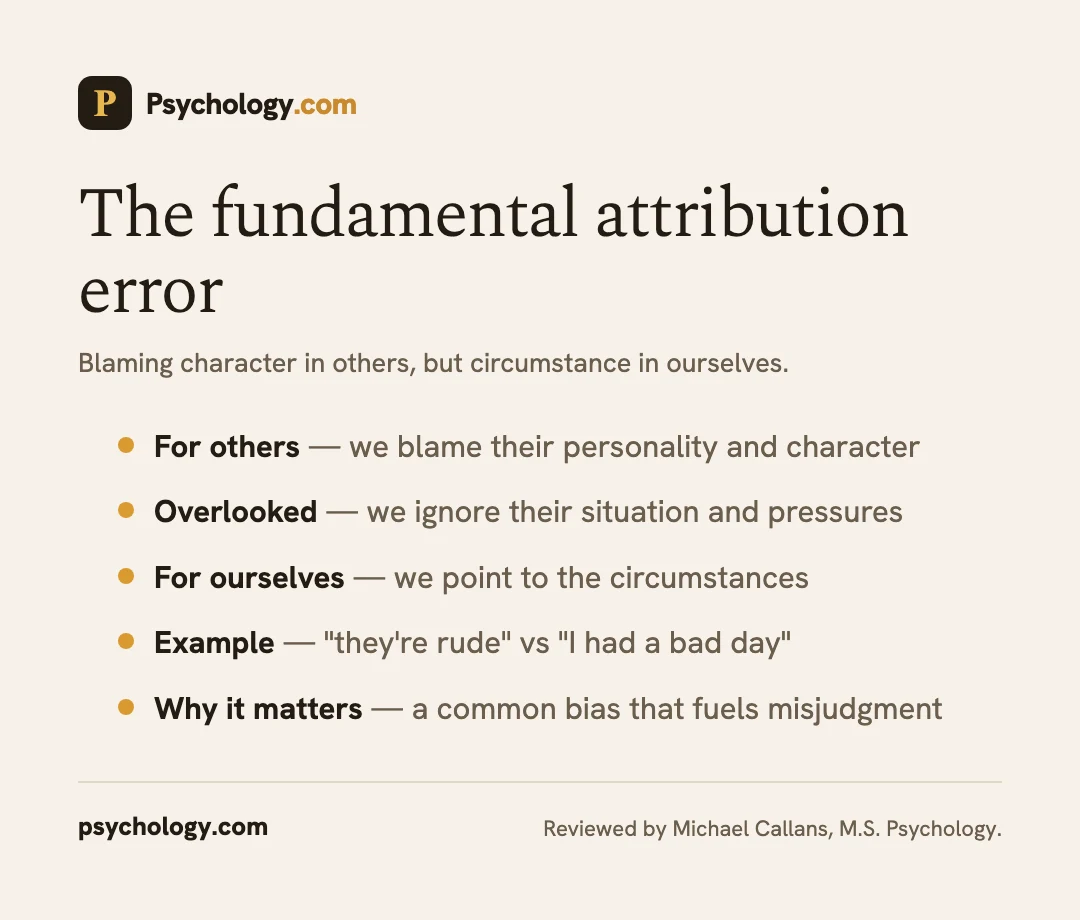
The fundamental attribution error is giving too much weight to personality and too little to circumstances when explaining someone else's behavior. Calling a late coworker careless before checking for a transit delay illustrates the error. It concerns judgments about others; comparisons with explanations of your own behavior are a separate question.
What the fundamental attribution error is
The fundamental attribution error is giving too much weight to personality and too little to circumstances when explaining someone else's behavior. Calling a late coworker careless before checking for a transit delay illustrates the error. It concerns judgments about others; comparisons with explanations of your own behavior are a separate question.
If a colleague is short with us, we are quick to conclude they are an unpleasant person, rather than considering that they might be exhausted, stressed, or dealing with bad news. The behavior gets attributed to who they are rather than to what they are facing.
The term was coined by the social psychologist Lee Ross in 1977, building on earlier work in attribution theory by Fritz Heider, who first noted that people behave like intuitive psychologists trying to find the causes behind behavior, and tend to favor dispositional explanations.
A classic demonstration
A well-known study by Edward Jones and Victor Harris in 1967 illustrates the effect. Participants read essays that either supported or opposed the Cuban leader Fidel Castro. Some were told the writer had freely chosen their position; others were told the writer had been assigned the position with no choice.
Even when participants knew the writer had been forced to argue a particular side, they still inferred that the essay reflected the writer's true attitudes. They could not fully discount the situation, attributing the content to the person's real beliefs despite clear evidence that the position had been imposed.
This showed how readily people leap to dispositional explanations, even in the face of obvious situational constraints.
Fundamental attribution error versus actor-observer bias
The fundamental attribution error concerns explanations of another person's behavior. Actor-observer asymmetry is a separate hypothesis: people explain their own actions more situationally and other people's actions more dispositionally. A person can make the fundamental attribution error without comparing anyone else's behavior with their own.
For example, calling a colleague unreliable after a late arrival may underweight the circumstances. Explaining your own lateness through traffic while attributing the colleague's lateness to personality adds an actor-observer comparison. Self-serving bias is different again: it involves explanations that favor your own image, such as claiming credit for success and blaming circumstances for failure.
Malle's meta-analysis examined 173 studies and found average actor-observer effects close to zero, with results varying by study conditions and event type. It challenges the idea of a universal self-versus-other reversal. Source: Malle, The actor-observer asymmetry in attribution: a (surprising) meta-analysis.
Why it happens
Several factors drive the error. Perceptually, the person who acts is vivid and prominent, while the situational forces acting on them are often invisible, so we naturally attribute cause to the visible actor. Cognitively, attributing behavior to character is quicker and requires less mental effort than carefully weighing situational influences.
Culture and context can influence which explanations people find plausible. Broad labels such as individualistic and collectivist describe tendencies across settings and cannot predict an individual's judgment. The underlying research question is how observers use information about the person and the situation.
Why it matters
The fundamental attribution error has real consequences. It fuels harsh, oversimplified judgments of others, contributes to blaming people for circumstances largely beyond their control, and can entrench conflict, since each side reads the other's actions as evidence of bad character rather than difficult situation.
Before concluding that behavior reveals character, separate observation from interpretation. Ask what information is missing and whether the pattern appears across different circumstances. Considering context can improve the basis for a judgment while leaving room to hold someone accountable for harm.
Criticisms and cross-cultural limits
The fundamental attribution error describes a tendency, not a fixed law that applies equally in every setting. Gilbert and Malone's review notes that the size of the effect depends on how much attention people pay to situational cues, how much time pressure they are under, and how the study is designed. Weaker or stronger versions of the pattern show up depending on those conditions.
Cross-cultural research also complicates a universal claim. Choi, Nisbett, and Norenzayan's review of causal attribution across cultures found that participants from East Asian cultures were often less likely to show the correspondence bias, the tendency to infer that behavior reflects a person's disposition even when a situational constraint is obvious. The difference did not mean dispositional thinking was absent; East Asian participants still used trait explanations, but weighed situational information more heavily in certain conditions. Source: Choi, Nisbett, Norenzayan, Causal attribution across cultures: variation and universality.
None of this erases the underlying pattern. It means the fundamental attribution error is best treated as a common cognitive shortcut that varies in strength across people, cultures, and circumstances, rather than a rule that predicts any individual judgment.
Checking an attribution in practice
Suppose a teammate misses a deadline. Record the observation, then consider possibilities such as competing assignments, unclear instructions, or poor planning. Ask what happened and agree on a next step. Repeated missed commitments provide additional evidence, especially when expectations and resources were clear.
The check the facts worksheet can help separate events from interpretations. The empathy self-check supports reflection on perspective-taking; it does not measure attribution error. Compare the halo effect and social identity theory, or explore the psychology concepts hub. If recurring assumptions fuel conflict, a licensed therapist can help you examine those interactions.
Key takeaways
- Jones and Harris found that readers inferred attitudes from assigned essay positions, underweighting the constraint on the writer. Source: The attribution of attitudes.
- Malle's meta-analysis covered 173 studies and found average actor-observer effects close to zero. Source: The actor-observer asymmetry in attribution: a (surprising) meta-analysis.
- Gilbert and Malone describe mechanisms including incomplete correction for circumstances and unrealistic expectations about behavior. Source: The correspondence bias.
Want to understand your own judgments and reactions?
Our free, clinician-reviewed self-tests can help you reflect on how you read situations. No account needed.
Cite this source
Psychology.com. (2026, September 15). The Fundamental Attribution Error. Psychology.com. https://psychology.com/concepts/fundamental-attribution-error
Frequently asked questions
What is the fundamental attribution error?
The fundamental attribution error is overemphasizing someone's personality while underestimating the situation when explaining their behavior. For example, you may label a coworker inconsiderate after a missed message without checking their workload. The error concerns the weight given to possible causes. It does not mean personality never influences behavior.
What is an example of the fundamental attribution error?
Imagine a student falls asleep in class and the teacher immediately calls the student lazy. The teacher may be overlooking illness, disrupted sleep, or responsibilities at home. Those possibilities need checking. The attribution error is jumping to a character explanation with inadequate attention to context, regardless of which explanation later proves most accurate.
What is the difference between fundamental attribution error and actor-observer bias?
Fundamental attribution error concerns overweighting personality when explaining other people's behavior. Actor-observer bias compares explanations of your own actions with explanations of others' actions. These concepts overlap in some examples, but they ask different questions. Malle's meta-analysis challenges the familiar claim that people generally reverse their explanations when judging themselves.
How is fundamental attribution error different from self-serving bias?
Self-serving bias involves explanations that protect a favorable self-image, such as crediting your skill for success and blaming circumstances for failure. Fundamental attribution error concerns underweighting context when judging another person. A judgment can involve both patterns, but you can explain someone else's behavior poorly without trying to defend your own reputation.
How can you avoid fundamental attribution error?
Describe what happened before assigning a trait. Ask what pressures, constraints, or missing information could matter, and check those possibilities when appropriate. Look for patterns across situations and revise your interpretation as evidence changes. Context helps explain behavior while accountability still addresses its consequences, especially when someone repeatedly harms others.
Does the fundamental attribution error happen in every culture?
Not to the same degree. Choi, Nisbett, and Norenzayan's cross-cultural review found that participants from East Asian cultures were often less likely to show the correspondence bias than participants from Western cultures, though dispositional thinking was still present. The finding suggests the error is a common tendency whose strength varies with cultural context, not a fixed rule.
Related concepts

References
- Ross L. The intuitive psychologist and his shortcomings: distortions in the attribution process. Advances in Experimental Social Psychology. 1977;10:173-220.
- Jones EE, Harris VA. The attribution of attitudes. Journal of Experimental Social Psychology. 1967;3(1):1-24.
- Heider F. The Psychology of Interpersonal Relations. Wiley; 1958.
- Gilbert DT, Malone PS. The correspondence bias. Psychological Bulletin. 1995;117(1):21-38.
- Malle BF. The actor-observer asymmetry in attribution: a (surprising) meta-analysis. Psychological Bulletin. 2006;132(6):895-919. pubmed.ncbi.nlm.nih.gov
- Jones EE, Harris VA. The attribution of attitudes. doi.org
- Gilbert DT, Malone PS. The correspondence bias. pubmed.ncbi.nlm.nih.gov
- Choi I, Nisbett RE, Norenzayan A. Causal attribution across cultures: variation and universality. Psychological Bulletin. 1999;125(1):47-63. doi.org