
In short
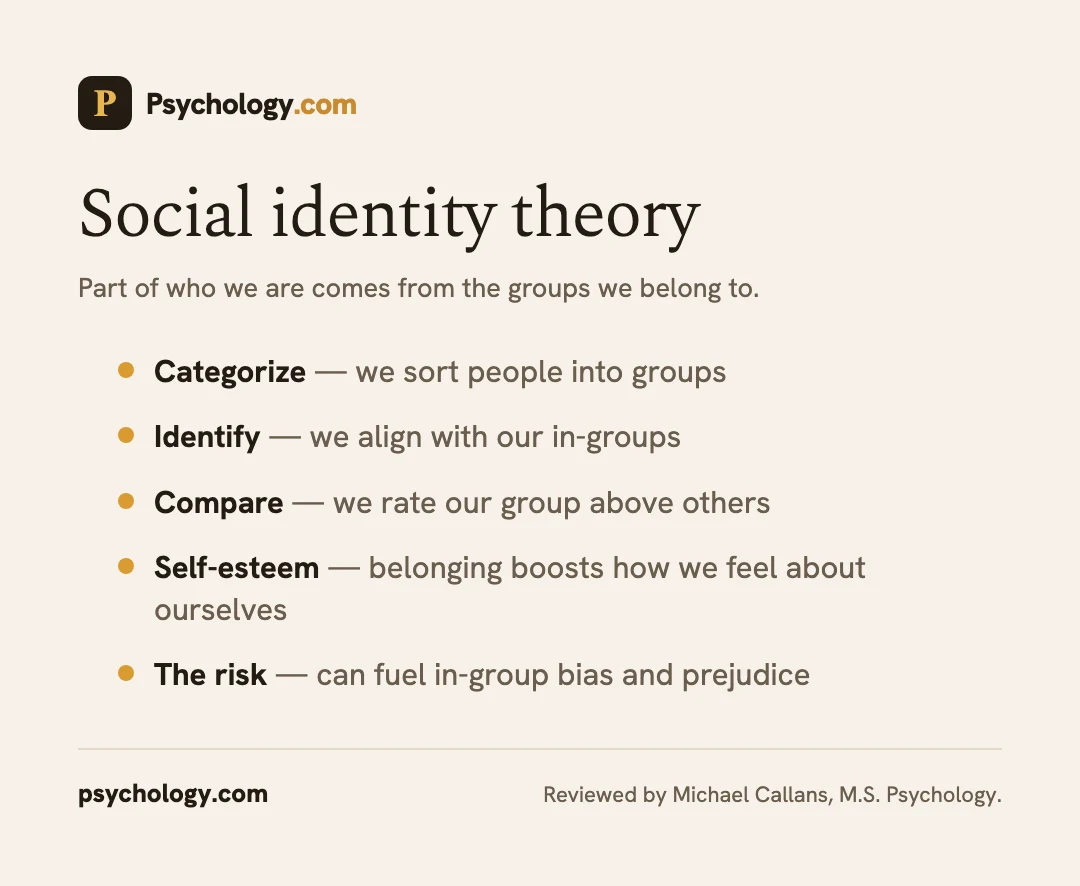
Social identity theory explains how group membership contributes to self-concept and intergroup behavior. People may favor groups they identify with and seek a positive comparison with other groups. Developed by Henri Tajfel and John Turner, the theory links belonging, status, and social comparison while recognizing different responses to unequal group positions.
What social identity theory is
Social identity theory explains how membership in groups shapes a person's sense of self and behavior toward others. Henri Tajfel and John Turner proposed that people seek a valued group identity through social comparison. Group status and the surrounding situation influence whether people favor insiders, challenge inequality, or pursue individual change.
A social identity might involve a profession, religion, nationality, neighborhood, or sports team. Personal identity includes qualities you understand as individual, such as your interests or history. Both can matter in the same situation, and the importance of a particular membership can change with context.
Tajfel and Turner's original account linked positive social identity to favorable comparisons with relevant groups. A team might value itself for technical skill, fairness, or community service. Which comparison matters depends on the group and situation. Group pride alone does not tell us how someone will treat outsiders.
The minimal group experiments
Tajfel and colleagues' minimal group experiments reduced group membership to relatively trivial distinctions. Their published study used categories such as supposed visual judgments or preferences between artists. Participants allocated rewards to anonymous people identified by group membership, with procedures designed to exclude direct self-reward.
The experiments found in-group favoritism under these limited conditions. Some allocation choices prioritized the difference between groups over maximizing the total reward. This supported the possibility that social categorization itself can influence decisions, even without an established history of group conflict.
The result concerns reward allocation in an experimental task. It cannot tell us that every participant was hostile or that all forms of real-world discrimination have the same cause. The study is useful precisely because it isolates a restricted question about categorization, rather than reproducing the full complexity of a society.
Categorization, identification, and comparison
Social categorization means organizing people, including yourself, into groups. For example, you might notice whether someone belongs to your department. Categories make the social world easier to interpret, but they can encourage broad assumptions that overlook individual differences.
Social identification means that a membership becomes meaningful to your sense of self. A person may think of being a nurse or a fan as part of who they are and take the group's expectations seriously. Membership on paper and strong personal identification can differ.
Social comparison means evaluating the in-group in relation to another group. A department might compare its workload, reputation, or performance with a neighboring department. These processes are often taught together as a useful way to understand the theory; they are not fixed developmental stages that everyone completes in order.
For a classroom example, consider students on rival debate teams. They notice team membership, become invested in their team, and compare performances. Fair-play norms could support respect for opponents, while norms that reward ridicule could encourage exclusion. The example illustrates why identity and the surrounding expectations need to be considered together.
In-group favoritism and out-group bias
In-group favoritism means treating members of your own group more favorably. Out-group hostility involves negative feelings or harmful behavior toward another group. Marilynn Brewer's research review distinguishes attachment to an in-group from hatred of an out-group. Favoritism can contribute to unfair outcomes even when someone feels no explicit hostility.
Tajfel and Turner also described ways people may respond to an unfavorable group position. Individual mobility involves trying to improve personal standing by leaving or distancing from the group. Social creativity involves changing the basis of comparison. Social competition involves collective efforts to improve the group's relative position.
The response depends partly on whether group boundaries seem permeable and whether status differences seem legitimate or stable. These conditions help explain why disadvantaged people might pursue individual opportunities in one setting and organize collectively in another. The theory addresses social structure alongside psychological identification.
Self-categorization and later developments
Self-categorization theory, developed by Turner and colleagues, examines when people understand themselves in terms of a shared group identity. It helps explain why different identities become relevant in different settings and how shared norms can influence conduct.
For example, coworkers who disagree as members of separate departments may identify together as staff during a wider organizational change. A broader identity can coexist with subgroup identities. It need not erase meaningful differences between people or remove unequal power within the organization.
Critiques and lasting influence
Minimal group tasks offer experimental control but simplify real social life. Historical discrimination, unequal resources, individual experience, and organizational rules may all contribute to an outcome. A group label by itself is an incomplete explanation for a specific conflict.
The popular claim that people discriminate simply to boost self-esteem is also too sweeping. Jolanda Jetten's research overview notes weak support for a simple self-esteem account and stresses the context of identification. Strong belonging can support mutual aid and collective purpose as well as exclusion.
Applications should therefore ask what the group stands for and how its norms are maintained. A workplace can examine who receives opportunities, whose expertise counts, and how decisions are justified. Shared identity may help cooperation, while fair procedures and accountability address how people are actually treated.
Reflecting on groups in your own life
Consider a group you value and a recent disagreement involving outsiders. Describe what happened before attributing motives to either side. Ask whether you would judge the same action differently if it came from someone in your group. This is a reflection exercise, rather than a test of whether you are prejudiced.
The Who Am I worksheet can help you explore meaningful memberships. A conflict style self-test offers a separate way to reflect on how you respond to disagreement. Its result does not measure social identity theory.
Compare the Robbers Cave experiment and fundamental attribution error, or browse the psychology concepts hub. If rejection or group conflict is affecting daily life, a licensed therapist can help you work through that experience.
Key takeaways
- Tajfel and colleagues found in-group favoritism in anonymous reward-allocation tasks with minimal group distinctions. Source: Social Categorization and Intergroup Behaviour.
- Tajfel and Turner describe individual mobility, social creativity, and social competition as responses to group status. Source: An Integrative Theory of Intergroup Conflict.
- Attachment to an in-group and hostility toward an out-group are distinguishable processes. Source: Brewer, The Psychology of Prejudice: Ingroup Love and Outgroup Hate?
- Self-categorization theory examines which group identity becomes relevant in a situation. Source: Turner and colleagues, Rediscovering the Social Group.
Curious how you relate to the groups in your life?
Our free, clinician-reviewed self-tests can help you reflect on your own patterns. No account needed.
Cite this source
Psychology.com. (2026, September 13). Social Identity Theory. Psychology.com. https://psychology.com/concepts/social-identity-theory
Frequently asked questions
What is social identity theory in simple terms?
Social identity theory says that belonging to groups contributes to how people understand themselves and relate to others. A person may value a team, profession, or community as part of their identity. Comparisons with other groups can encourage favoritism, while norms, status, and context influence how that identification is expressed.
Who developed social identity theory?
Henri Tajfel and John Turner developed social identity theory to explain relationships between groups. Tajfel's minimal group experiments helped establish that group distinctions can affect how people allocate rewards. Turner and colleagues later developed self-categorization theory, which examines when a particular group identity becomes relevant to a person's thinking and behavior.
What are the three processes in social identity theory?
A common teaching summary describes social categorization, social identification, and social comparison. Categorization means grouping people; identification means experiencing membership as part of yourself; comparison means evaluating your group relative to others. These are related processes rather than a fixed sequence everyone follows. Group norms and status also shape what happens.
What is an example of social identity theory?
A fan may see a sports team as part of their identity, celebrate its success, and judge its players more generously than rivals. That illustrates group identification and favorable comparison. The theory also asks about context: a group that values sportsmanship may encourage respectful treatment of opponents despite strong loyalty.
What did the minimal group experiments show?
The minimal group experiments found that participants could favor their own group when distributing rewards to anonymous people, even with relatively trivial group distinctions. This shows that established conflict is not required for favoritism in such tasks. It leaves open how strongly the same process explains more complex situations involving power, history, or discrimination.
Related concepts

References
- Tajfel H, Turner JC. An integrative theory of intergroup conflict. In: Austin WG, Worchel S, eds. The Social Psychology of Intergroup Relations. Brooks/Cole; 1979:33-47.
- Tajfel H, Billig MG, Bundy RP, Flament C. Social categorization and intergroup behaviour. European Journal of Social Psychology. 1971;1(2):149-178. doi.org
- Turner JC, Hogg MA, Oakes PJ, Reicher SD, Wetherell MS. Rediscovering the Social Group: A Self-Categorization Theory. Blackwell; 1987.
- Brewer MB. The psychology of prejudice: Ingroup love and outgroup hate? Journal of Social Issues. bcsh.bard.edu
- Jetten J. Social Identity. Open Encyclopedia of Cognitive Science, MIT Press. oecs.mit.edu