
In short
Cognitive dissonance describes discomfort around an inconsistency between beliefs or between beliefs and behavior. Leon Festinger's theory proposes that this discomfort motivates efforts to restore consistency. A useful response is to identify the conflict, examine the evidence, and choose an action that fits your values rather than rushing to justify it.
What cognitive dissonance is
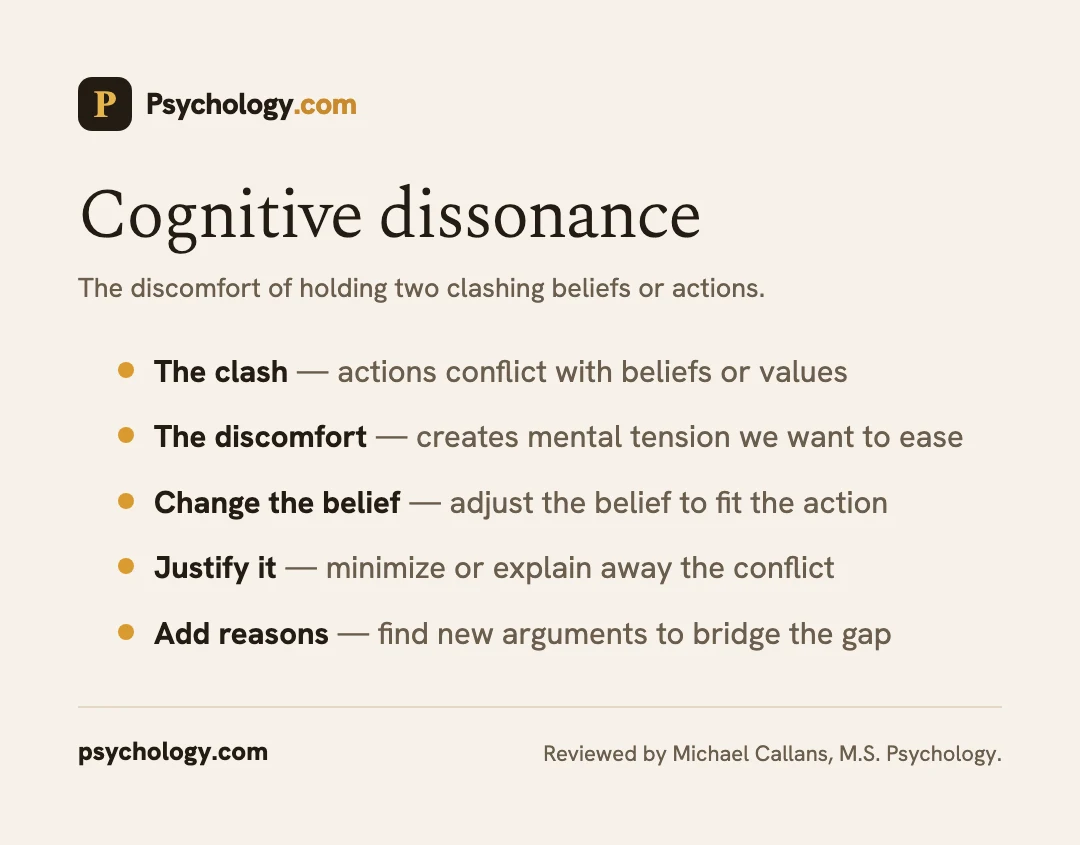
Cognitive dissonance is the discomfort that can arise when your beliefs conflict or your actions clash with your values. The theory predicts motivation to reduce that inconsistency. You might change an action, reconsider a belief, or justify what happened. Feeling relief alone does not establish that the chosen explanation is accurate.
Leon Festinger introduced the theory in A Theory of Cognitive Dissonance. It concerns how people respond to psychologically important inconsistencies. A conflict may be especially uncomfortable when it touches a valued commitment, such as seeing yourself as fair while treating someone unfairly.
A familiar example is the smoker who knows smoking is harmful. The belief "smoking causes serious illness" conflicts with the behavior "I smoke," creating dissonance. The person must do something to ease that tension.
How people reduce dissonance
Festinger described several ways people resolve the discomfort. The most direct is to change the conflicting belief or behavior, for example by quitting smoking so that action and belief align.
When behavior is difficult to change, a person may revise a belief or add a justification. Someone who smokes might downplay health risks or emphasize smoking's perceived role in coping with stress. Those explanations can ease discomfort while leaving the underlying health concern unresolved.
People may also reduce the importance of the conflicting thought, telling themselves it does not matter much, or avoid information and situations that would increase the dissonance. What unites these strategies is the goal of restoring a sense of consistency and reducing discomfort.
Festinger and Carlsmith's classic experiment
The most famous demonstration came from a 1959 study by Festinger and James Carlsmith. Participants were asked to perform an extremely boring task, then paid to tell the next participant, waiting outside, that the task had been enjoyable, a clear lie.
Crucially, some participants were paid 20 dollars to tell this lie and others only one dollar. Afterward, the researchers asked how much the participants had actually enjoyed the task. Counterintuitively, those paid just one dollar later reported liking the task more than those paid 20 dollars.
Festinger and Carlsmith interpreted the result in terms of external justification. The larger payment supplied a more convincing reason for the false statement. With less external justification, participants might reduce the conflict by shifting their reported attitude. This interpretation concerns the experimental comparison; it cannot tell you why a particular person changed their mind.
Where dissonance shows up
Cognitive dissonance is one of the most widely applicable ideas in psychology because the conflicts it describes are everywhere. After making a difficult decision, people often boost their opinion of the option they chose and downgrade the one they rejected, easing any second thoughts. This is sometimes called post-decision dissonance.
Effort justification is another proposed pattern: people may value a group more after working hard to join it. Conflicting evidence can also prompt defensive explanations. Whether someone changes their mind depends on the situation, so the theory alone cannot establish that presenting corrective information will backfire.
Refinements and critiques
Researchers debate the conditions under which inconsistency produces discomfort and the mechanisms behind attitude change. Self-image, perceived choice, responsibility, and how attitudes are measured can all matter. Self-perception theory offers an alternative account of some findings: people may infer their attitudes from observing their own behavior.
A multilab study by Vaidis and colleagues tested an induced-compliance procedure based on Croyle and Cooper, using counterattitudinal essays. It found no significant attitude difference between high-choice and low-choice conditions, although counterattitudinal essays differed from neutral essays. This was a constructive replication of a later paradigm, rather than a direct repeat of the payment experiment.
The findings raise questions about how strongly that paradigm supports the proposed dissonance mechanism. The concept can help frame a question about your reaction, but using it as a label does not establish another person's motives.
How researchers measure cognitive dissonance
Dissonance is not directly observable, so researchers infer it from two main types of measurement: self-reported discomfort and physiological arousal. Both approaches ask what happens inside a person during an induced-compliance task, such as writing an essay that contradicts a personal opinion.
Elliot and Devine asked participants to write a counterattitudinal essay and then rated their own discomfort on a self-report scale. Participants who wrote the essay under conditions of high perceived choice reported more discomfort than participants in a low-choice or control condition, supporting the idea that dissonance functions as an unpleasant motivational state rather than only a change in reported attitudes.
Croyle and Cooper took a different approach, recording galvanic skin response, a measure of physiological arousal, while participants completed a similar induced-compliance procedure. Participants in the high-choice condition showed greater skin conductance than those in the low-choice condition, offering physiological support for the arousal Festinger's theory proposes. Together, these measures are why dissonance research increasingly separates the feeling of discomfort from the attitude change some people show afterward.
Cognitive dissonance in relationships
Close relationships are a common place for dissonance to appear, because loyalty and shared history make it harder to act on doubts. Someone who notices a partner behaving disrespectfully but also holds the belief that the partner loves them may feel the two do not fit together.
Reducing that discomfort does not always mean addressing the behavior. A person might instead minimize what happened, explain it away as a one time lapse, or focus on the partner's positive qualities so the relationship feels consistent with the belief that it is a good one. Ending the relationship and naming the behavior directly are only two of several possible responses, and dissonance theory does not say which one a given person will choose.
This pattern can make it harder to notice a pattern of concerning behavior over time, since resolving the discomfort by adjusting a belief is often quicker than resolving it by changing the relationship. Naming specific behaviors rather than relying on an overall impression, and talking with someone outside the relationship, can make the underlying conflict easier to see clearly.
How to respond to cognitive dissonance
Write down the conflict in specific terms: "I value honesty, and I left an error out of my report." Separate facts from assumptions, then consider an action you can take, such as correcting the report or explaining the omission. A manageable repair can make the value concrete.
The values clarification worksheet and values self-check can help you name competing priorities. These are reflection aids. They do not measure cognitive dissonance or determine what decision is right for you.
Explore the psychology concepts hub, defense mechanisms, and fundamental attribution error for related ideas about explanations and judgments. If conflict or guilt repeatedly disrupts daily life, find a therapist to work through the circumstances.
Key takeaways
- Festinger proposed cognitive dissonance as a motivational response to inconsistency among cognitions. Source: A Theory of Cognitive Dissonance.
- In the original payment study, participants paid $1 rated the dull task as more enjoyable than participants paid $20. Source: Festinger and Carlsmith, Cognitive consequences of forced compliance.
- A later multilab essay study found no significant attitude difference between high-choice and low-choice conditions. Source: Vaidis and colleagues, A multilab replication of the induced-compliance paradigm of cognitive dissonance.
- The multilab study examined a procedure based on Croyle and Cooper, rather than directly repeating Festinger and Carlsmith's payment study. Source: Vaidis and colleagues.
- Participants who wrote a counterattitudinal essay under high perceived choice reported more self-rated discomfort than those in a low-choice condition. Source: Elliot and Devine, On the motivational nature of cognitive dissonance: Dissonance as psychological discomfort.
- Participants in a high-choice induced-compliance condition showed greater skin conductance, a physiological arousal measure, than those in a low-choice condition. Source: Croyle and Cooper, Dissonance arousal: Physiological evidence.
Noticing a conflict between how you feel and how you act?
Our free, clinician-reviewed self-tests can help you make sense of it. No account needed.
Cite this source
Psychology.com. (2026, September 15). Cognitive Dissonance. Psychology.com. https://psychology.com/concepts/cognitive-dissonance
Frequently asked questions
What is cognitive dissonance in simple terms?
Cognitive dissonance is the discomfort that can occur when your beliefs conflict with each other or with your actions. You may feel pulled to resolve the mismatch by changing behavior, reconsidering a belief, or offering a justification. The concept describes a psychological process; it cannot establish the motive behind every change of mind.
What is an example of cognitive dissonance?
Imagine valuing honesty while hiding a mistake at work. The conflict may feel uncomfortable. You could correct the omission, rethink your commitment, or tell yourself the mistake was too small to mention. Each response can reduce tension in a different way. Feeling better does not necessarily mean you have addressed the underlying problem.
How do you reduce cognitive dissonance?
Start by naming the beliefs or actions that conflict. Check the evidence and identify what you can change. A concrete repair, such as acknowledging an error, may bring behavior closer to your values. Justifications can also reduce discomfort, so examine whether your explanation addresses the problem or simply makes it easier to dismiss.
Can a core beliefs worksheet help with cognitive dissonance?
A core beliefs worksheet can help you name an assumption behind a conflict, such as believing you must always be competent while acknowledging a mistake. Write the assumption, relevant evidence, and a more balanced interpretation. The worksheet supports reflection; it cannot determine whether dissonance is the reason for your discomfort or someone else's behavior.
What did Festinger and Carlsmith's experiment find?
In Festinger and Carlsmith's study, participants performed dull tasks and were paid to describe them positively. Those paid $1 later rated the tasks as more enjoyable than those paid $20. The authors interpreted the smaller payment as providing less external justification, making attitude change a way to reduce the inconsistency.
Is cognitive dissonance a mental illness?
Cognitive dissonance is a psychological concept describing discomfort around inconsistency. It can arise in ordinary decisions, relationships, and moral conflicts. Persistent guilt, anxiety, or distress may deserve professional attention, whatever explanation seems plausible. A clinician can explore symptoms and circumstances instead of assuming that a familiar psychology term accounts for everything.
Related concepts

References
- Festinger L. A Theory of Cognitive Dissonance. Stanford University Press; 1957.
- Festinger L, Carlsmith JM. Cognitive consequences of forced compliance. Journal of Abnormal and Social Psychology. 1959;58(2):203-210. psychclassics.yorku.ca
- Vaidis DC, Sleegers WWA, van Leeuwen F, et al. A multilab replication of the induced-compliance paradigm of cognitive dissonance. Advances in Methods and Practices in Psychological Science. 2024;7(1). journals.sagepub.com
- Aronson E. The Social Animal. 11th ed. Worth Publishers; 2011.
- Cooper J. Cognitive Dissonance: 50 Years of a Classic Theory. SAGE; 2007.
- Vaidis DC, et al. A multilab replication of the induced-compliance paradigm of cognitive dissonance. University of Amsterdam repository. dare.uva.nl
- Elliot AJ, Devine PG. On the motivational nature of cognitive dissonance: Dissonance as psychological discomfort. Journal of Personality and Social Psychology. 1994;67(3):382-394. doi.org
- Croyle RT, Cooper J. Dissonance arousal: Physiological evidence. Journal of Personality and Social Psychology. 1983;45(4):782-791. doi.org