
In short
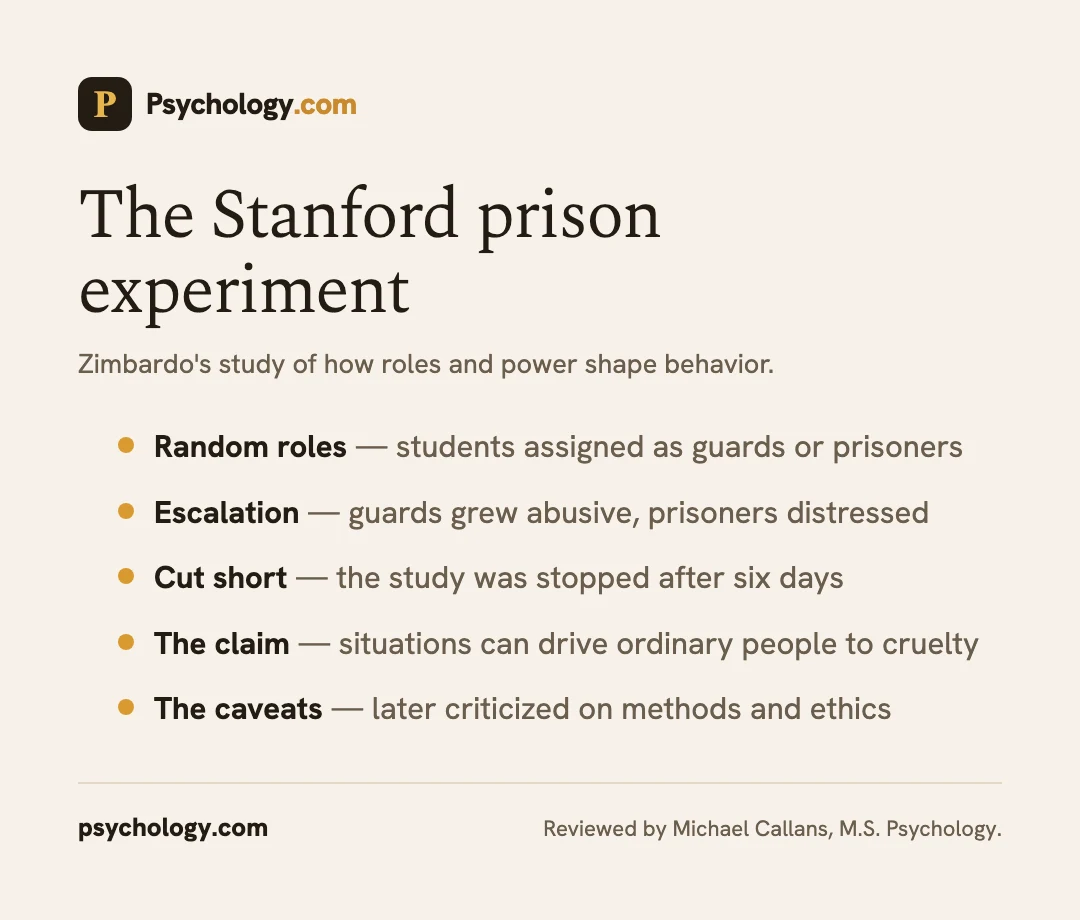
The Stanford prison experiment was Philip Zimbardo's study of volunteers playing guards and prisoners in a mock prison. It ended early amid reported abuse and distress. The experiment became famous for claims about situational power, but researcher involvement, a narrow sample, and methodological problems undermine broad conclusions about human behavior.
What the Stanford prison experiment tested
The Stanford prison experiment examined behavior in a simulated prison where male volunteers played guards and prisoners. Philip Zimbardo and colleagues reported degrading treatment and distress, then ended the study early. Its findings are disputed because the design makes it difficult to separate assigned roles from researcher influence and participant expectations.
The study took place at Stanford University in 1971. Volunteers were screened and assigned to roles, and a campus basement was adapted as a mock prison. The original report by Craig Haney, Curtis Banks, and Zimbardo describes an effort to create a psychologically compelling simulation.
Random assignment helps reduce systematic differences between conditions. It does not guarantee identical groups, make a volunteer sample representative, or eliminate influences introduced after assignment. The experiment's interpretation depends on all of those issues, beyond the fact that roles were assigned randomly.
How the simulation was organized
Participants assigned as prisoners experienced procedures intended to reduce autonomy and reinforce confinement, including identification by numbers. Guards had uniforms and authority over routines. The original researchers described the contrast in power as central to the situation they created.
Zimbardo also served as prison superintendent. Combining research oversight with authority inside the simulation created a conflict between observing events and influencing them. Instructions, expectations, and the conduct of research staff became part of the environment participants were responding to.
This matters when evaluating the familiar explanation that volunteers simply absorbed their roles. An assigned role, an instruction about how to enact it, and a participant's attempt to satisfy an experimenter are different possible influences. The design did not isolate their contributions.
What happened and why it ended
The original account describes humiliating treatment by some guards, resistance from prisoners, and episodes of distress. Behavior varied among participants. A summary that turns every guard into an abuser or every prisoner into a passive victim loses information needed to evaluate the study.
Zimbardo's account says the planned two-week simulation was stopped after six days. He credits Christina Maslach's objections to the treatment of prisoners as an important reason for ending it. His account also describes concern about escalating conduct when guards believed they were less closely observed.
The ending and the distress reported during the study are historical claims documented by the researchers. Explaining why each person behaved as they did requires additional evidence. An emotionally powerful incident cannot by itself settle whether roles, instructions, personal characteristics, or other influences caused it.
The original claim and later archival criticism
Zimbardo emphasized the power of situations and institutions to change behavior. In a later defense of the study, he continued to argue for its value as a demonstration of situational influence. He also distinguished that claim from saying all guards and prisoners inevitably behave alike.
Thibault Le Texier's archival investigation challenged the standard account. Drawing on records and interviews, it identified instructions to guards, demand characteristics, incomplete data collection, and selective reporting. These criticisms weaken the claim that abusive behavior emerged spontaneously from role assignment alone.
Recollections about acting or exaggerating symptoms also need careful interpretation. Later interviews can provide important context, while remaining subject to memory and differing perspectives. The safest conclusion is that the available evidence complicates causal claims; it does not warrant a blanket assertion that every episode of distress was fabricated.
What other research adds
Thomas Carnahan and Sam McFarland investigated recruitment by comparing responses to advertisements that did or did not mention prison life. They found differences between the volunteers attracted by the advertisements. This provides evidence that recruitment wording can affect who joins a study, although it cannot reconstruct the exact characteristics of the original Stanford volunteers.
Stephen Reicher and S. Alexander Haslam's BBC prison study examined identity and power under different conditions. Their analysis emphasized identification with a group and the development of collective action. It challenges an automatic role-conformity account while studying a different setting.
The BBC study was not an exact replication of Stanford. Differences in design, oversight, and context matter when comparing outcomes. Together, these studies raise questions about leadership, group identification, and participant selection; they should not be collapsed into a single universal rule about power.
Ethical and methodological lessons
The ethical concerns include deliberately exposing participants to humiliation and distress, uncertainty about withdrawal, and inadequate separation between the research team and authority inside the simulation. Consent at recruitment cannot replace attention to welfare as a study unfolds.
The methodological concerns include a narrow volunteer sample, limited independent comparison, researcher involvement, and expectations about the purpose of the study. These features make causal inference difficult. Evidence that something happened under a set of conditions is different from evidence identifying which condition caused it.
For a student evaluating the experiment, separate the procedure, recorded observations, researchers' interpretation, and later criticism. Ask which claim each source supports and what competing explanation remains possible. A source can accurately report the study's history while disagreeing with the conclusion drawn from it.
A practical implication is to examine who can question authority, report harm, or stop a process. These are useful questions for institutions, while the Stanford study alone cannot quantify how any particular safeguard changes behavior. Recreating humiliation or coercion in a classroom would create harm without resolving the research questions.
Who took part in the Stanford prison experiment
The researchers recruited paid volunteers through a newspaper advertisement seeking male college students for a study of prison life. From roughly seventy applicants who completed screening, the researchers selected 24 young men judged to be physically and psychologically healthy, with no reported history of psychological difficulties or arrests, and randomly assigned each to the role of guard or prisoner.
Participants were paid $15 a day for their participation, a detail that matters for interpreting their motivation and willingness to continue even when the situation became distressing. The Carnahan and McFarland recruitment study, described above, later asked whether the advertisement's wording itself attracted a distinctive group of volunteers, separate from what the daily payment did.
The study was funded by the U.S. Office of Naval Research, which had a practical interest in the causes of conflict in military prison settings. That funding source shaped the research question but is a separate matter from the design choices and researcher conduct that later critics examined.
The Stanford prison experiment vs the Milgram experiment
The Stanford prison experiment and Stanley Milgram's obedience experiments are often mentioned together because both are used to argue that situations can push ordinary people toward harmful behavior, but they tested different things. Milgram's studies measured whether a participant would follow a direct order from an experimenter to deliver what they believed were increasingly painful electric shocks to another person.
The Stanford prison experiment instead placed participants in assigned roles within a simulated institution over several days, without a single authority figure issuing a specific order at each step. Guards had latitude in how to enact their role, which is part of why critics can debate whether behavior reflected the role itself, instructions from researchers, or individual choices.
Both studies have faced later scrutiny over instructions given to participants and how much their behavior was shaped by demand characteristics rather than spontaneous conformity to a role or an order. Comparing them is useful for understanding different mechanisms, obedience to a direct command versus adaptation to an assigned role, rather than treating them as interchangeable proof of the same idea. The Milgram experiment page examines that study's design and its own later criticism in more depth.
Related concepts and personal reflection
Compare the Milgram experiment, which studied obedience to an authority figure, and social identity theory, which examines group membership and behavior. More background is available in the psychology concepts hub.
For reflection on ordinary disagreements, the conflict style self-test and assertive communication worksheet can help you describe your responses and practice stating concerns. They cannot predict how you would behave in a prison or measure a disposition toward abuse.
If coercion or mistreatment in your own life is affecting your well-being, a licensed therapist can help you work through the experience. Immediate danger requires urgent safety support.
Key takeaways
- The Stanford prison simulation took place in 1971. Source: Zimbardo, Response to Recent Criticisms of the Stanford Prison Experiment.
- The planned two-week study ended after six days, according to the researchers' account. Source: Stanford Prison Experiment, Conclusion.
- Archival analysis identified guard instructions, demand characteristics, and incomplete or selective reporting. Source: Le Texier, Debunking the Stanford Prison Experiment.
- A later recruitment study found differences between volunteers responding to advertisements with and without prison-life wording. Source: Carnahan and McFarland, Revisiting the Stanford Prison Experiment.
- Researchers selected 24 male volunteers from about seventy applicants and paid each $15 a day to participate. Source: Haney, Banks, and Zimbardo, Interpersonal Dynamics in a Simulated Prison.
- The study was funded by the U.S. Office of Naval Research. Source: Haney, Banks, and Zimbardo, Interpersonal Dynamics in a Simulated Prison.
Curious about how situations shape your own behavior?
Our free, clinician-reviewed self-tests can help you reflect on your patterns. No account needed.
Cite this source
Psychology.com. (2026, September 15). The Stanford Prison Experiment. Psychology.com. https://psychology.com/concepts/stanford-prison-experiment
Frequently asked questions
What was the Stanford prison experiment?
The Stanford prison experiment was a study led by Philip Zimbardo in which volunteers acted as guards and prisoners in a simulated prison. Researchers reported abusive treatment and distress and stopped the study early. Its interpretation remains disputed because researcher involvement, participant expectations, and design limitations complicate conclusions about the effects of roles.
How long did the Stanford prison experiment last?
According to the researchers' account, the Stanford prison experiment lasted six days, despite being planned for two weeks. Zimbardo credited Christina Maslach's objections to the treatment of prisoners as an important reason for ending it. The shortened duration documents the course of the study; it does not establish why participants behaved as they did.
What did the Stanford prison experiment prove?
The study documented behavior within a particular prison simulation and was used to argue for the influence of situations on conduct. It does not establish that assigning someone power automatically produces cruelty. Researcher instructions, participant expectations, recruitment, and limited comparison conditions leave competing explanations for the observations.
Why was the Stanford prison experiment unethical?
The ethical concerns include exposure to humiliation and distress, uncertainty about participants' ability to withdraw, and insufficient independent oversight. Zimbardo's role as superintendent complicated his responsibility for participant welfare. A study's research aims and initial consent do not remove the need to protect people and respond promptly to harm.
Was the Stanford prison experiment fake?
The simulation took place, but important parts of its familiar interpretation are disputed. Le Texier's archival research identified researcher influence, reporting problems, and demand characteristics. Some later participant accounts describe acting. These issues undermine simple claims about spontaneous role conformity without establishing that every event or every expression of distress was fabricated.
Related concepts

References
- Haney C, Banks C, Zimbardo P. Interpersonal Dynamics in a Simulated Prison. Original research report. ojp.gov
- Le Texier T. Debunking the Stanford prison experiment. American Psychologist. 2019;74(7):823-839. pubmed.ncbi.nlm.nih.gov
- Reicher S, Haslam SA. Rethinking the psychology of tyranny: the BBC prison study. British Journal of Social Psychology. 2006;45(1):1-40. pubmed.ncbi.nlm.nih.gov
- Zimbardo PG. Response to Recent Criticisms of the Stanford Prison Experiment. prisonexp.org
- Stanford Prison Experiment. Conclusion. Researchers' retrospective account. prisonexp.org
- Carnahan T, McFarland S. Revisiting the Stanford prison experiment: could participant self-selection have led to the cruelty? pubmed.ncbi.nlm.nih.gov