
In short
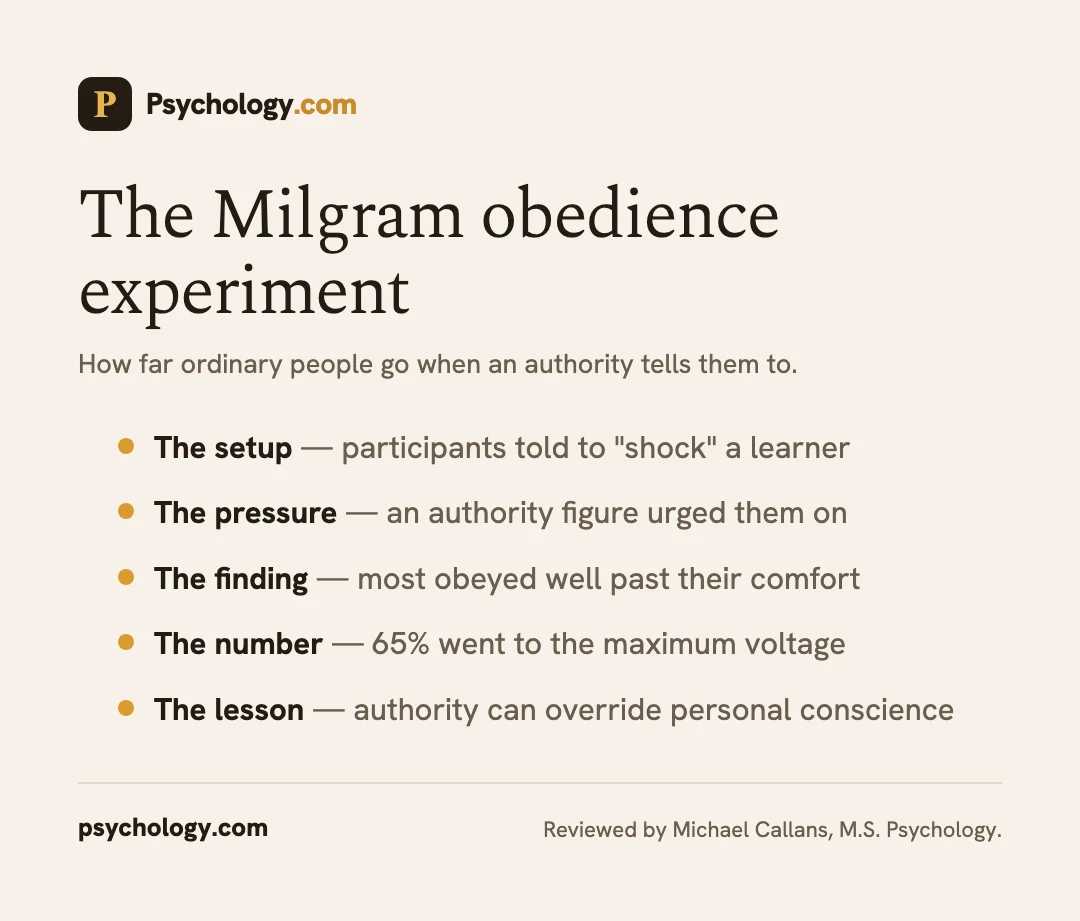
The Milgram experiment tested how far participants would follow an authority's instructions to give apparent electric shocks to another person. The learner received no shocks. In the sample reported in 1963, 26 of 40 men reached the highest setting. The findings concern a specific situation and raise substantial ethical questions.
Why Milgram ran the study
The Milgram experiment investigated obedience when an authority instructed people to carry out an apparently harmful task. Participants acted as teachers in a supposed learning study and were directed to increase apparent shocks after wrong answers. The research measured how far they continued, alongside their protests and visible distress.
Milgram framed the work around the problem of destructive obedience. A laboratory task could expose pressures that influence behavior, although it could not reproduce the history, ideology, institutions, or consequences involved in real atrocities. Comparisons with those events require care.
The central question remains relevant when people face conflicting responsibilities. A person might trust an institution's expertise while also feeling concerned about someone affected by its instructions. The experiment created a highly controlled conflict of this kind, using deception.
How the experiment worked
Participants were recruited for a supposed study of memory and learning. A rigged role assignment made the participant the teacher and an accomplice the learner. The teacher was instructed to increase the apparent shock level after each incorrect response.
The learner received no shocks. Participants did receive a real sample shock to make the apparatus convincing. Milgram's original report describes a generator with labeled settings rising to 450 volts. These settings represented apparent punishment in the task, rather than actual shocks delivered to the learner.
The procedure varied across Milgram's studies. In the condition reported in the original paper, the learner pounded on the wall at a high setting and later stopped responding. Accounts involving spoken protests or heart complaints concern other variations and should not be merged into a single script.
When a participant hesitated, the experimenter used prompts intended to keep the task going. The instructions and the apparent authority of the setting created pressure to continue, even when the participant expressed concern.
What Milgram found
In Behavioral Study of Obedience, published in 1963, Milgram reported that 26 of 40 male participants reached the maximum 450-volt setting. That is 65% of this particular sample. The remaining participants stopped before the maximum.
The study also recorded sweating, trembling, nervous laughter, and verbal objections. Continuing with the task could coexist with discomfort and protest. Observed compliance alone does not establish enjoyment of suffering or a stable personality trait.
The sample and procedure matter. A percentage from a particular laboratory condition cannot estimate how humanity would behave in every conflict with authority. Milgram's broader program varied the circumstances precisely because the setting could affect participants' decisions.
The variations that revealed what mattered
Milgram changed features such as the authority's proximity, the learner's proximity, the institution associated with the study, and the presence of other people who resisted. These variations are discussed in his book Obedience to Authority. They make the setting part of the explanation.
A person who sees a peer object has a different social example from someone facing the experimenter alone. Similarly, distance from the learner changes the immediate cues available. A comparison across conditions must specify which features changed before interpreting differences in obedience.
Reporting only the best-known result hides this variation. When evaluating a summary, check whether it identifies the condition, recruitment, endpoint, and procedure. Those details determine what the observed behavior can reasonably tell us.
How Milgram explained it
Milgram's agentic-state explanation proposed that people may see themselves as carrying out an authority's wishes and shift responsibility toward that authority. This was an interpretation of the behavior, rather than a directly observed switch inside a participant's mind.
Reicher, Haslam, and Smith proposed an account emphasizing identification with the experimenter and the scientific project. In this view, believing that the work served a valued purpose could help explain cooperation. Their article Working Toward the Experimenter develops this alternative.
The debate matters because explanations imply different questions. Was a participant deferring responsibility, trusting the institution, identifying with science, responding to pressure, or combining those processes? Similar outward behavior can have different motivations.
Ethics and lasting controversy
The study used deception and exposed participants to substantial distress. Prompts to continue also complicated their practical freedom to withdraw. These features raise ethical questions about consent, risk, and whether debriefing can adequately address what a participant experienced.
Modern evaluation would consider safeguards before recruitment, an effective withdrawal process, monitoring of distress, and follow-up. A study's scientific value must be considered alongside the burden imposed on participants. The absence of real shocks to the learner does not erase distress experienced by the teacher.
Jerry Burger's partial replication, published in 2009, stopped at the 150-volt decision point and used additional safeguards. Its design provides evidence about that earlier point in the procedure. It cannot directly establish how participants would have behaved at Milgram's maximum setting.
Criticisms of the Milgram experiment
Milgram's results have also drawn criticism aimed at the method itself, separate from the ethical concerns already described. The psychologist and historian Gina Perry examined Milgram's original archives and argued that some experimenters departed from the standardized script described in his published reports, raising questions about how uniform the procedure really was across sessions.
A separate line of criticism concerns whether participants believed the shocks were genuine. Perry and colleagues reanalyzed an unpublished measure from Milgram's own research and found that a meaningful share of participants expressed doubt about the setup, which complicates any simple reading of the obedience rate as evidence of how people behave when they fully believe they are harming someone.
These criticisms do not overturn the basic finding that many participants continued a distressing task under an experimenter's direction. They do mean that a single obedience percentage should be read alongside its procedural details and the uncertainty about what each participant believed was actually happening.
Applying the questions without labeling people
The psychology concepts hub includes fundamental attribution error, which concerns how we explain other people's actions, and social identity theory, which addresses group membership. Both offer useful questions when considering obedience, alongside their own limits.
If you struggle to express disagreement, the people-pleasing self-check can prompt reflection. It does not measure how you would behave in Milgram's experiment. The assertive communication worksheet can help you practice asking for clarification or naming a concern.
For example, you might ask a supervisor to explain the reason for a request, state what worries you, or seek independent advice. The safest response depends on the setting and possible consequences. A licensed therapist can help when fear of disagreement or pressure in relationships is affecting your well-being.
Key takeaways
- Milgram's 1963 report described 40 male participants; 26 reached the maximum setting, equivalent to 65%. Source: Behavioral Study of Obedience.
- The maximum setting was labeled 450 volts, but the learner received no shocks. Source: Milgram, Behavioral Study of Obedience.
- Participants received a real sample shock before acting as teacher. Source: Milgram, Behavioral Study of Obedience.
- Burger's partial replication stopped at the 150-volt decision point and used additional safeguards. Source: Replicating Milgram.
- Identification with scientific goals is a proposed alternative explanation for cooperation. Source: Reicher, Haslam, and Smith, Working Toward the Experimenter.
Want to understand what drives your own decisions?
Our free, clinician-reviewed self-tests can help you reflect on how you respond under pressure. No account needed.
Cite this source
Psychology.com. (2026, September 15). The Milgram Obedience Experiment. Psychology.com. https://psychology.com/concepts/milgram-experiment
Frequently asked questions
What was the Milgram experiment?
The Milgram experiment studied obedience to authority using a deceptive learning task. Participants were instructed to give apparent electric shocks after a learner's mistakes and to increase the intensity. The learner was an accomplice who received no shocks. Researchers observed how far participants continued and how they reacted when asked to proceed.
What percentage obeyed in the Milgram experiment?
In Milgram's 1963 report, 26 of 40 male participants reached the setting labeled 450 volts, equivalent to 65%. This result describes that sample and condition. Milgram conducted other variations with different procedures, so the percentage should not be presented as a universal rate of obedience or a prediction about a particular person.
Were the shocks in the Milgram experiment real?
The shocks supposedly delivered to the learner were simulated, and the learner was an accomplice. Participants did receive a real sample shock to support the impression that the apparatus worked. Their subsequent decisions occurred under deception about the learner's experience. The absence of actual shocks to the learner does not remove concerns about participants' distress.
Why was the Milgram experiment unethical?
Milgram's experiment raised ethical concerns because participants were deceived, exposed to substantial distress, and pressured to continue when they hesitated. Meaningful consent, freedom to withdraw, and adequate debriefing are central issues. Assessing those problems requires attention to participants' experiences even though the learner was acting and received no shocks.
What did the Milgram experiment show about obedience?
Milgram's experiment showed that participants could continue an apparently harmful task under an authority's direction while expressing distress or objections. Its interpretation remains debated. Explanations include perceived authority, shifting responsibility, trust in the setting, and identification with scientific goals. The result illustrates behavior under particular pressures and cannot diagnose an individual's character.
Has the Milgram experiment been repeated?
Researchers have conducted modified and partial versions of the obedience procedure. Jerry Burger's study, published in 2009, ended at the 150-volt decision point and added safeguards. Because it stopped earlier, it cannot establish how participants would have responded at the maximum setting. Replication claims need to distinguish the exact procedure and endpoint.
Related concepts

References
- Milgram S. Behavioral study of obedience. Journal of Abnormal and Social Psychology. 1963;67:371-378. web.mit.edu
- Milgram S. Obedience to Authority: An Experimental View. Harper & Row; 1974.
- Burger JM. Replicating Milgram: would people still obey today? pubmed.ncbi.nlm.nih.gov
- Reicher SD, Haslam SA, Smith JR. Working toward the experimenter: reconceptualizing obedience within the Milgram paradigm as identification-based followership. pubmed.ncbi.nlm.nih.gov
- Perry G. Behind the Shock Machine: The Untold Story of the Notorious Milgram Psychology Experiments. The New Press; 2013.
- Perry G, Brannigan A, Wanner RA, Stam H. Credibility and Incredulity in Milgram's Obedience Experiments: A Reanalysis of an Unpublished Test. Social Psychology Quarterly. 2020;83(1):88-106. doi.org