
In short
The Robbers Cave experiment was a summer-camp study of intergroup conflict led by Muzafer Sherif and colleagues. Competition between the Eagles and Rattlers increased hostility; shared goals requiring cooperation helped reduce it. The study supports realistic conflict theory, although its engineered setting and narrow sample limit conclusions about other groups.
What the study set out to test
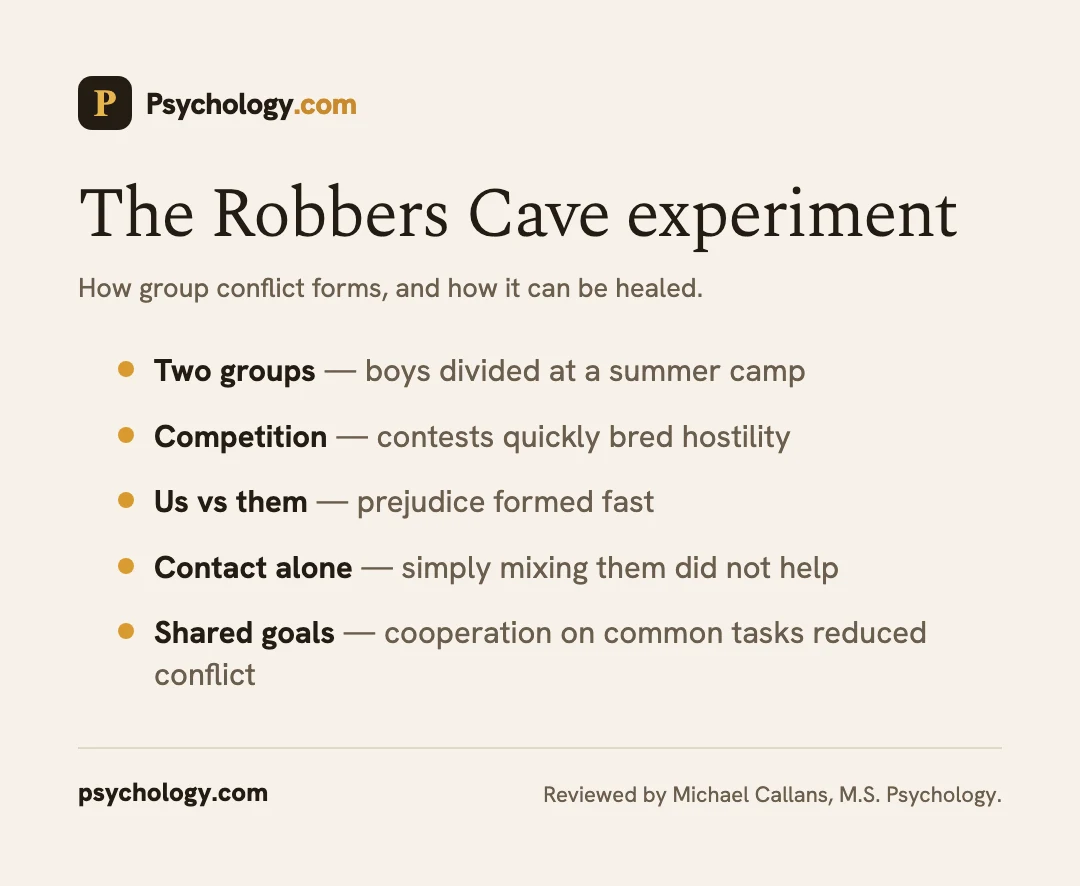
The Robbers Cave experiment tested whether competition could create hostility between groups and whether cooperation could reduce it. Muzafer Sherif, Carolyn Sherif, and colleagues organized a summer camp in Oklahoma where boys formed separate groups, competed for rewards, and then faced shared problems. Relations changed as the activities changed.
The study took place in 1954, as documented in Sherif and colleagues' original report. Its guiding idea became associated with realistic conflict theory: groups may become hostile when their goals conflict, especially when a benefit for one group means a loss for another. The camp provided a setting for observing that process over time.
The researchers arranged group formation, competition, and conflict reduction in successive phases. They observed behavior and examined attitudes and friendship preferences. These measures addressed whether changes extended beyond completing a cooperative task to how the boys viewed and treated members of the other group.
Phase one: forming the groups
The original report describes 22 boys, mostly around age eleven, selected for similar backgrounds and a lack of prior acquaintance. The researchers separated them into camp groups. This recruitment strategy helped create comparable groups, while also limiting the range of people represented in the study.
Each group spent the first phase bonding through normal camp activities such as hiking, swimming, and pitching tents. Over a few days, each developed its own identity, norms, leaders, and even names: one group called itself the Rattlers, the other the Eagles. This phase showed how quickly a sense of group belonging and structure can form among strangers.
Phase two: competition and conflict
In the second phase, the researchers brought the two groups together for a tournament of competitive games such as tug-of-war and baseball, with prizes for the winners and nothing for the losers. This created exactly the kind of zero-sum competition Sherif wanted to study.
Hostility appeared almost immediately and escalated fast. The groups taunted each other, refused to eat together, raided and ransacked each other's cabins, burned the other group's flag, and came close to physical fights. Negative stereotypes of the other group hardened, while loyalty within each group intensified.
The tournament changed how the groups related to each other. Loyalty within each group grew alongside negative judgments about the rival group. Because the staff arranged the competition and controlled the setting, the observations describe behavior under those particular conditions.
Phase three: reducing the conflict
After competition, the researchers arranged contact between the groups. Pleasant shared activities did not reliably overcome the established hostility in this camp. Some encounters provided further opportunities for insults and arguments. This finding concerns groups with an active conflict; it cannot establish that ordinary contact is always ineffective.
The next approach used superordinate goals: outcomes both groups valued and needed each other to achieve. The original report describes tasks involving the camp water supply and moving a truck. These tasks changed the immediate incentive from defeating the rival group to accomplishing something useful together.
Sherif reported improving relations after a series of cooperative activities. The shift was gradual, with changes in social distance and willingness to associate across group lines. His paper on superordinate goals emphasizes the importance of a goal that requires collaborative effort, beyond simply putting people in the same place.
What the experiment showed
Robbers Cave provides evidence that the structure of group activities can influence hostility and cooperation. In the camp, researchers changed the relationship between the groups' goals and observed changes in their behavior. It remains a useful example of how incentives and interdependence can shape social relations.
A different research question is whether group favoritism can emerge without competing for scarce resources. Social identity research examines that possibility. Reading these approaches together helps distinguish conflict over resources from the psychological importance of belonging to a group.
Later evidence also gives a broader picture of contact. Pettigrew and Tropp's meta-analysis found that intergroup contact generally reduces prejudice. The Robbers Cave contact phase should therefore be interpreted within its specific setting of recently created hostility. The quality and context of an encounter matter.
Criticisms and context
The sample was small and socially narrow. Findings from boys at a supervised camp cannot establish how adults, culturally different groups, or communities with long histories of conflict will respond. Political power, discrimination, and material inequality can shape conflicts in ways a camp tournament cannot reproduce.
Staff members both arranged the situations and observed what happened. Their expectations and involvement complicate interpretation. The phases also happened in a fixed order, making it difficult to separate the effects of cooperation from the passage of time and other changes during camp.
The boys experienced deliberately engineered hostility without understanding the research purpose. That raises concerns about deception, distress, and meaningful consent. Classroom demonstrations should use discussion or harmless examples rather than creating exclusion or rivalry to recreate the study.
A shared task is a possible aid to cooperation, rather than a universal solution to conflict. In a setting involving intimidation or unequal power, safety and fair procedures may need attention before joint activities can be useful.
Robbers Cave versus the Stanford Prison Experiment
Robbers Cave and the Stanford Prison Experiment are both landmark mid-twentieth-century field studies of behavior in a constructed social situation, but they test different questions. Sherif's study examined how competition between two roughly equal peer groups creates hostility and how shared goals can reduce it. Haney, Banks, and Zimbardo's Stanford Prison Experiment examined how randomly assigned institutional roles, guard and prisoner, with unequal power built in from the start, shape behavior within a mock prison. Source: Haney, Banks, Zimbardo, Interpersonal dynamics in a simulated prison.
The designs differ in important ways. The Robbers Cave boys did not know they were part of an experiment and began camp with no imposed hierarchy; group identity and rivalry developed gradually as staff introduced competition. Stanford Prison Experiment participants knew they had volunteered for a study and were assigned unequal roles by the researchers from day one, which foregrounds institutional power rather than intergroup competition between equals.
Both studies are frequently cited as evidence that situations can strongly shape behavior, and both raise similar ethical concerns about distress, deception, and heavy researcher involvement, discussed above. Comparing them helps separate two distinct mechanisms: rivalry between comparable groups over scarce rewards, and behavior shaped by an assigned position of power or powerlessness within an institution. The Stanford Prison Experiment, covered in its own guide, addresses the second mechanism in full.
Applying the idea to everyday group conflict
Imagine departments blaming each other for delayed work. A practical application is to identify an outcome they both value, agree on responsibilities, and make cooperation possible through shared information. This is an illustration of the concept, rather than evidence that a particular workplace exercise will resolve conflict.
Ask what each group believes it could lose, which rules reward rivalry, and whether everyone has a meaningful voice. The conflict resolution worksheet can help structure that discussion. The conflict style self-test offers personal reflection; it does not measure group prejudice or predict an experiment's outcome.
Compare social identity theory and the fundamental attribution error, or explore the psychology concepts hub. If ongoing conflict is affecting your well-being, a licensed therapist can help you work through its personal effects.
Key takeaways
- The camp study took place in Oklahoma in 1954. Source: Sherif and colleagues, Intergroup Conflict and Cooperation, original report.
- The report describes group formation, competitive conflict, and efforts to reduce conflict as successive phases. Source: Sherif and colleagues, original report, Approach, Hypotheses and General Design.
- Superordinate goals required collaborative effort toward an outcome valued by the rival groups. Source: Sherif, Superordinate Goals in the Reduction of Intergroup Conflict.
- Later meta-analytic research found that intergroup contact generally reduces prejudice. Source: Pettigrew and Tropp, A Meta-Analytic Test of Intergroup Contact Theory.
Want to understand the groups and rivalries in your own life?
Our free, clinician-reviewed self-tests can help you reflect on how you relate to others. No account needed.
Cite this source
Psychology.com. (2026, September 15). The Robbers Cave Experiment. Psychology.com. https://psychology.com/concepts/robbers-cave-experiment
Frequently asked questions
What was the Robbers Cave experiment?
The Robbers Cave experiment was a field study led by Muzafer Sherif and colleagues at an Oklahoma summer camp. Boys formed groups called the Eagles and Rattlers, competed for rewards, and later worked on shared problems. Researchers observed increased hostility during competition and improving relations during cooperative activities.
What were the stages of the Robbers Cave experiment?
The study moved through group formation, intergroup competition, and conflict reduction. During group formation, the boys developed identities and routines separately. Competitive activities then created rivalry. During conflict reduction, researchers first arranged contact and then introduced shared goals that required cooperation. The fixed sequence is also a limitation when interpreting the changes.
What did the Robbers Cave experiment prove?
Robbers Cave supported the idea that competing goals can encourage group hostility and cooperative goals can help reduce it. Its findings apply directly to the conditions researchers created at the camp. The narrow sample and active staff involvement limit broader claims about prejudice, adult conflict, or the effectiveness of every shared task.
What is a superordinate goal in the Robbers Cave experiment?
A superordinate goal is an outcome that rival groups value and need each other to achieve. The camp study used shared practical problems, including a water-supply problem, to create interdependence. The key feature is needing to cooperate for a meaningful result. Merely attending an event together does not create that dependency.
Why was the Robbers Cave experiment unethical?
Ethical concerns center on deception and deliberately exposing children to hostility and distress. The boys experienced the camp as ordinary life while researchers manipulated group relations. Evaluating the study requires considering participants' understanding, consent, protection from harm, and ability to withdraw. Its historical influence does not resolve those concerns.
How is the Robbers Cave experiment different from the Stanford Prison Experiment?
Robbers Cave examined competition between two roughly equal peer groups and how shared goals reduced the resulting hostility. The Stanford Prison Experiment examined how randomly assigned, unequal institutional roles, guard and prisoner, shaped behavior. Robbers Cave boys did not know they were studied; Stanford Prison Experiment participants knew they had volunteered but were assigned unequal power from the start.
Related concepts

References
- Sherif M, Harvey OJ, White BJ, Hood WR, Sherif CW. Intergroup Conflict and Cooperation: The Robbers Cave Experiment. Original report. psychclassics.yorku.ca
- Sherif and colleagues. Approach, Hypotheses and General Design of the Study. psychclassics.yorku.ca
- Sherif and colleagues. Role of Staff, Subject Selection, Experimental Site. psychclassics.yorku.ca
- Sherif and colleagues. Experimental Formation of In-groups. psychclassics.yorku.ca
- Sherif M. Superordinate goals in the reduction of intergroup conflict. American Journal of Sociology. doi.org
- Pettigrew TF, Tropp LR. A meta-analytic test of intergroup contact theory. Journal of Personality and Social Psychology. pubmed.ncbi.nlm.nih.gov
- Haney C, Banks C, Zimbardo P. Interpersonal dynamics in a simulated prison. International Journal of Criminology and Penology. 1973;1:69-97. ojp.gov