In short
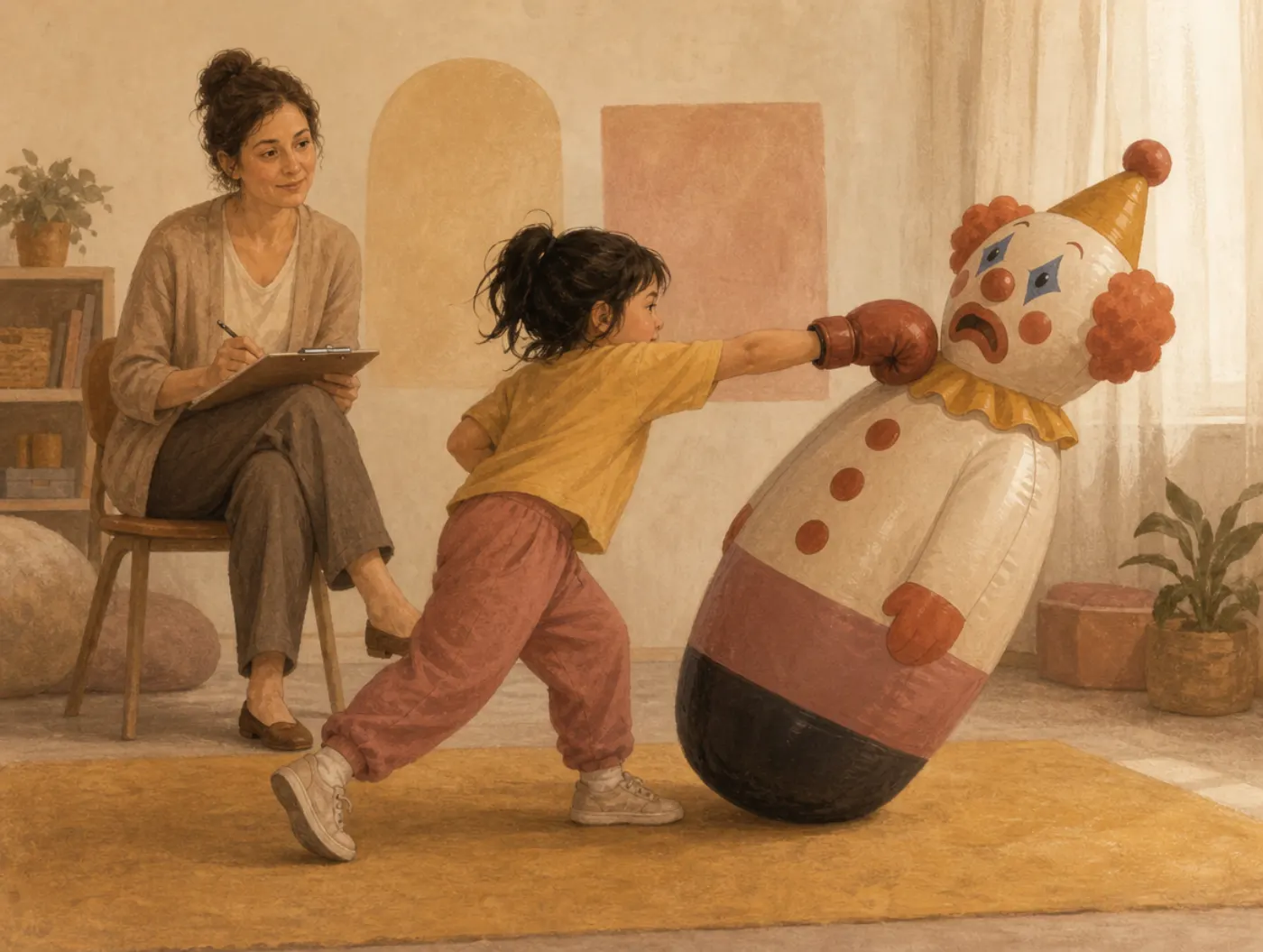
The Bobo doll experiment tested whether children copied an adult's aggression in a later setting. Children exposed to an aggressive model reproduced distinctive actions and speech. This supported observational learning. The study measured immediate behavior toward a doll and leaves questions about how those findings transfer to everyday life.
What the experiment set out to test
Bandura's Bobo doll experiment tested whether children would imitate an adult's aggressive behavior after the adult was absent. Children who observed aggression later copied distinctive actions toward an inflatable doll. The findings supported observational learning, while the artificial setting limited conclusions about how children would behave toward people.
At the time, the dominant view of learning was behaviorist: behavior was thought to be shaped mainly by direct reward and punishment. Bandura suspected that much human behavior is instead acquired through observation, and he designed the study to demonstrate observational learning directly.
The Bobo doll itself was a large inflatable clown weighted at the bottom so it rights itself when struck, which made it an obvious target for aggressive play and easy to observe.
How the study was run
Bandura, Dorothea Ross, and Sheila Ross studied 72 children from Stanford University's nursery school in 1961. The sample included 36 boys and 36 girls aged 37 to 69 months. Children entered aggressive-model, non-aggressive-model, or no-model control conditions, with initial aggression ratings used to balance groups.
Children in the aggressive condition watched an adult attack the Bobo doll in distinctive ways: striking it with a mallet, throwing it, kicking it, and shouting unusual phrases such as "Pow" and "Sock him in the nose." Children in the non-aggressive condition saw the adult play quietly with other toys and ignore the doll.
Each child was then deliberately mildly frustrated by being shown attractive toys they were not allowed to keep playing with, then left alone in a room containing the Bobo doll and other toys while observers watched through a one-way mirror and recorded their behavior.
The distinctive actions mattered to the design. General rough play could have several explanations; reproducing a demonstrated sequence or unusual phrase gave the observers a more specific sign of imitation. Bandura, Ross, and Ross separated imitative responses from other aggressive behavior in their original report, so those outcomes should stay separate when interpreting the findings.
What the researchers found
Children who had watched the aggressive model were far more aggressive toward the Bobo doll than the other groups. Many imitated the model's specific physical actions and even repeated the exact phrases they had heard, a clear sign that the behavior had been copied rather than invented.
The researchers also examined differences associated with the child's and model's sex. Results varied across physical and verbal measures. These subgroup findings require more care than the broad claim that children always copy models of the same sex.
The control and non-aggressive groups showed much less aggression, supporting the conclusion that the aggressive behavior in the experimental group was learned from watching the model rather than simply a product of frustration or the doll itself.
The follow-up studies on reward and punishment
The later studies addressed different questions. The 1963 paper examined film-mediated models. The 1965 paper tested what happened when children observed a model being rewarded, punished, or receiving no consequences for aggressive behavior.
Children who saw the model punished imitated the aggression less than those who saw the model rewarded or unpunished. This demonstrated vicarious reinforcement: people adjust their behavior based on the consequences they see happen to others.
When incentives were offered for reproducing the model's actions, differences between the consequence conditions were reduced. This supported a distinction between acquiring a behavior and performing it spontaneously. What a child displays immediately can depend on expected consequences as well as what the child has learned.
Why it mattered
The Bobo doll experiments were a turning point. They provided direct evidence that aggression and other behaviors can be acquired through observation alone, without any direct reinforcement of the learner. This finding became the empirical backbone of Bandura's social learning theory.
The studies also opened decades of research and public debate about the effect of violent media on children. If children imitate aggression they watch an adult perform in person, the question naturally arose about what they absorb from violence on television, in film, and in video games.
Criticisms and limitations
The studies have been criticized on several grounds. The Bobo doll is designed to be hit, so striking it may reflect ordinary play rather than meaningful aggression toward a living target, which limits how far the results generalize to real-world violence.
The setting was artificial and the observation period brief, leaving open the question of whether the imitation was short-lived novelty rather than lasting learning. There are also ethical concerns, since the studies deliberately exposed young children to aggressive models and may have encouraged aggressive behavior, however briefly.
The study supports a specific conclusion about imitation in its experimental setting. Claims about enduring aggression, individual children, or modern media require additional research with outcomes and contexts suited to those questions.
A useful way to evaluate the experiment is to separate the measurement from the broader claim. The observers could record an action toward the doll, but that record alone could not establish an intention to hurt someone. For an assignment, identify the modeled behavior, the observed response, and the missing evidence before making a claim about aggression outside the study.
What parents and students can take from the study
For parents, a practical application is to demonstrate the behavior you want a child to practice: pausing, asking for a turn, or repairing an argument. This is an application of modeling, rather than an intervention tested by the original experiment. Use the Emotional Regulation Activities for Kids for age-appropriate practice. Adults concerned about their own reactions can use the Anger Issues Test self-assessment to organize observations. It cannot predict a child's behavior. Find the wider context in the psychology concepts hub, social learning theory, and operant conditioning. If anger is harming relationships or safety, use the Psychology.com therapist directory for personal support from a licensed professional.Key takeaways
- The original study included 72 nursery-school children aged 37 to 69 months. Source: Bandura, Ross, and Ross, Transmission of aggression through imitation of aggressive models (1961).
- Children were compared across aggressive-model, non-aggressive-model, and no-model conditions. Source: Bandura, Ross, and Ross (1961).
- Observers recorded physical and verbal imitation after the model was absent. Source: Bandura, Ross, and Ross (1961).
- The later reward-and-punishment study distinguished acquisition of modeled behavior from spontaneous performance. Source: Bandura, Influence of models' reinforcement contingencies on the acquisition of imitative responses (1965).
Curious about your own patterns of behavior?
Our free, clinician-reviewed self-tests can help you make sense of how you respond to the world. No account needed.
Cite this source
Psychology.com. (2026, September 15). Bandura's Bobo Doll Experiment. Psychology.com. https://psychology.com/concepts/bobo-doll-experiment
Frequently asked questions
What was the aim of the Bobo doll experiment?
The Bobo doll experiment tested whether children would imitate aggressive behavior they had watched an adult perform, even after the adult was absent. Bandura and colleagues compared children exposed to aggressive and non-aggressive models with a control group. Recording distinctive actions and speech helped researchers identify imitation of the demonstration.
What did the Bobo doll experiment show?
Children who watched an aggressive adult model later copied distinctive aggressive actions and speech toward a Bobo doll. The result supported observational learning: direct rewards to the child were unnecessary for the immediate imitation observed. The experiment measured behavior in a laboratory, so conclusions about lasting violence toward people require additional evidence.
How many children were in the Bobo doll experiment?
The original study by Bandura, Ross, and Ross included 72 children from Stanford University's nursery school: 36 boys and 36 girls, aged 37 to 69 months. The researchers balanced experimental groups using initial aggression ratings. This local nursery-school sample limits how confidently the findings can be generalized to other populations.
Why was the Bobo doll experiment criticized?
The Bobo doll study used an artificial setting and a toy designed to be struck. Hitting it may have meanings different from harming a person. The observation captured short-term behavior, and exposure to aggressive models plus deliberate frustration raises ethical concerns. These limits matter when applying the findings to parenting or media policy.
What is the difference between the original and later Bobo doll studies?
The original experiment used live adult models to examine imitation. Later research examined filmed models and the consequences models received. In the reward-and-punishment study, incentives for children helped distinguish what they had learned from what they displayed spontaneously. Keeping these procedures separate avoids attributing every result to the original experiment.
Related concepts

References
- Bandura A, Ross D, Ross SA. Transmission of aggression through imitation of aggressive models. Journal of Abnormal and Social Psychology. 1961;63(3):575-582. psychclassics.yorku.ca
- Bandura A, Ross D, Ross SA. Imitation of film-mediated aggressive models. Journal of Abnormal and Social Psychology. 1963;66(1):3-11.
- Bandura A. Influence of models' reinforcement contingencies on the acquisition of imitative responses. Journal of Personality and Social Psychology. 1965;1(6):589-595. pubmed.ncbi.nlm.nih.gov
- Bandura A. Social Learning Theory. Prentice Hall; 1977.