
In short
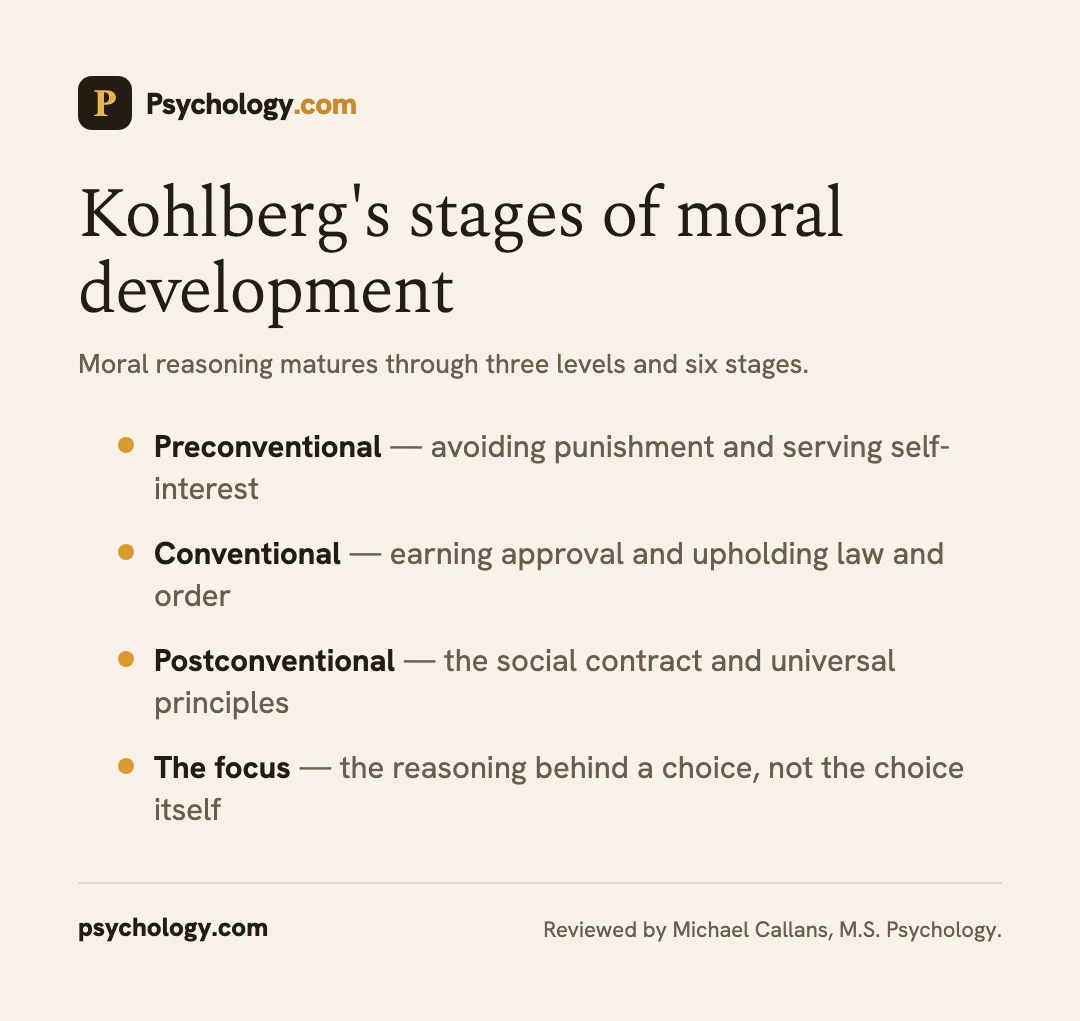
Kohlberg's stages of moral development describe how moral reasoning matures through three levels, each with two stages, for six in total. The levels move from preconventional reasoning based on rewards and punishments, to conventional reasoning based on social rules and approval, to postconventional reasoning based on abstract principles of justice. Kohlberg studied this using moral dilemmas, most famously the Heinz dilemma, and his focus was on the reasoning behind a choice rather than the choice itself.
What Kohlberg's theory is about
Lawrence Kohlberg was an American psychologist who studied how people reason about right and wrong. Building on Jean Piaget's earlier work on children's moral thinking, Kohlberg proposed in his 1958 doctoral research that moral reasoning develops in a predictable sequence as people mature.
A crucial point is that Kohlberg was interested in the reasoning, not the verdict. When he posed moral dilemmas, he did not care whether someone said an action was right or wrong. He cared about why they said it. Two people could reach opposite conclusions while reasoning at the same level, and two people could reach the same conclusion for very different reasons.
From his research Kohlberg described three broad levels of moral reasoning, each divided into two stages, giving six stages in all. He argued that people move through them in order, that each stage represents a more adequate way of reasoning than the last, and that not everyone reaches the highest stages.
The Heinz dilemma
Kohlberg's best-known research tool was a set of hypothetical moral dilemmas, the most famous being the Heinz dilemma. In it, a woman is dying of a rare disease. A druggist has discovered a drug that could save her but is charging far more than her husband, Heinz, can afford. Heinz tries everything to raise the money, fails, and finally considers breaking into the pharmacy to steal the drug.
Participants were asked whether Heinz should steal the drug and, more importantly, to explain their reasoning. Kohlberg then analyzed the structure of those explanations rather than the yes-or-no answer.
The same dilemma can elicit very different kinds of reasoning. One person might say Heinz should not steal because he would be punished. Another might say he should steal because a life is worth more than property and the duty to preserve life is a higher principle than the law. These answers reveal different levels of moral development.
The three levels and six stages
The preconventional level is typical of young children but can persist. At Stage 1, obedience and punishment orientation, an action is wrong mainly because it gets punished. At Stage 2, self-interest orientation, reasoning becomes a matter of what is in it for me, with a basic sense of fair exchange.
The conventional level is typical of adolescents and most adults. At Stage 3, the good interpersonal relationships orientation, being good means living up to what others expect and earning approval. At Stage 4, the social order orientation, the focus shifts to upholding laws, duties, and the wider social system, because society needs rules to function.
The postconventional level is reached by a minority of adults, if at all. At Stage 5, the social contract orientation, laws are seen as social agreements that should serve people's rights and welfare and can be changed when they fail to. At Stage 6, the universal ethical principles orientation, moral reasoning is guided by self-chosen abstract principles such as justice, equality, and the dignity of every person, which take precedence over any particular law.
Kohlberg considered Stage 6 something of an ideal, rarely observed in practice, and he later treated it more as a theoretical endpoint than a stage many people clearly reach.
Criticisms of the theory
Kohlberg's theory has been influential, but it has drawn substantial criticism. One prominent objection came from his colleague Carol Gilligan, who argued that his theory was based largely on studies of boys and men and reflected a justice-focused view of morality. She proposed that an ethic of care, emphasizing relationships and responsibility for others, is an equally valid moral orientation that his stages undervalued.
Other critics point to cultural bias. The highest stages reflect a particular tradition of individualistic, rights-based ethics, and people from cultures that prioritize community, duty, or interdependence may reason in ways the model scores as lower without those ways being less mature.
A further criticism is the gap between moral reasoning and moral behavior. Knowing how to reason about a dilemma in the abstract does not reliably predict how a person will act under real pressure. Reasoning is only one part of moral life, alongside emotion, character, and situation.
Why the theory still matters
Despite these limits, Kohlberg's work remains a foundational contribution to the psychology of morality. It reframed moral development as something that unfolds and matures rather than being fixed, and it gave researchers a structured way to study how people think about ethical questions.
Its core insight endures: the reasons behind a moral judgment matter, and those reasons tend to grow more sophisticated, moving from self-interest toward principle, as cognitive and social development proceeds. The model is still widely taught in psychology, education, and ethics as a starting point for understanding moral growth, even where its details are debated.
Key takeaways
- Kohlberg described moral reasoning as developing through three levels and six stages.
- The levels move from preconventional (rewards and punishment), to conventional (social rules and approval), to postconventional (abstract principles).
- He studied this with moral dilemmas, most famously the Heinz dilemma, focusing on the reasoning rather than the answer.
- Carol Gilligan criticized the theory as male-centered and proposed an equally valid ethic of care.
- Moral reasoning does not always predict moral behavior, and the highest stages have been criticized as culturally biased.
Want to understand yourself more deeply?
Explore our free, clinician-reviewed psychology tests and self-assessments. No account needed.
Frequently asked questions
What are Kohlberg's three levels of moral development?
Preconventional, based on rewards and punishments; conventional, based on social rules and gaining approval; and postconventional, based on abstract principles such as justice and human rights. Each level contains two stages, for six in total.
What is the Heinz dilemma?
It is Kohlberg's most famous moral dilemma, in which a man named Heinz considers stealing an overpriced drug to save his dying wife. People are asked to explain their reasoning, which reveals their level of moral development.
What did Kohlberg actually measure?
He measured the reasoning behind moral judgments, not the judgments themselves. He cared about why a person thought an action was right or wrong, because the structure of that reasoning indicates the stage of moral development.
What is the main criticism of Kohlberg's theory?
Carol Gilligan argued it was based largely on males and overvalued a justice-focused morality while undervaluing an ethic of care. Critics also note cultural bias in the higher stages and the weak link between moral reasoning and actual behavior.
Does everyone reach the highest stage?
No. Kohlberg held that most people reason at the conventional level and that the postconventional level, especially Stage 6, is reached by relatively few. He came to treat Stage 6 as more of a theoretical ideal than a commonly observed stage.
Related concepts

References
- Kohlberg L. The Development of Modes of Moral Thinking and Choice in the Years 10 to 16. Doctoral dissertation, University of Chicago; 1958.
- Kohlberg L. Essays on Moral Development, Vol. I: The Philosophy of Moral Development. Harper & Row; 1981.
- Gilligan C. In a Different Voice: Psychological Theory and Women's Development. Harvard University Press; 1982.
- Piaget J. The Moral Judgment of the Child. Kegan Paul; 1932.
- Colby A, Kohlberg L. The Measurement of Moral Judgment. Cambridge University Press; 1987.