
In short
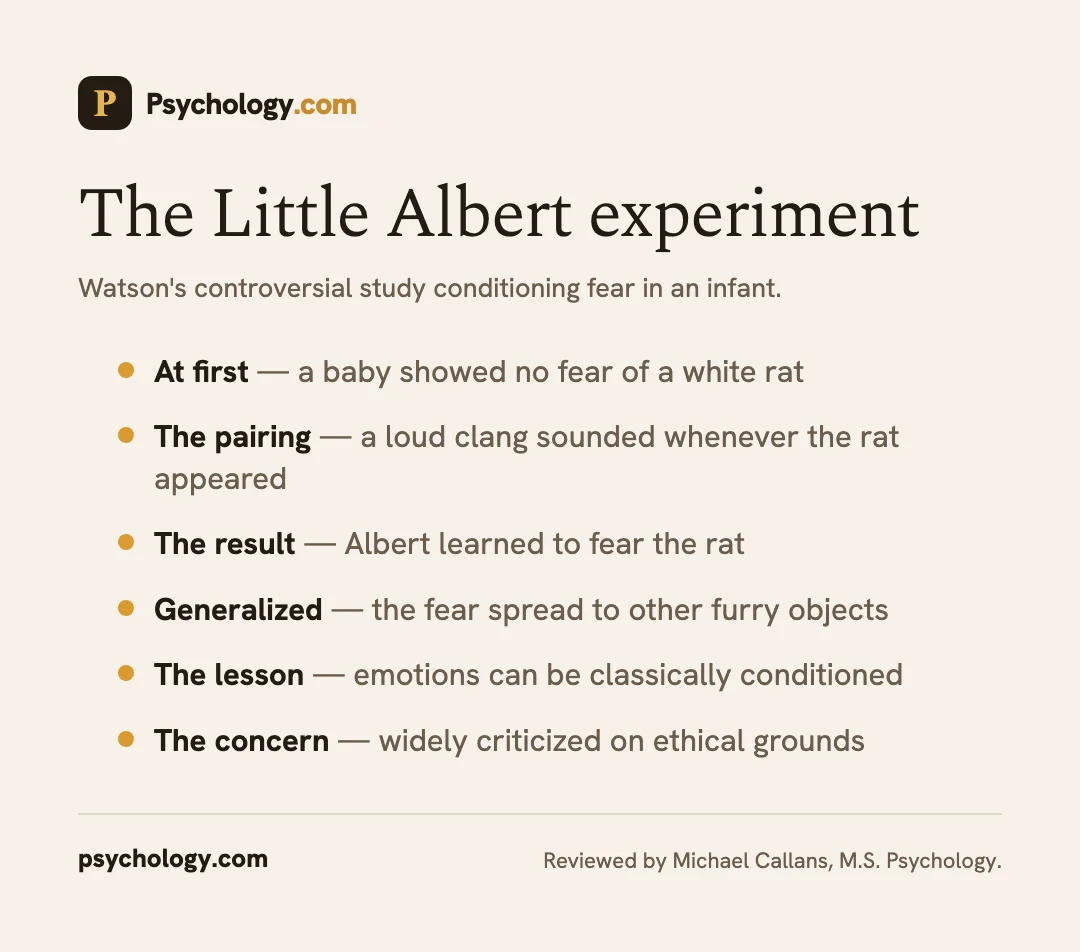
The Little Albert experiment was a study of learned fear by John B. Watson and Rosalie Rayner. They paired a white rat with a loud noise and reported that an infant later feared the rat alone. The case illustrates classical conditioning, with serious ethical problems and uncertain long-term effects.
The background and aim
The Little Albert experiment tested whether an initially neutral animal could become a signal of danger through learning. The researchers paired a white rat with a startling noise, then observed the infant's response to the rat alone. Their report describes conditioned fear, although the study offers limited evidence about lasting phobias.
Watson and Rayner published Conditioned Emotional Reactions in 1920. Their participant was called Albert B. The report describes baseline observations at about nine months and rat-noise conditioning at about eleven months. These are different points in the study, which explains why accounts give different ages.
The question concerned learning through associations. Albert's reaction is usually discussed under classical conditioning: a cue comes to predict an event that produces a response. A familiar everyday example is feeling tense at a sound associated with an unpleasant experience.
What happened in the study
At baseline, the researchers described little fear of the animals and objects they presented. A sudden noise, made by striking a steel bar with a hammer, startled and distressed Albert. In learning terminology, the sound was the unconditioned stimulus and the reaction to it the unconditioned response.
The researchers then paired the white rat with the frightening noise. The rat began as a neutral stimulus. After the pairings, they reported withdrawal and crying when the rat appeared alone. The rat had become a conditioned stimulus, with the learned fear described as the conditioned response.
These labels identify the proposed learning process. They do not establish how long it lasted, whether another observer would rate the behavior identically, or how it compares with a clinical phobia. A diagnosis would require information beyond the immediate laboratory response.
Generalization of fear
Stimulus generalization means that a learned response occurs to something resembling the original cue. Watson and Rayner described reactions to a rabbit, a dog, and a fur coat after conditioning with the rat. Responses differed across objects and occasions.
A modern illustration would be someone who becomes wary of barking dogs after a frightening encounter with a particular dog. This explains the concept without assuming that every fear develops this way. Personal experiences, observation, information from others, and individual differences can all affect fear.
Claims that Albert became afraid of every white or furry object flatten a complicated record. The observations need to be read with attention to the object, context, handling, and actual behavior. Generalization does not mean that all similar objects produce an identical response.
The serious ethical problems
The researchers deliberately frightened an infant who depended on adults to protect his welfare. The report says their planned effort to remove the conditioned responses was not carried out before Albert left the hospital. This raises concerns about distress, protection of vulnerable participants, and follow-up care.
The APA ethics code addresses informed consent, deception, withdrawal, and debriefing. Research with infants raises additional questions about parental permission, acceptable risk, and stopping procedures when distress occurs. An infant's inability to consent places greater responsibility on the adults overseeing the work.
The historical report provides too little detail to reconstruct every conversation with Albert's mother. Ethical criticism can rest on the documented procedure without inventing what she knew. The study's fame also does not establish that it directly caused later ethics laws or review systems.
Legacy and the question of who Albert was
The original report does not establish Albert's long-term outcome. It records that the researchers did not attempt their planned fear-removal procedure. Recovery, persistence, and later treatment remain unverified by the experiment itself.
Historical researchers have proposed different identities. Powell and colleagues argued that Albert Barger matched the records better than a previously proposed candidate, Douglas Merritte. Harris's review of the archival dispute describes problems with the reasoning and reporting behind competing claims. Biographical assertions therefore need explicit attribution.
Claims that the experiment caused Albert's death or established a lifelong fear of animals go beyond the conditioning report. They depend on identifying the child correctly and establishing a causal link. The historical uncertainty is a reason to be precise about the evidence available.
How to evaluate the evidence
The case concerns a single infant, with no comparable untreated group. That design makes it difficult to separate the effects of the rat-noise pairing from repeated handling, arousal, context, or other experiences. A dramatic demonstration can suggest a mechanism while leaving causal questions unresolved.
Descriptions such as crying, leaning away, or reaching toward an object are observations. A persistent phobia is a broader clinical claim. When reading an account, ask whether the author is describing observed behavior, offering an interpretation, or making a claim about later life. Those require different kinds of evidence.
Watson and Rayner were testing a theory they favored. Expectations can influence interpretation, especially when the observer also carries out the procedure. Clear behavioral definitions, independent ratings, and transparent reporting help readers assess whether an explanation fits the results. These are useful questions for evaluating other famous experiments as well.
Related learning concepts and help with fears
Explore the psychology concepts hub, then compare classical conditioning with operant conditioning. The former concerns associations between events; the latter concerns the consequences of behavior.
If fear affects your daily life, the phobia self-check can help organize what you avoid. The anxiety triggers worksheet offers space to record situations, sensations, and reactions. Bring concrete examples to a clinician when avoidance limits work, relationships, or ordinary activities. These resources support reflection and cannot establish a diagnosis or the origin of a fear.
Key takeaways
- Watson and Rayner published the infant fear-conditioning report in 1920. Source: Conditioned Emotional Reactions.
- The rat was paired with a loud noise made by striking a steel bar; fear was later reported when the rat appeared alone. Source: Watson and Rayner.
- Responses to other animals and objects varied across observations. Source: Watson and Rayner.
- The planned fear-removal procedure was never attempted within the study; the report supplies no long-term outcome. Source: Watson and Rayner.
- Historical scholarship has challenged competing claims about Albert's identity. Sources: Powell and colleagues, Correcting the Record; Harris, Journals, Referees, and Gatekeepers.
Living with a fear or phobia?
A licensed therapist can assess a persistent fear and discuss treatment options that fit your situation.
Frequently asked questions
What was the Little Albert experiment?
The Little Albert experiment investigated whether an infant could learn to fear a white rat through association with a frightening noise. Watson and Rayner described fear of the rat after pairing it with the sound of a struck steel bar. The case is commonly used to explain classical conditioning, alongside its methodological and ethical limitations.
What did the Little Albert experiment prove?
The Little Albert experiment provided a reported example of fear learning through association. Its small, uncontrolled design limits how confidently the behavior can be attributed to conditioning alone. The study did not establish that every phobia is learned this way or that Albert developed a lifelong disorder. General claims require evidence beyond this case.
Why was the Little Albert experiment unethical?
The Little Albert experiment deliberately distressed an infant who could not understand the procedure or withdraw independently. The researchers also left their planned fear-removal work unfinished. These features raise concerns about risk, protection, consent, and follow-up. The historical record does not justify confident claims about every detail of parental permission.
How old was Little Albert during the experiment?
Watson and Rayner described baseline observations when Albert was about nine months old and began the rat-noise conditioning when he was about eleven months old. The ages refer to different phases of their report. Saying the entire experiment happened at a single age obscures the sequence of observation, conditioning, and later tests.
What happened to Little Albert after the experiment?
The Little Albert report does not establish the child's long-term psychological outcome. Researchers later proposed competing identities, including Douglas Merritte and Albert Barger, and challenged the evidence for those proposals. Statements about his later health, death, or lifelong fears should identify the historical source and its uncertainty rather than present a settled biography.
Was Little Albert's fear ever cured?
Watson and Rayner did not carry out their planned procedure to reduce Albert's fear before he left the hospital. Their report therefore cannot tell us whether the fear later faded, persisted, or was addressed elsewhere. The study supplied no verified long-term outcome, so claims of an enduring phobia remain uncertain.
Related concepts

References
- Watson JB, Rayner R. Conditioned emotional reactions. Journal of Experimental Psychology. 1920;3:1-14. psychclassics.yorku.ca
- American Psychological Association. Ethical principles of psychologists and code of conduct. apa.org
- Powell RA, Digdon N, Harris B, Smithson C. Correcting the record on Watson, Rayner, and Little Albert: Albert Barger as psychology's lost boy. pubmed.ncbi.nlm.nih.gov
- Harris B. Journals, referees, and gatekeepers in the dispute over Little Albert. pubmed.ncbi.nlm.nih.gov