
In short
Maslow's hierarchy of needs describes five categories of motivation: physiological needs, safety, love and belonging, esteem, and self-actualization. Maslow proposed that urgent basic needs often take priority while allowing overlap and exceptions. The hierarchy is useful for discussing unmet needs, though evidence does not establish a universal sequence.
What Maslow's hierarchy of needs is
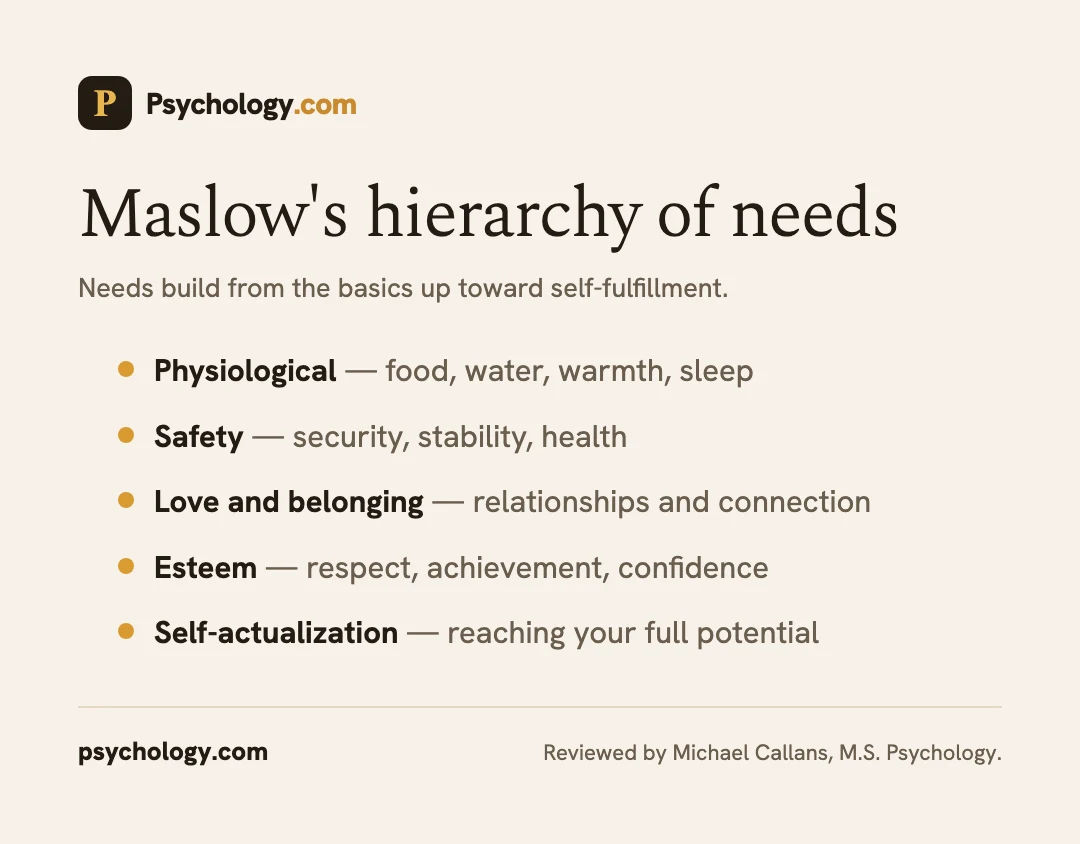
Maslow's hierarchy of needs describes motivation through physiological needs, safety, love and belonging, esteem, and self-actualization. It proposes that unmet basic needs often command attention while allowing several needs to operate together. The model offers vocabulary for discussing human concerns, with limits as a scientific prediction of individual behavior.
Abraham Maslow introduced the theory in his 1943 paper A Theory of Human Motivation. His account allowed partial satisfaction, overlapping motivations, and exceptions to the usual ordering. Someone can seek friendship while worrying about housing or pursue a creative project during financial insecurity.
The familiar pyramid was developed by later writers. Bridgman, Cummings, and Ballard traced its history in management education. A triangular diagram is easy to remember, but its clean boundaries can obscure the flexibility in Maslow's account.
The five levels, from the bottom up
Physiological needs include food, water, sleep, and other bodily requirements. Hunger or exhaustion can make these needs especially pressing. For example, a student who skipped meals may find it harder to engage with a lesson until food is available.
Safety needs concern security and predictability, including protection from violence, stable living conditions, and reliable access to essentials. Someone facing an eviction notice may devote substantial attention to finding somewhere safe to stay.
Love and belonging concern affection, friendship, family connections, and acceptance within a group. A person can have adequate food and housing while still feeling isolated. Reliable companionship addresses a different concern from material comfort.
Esteem concerns both a sense of competence and recognition from others. Learning a valued skill may support confidence; fair acknowledgment of that work may support feeling respected. Status alone can be an unreliable measure of whether someone feels capable or valued.
Self-actualization concerns developing and expressing personal capacities. It could involve creative work, learning, parenting, or service. The activity depends on the person. A prestigious job or public achievement cannot by itself establish that someone feels fulfilled.
Using the hierarchy to ask practical questions
Start with the situation rather than assigning yourself a level. If you feel unmotivated, ask about sleep, meals, safety, connection, respect, and opportunities for meaningful activity. More than one area may need attention. The model does not supply a diagnosis of why motivation has changed.
Make the next step specific. A concern about belonging might lead to contacting a trusted friend or finding an accessible group. A safety concern might require housing advice, practical assistance, or protection from harm. The same feeling of being stuck can arise in very different circumstances.
Separate what you can influence from what requires support. A worksheet cannot resolve inaccessible housing, discrimination, or inadequate income. Naming those needs can still help clarify a request for assistance. Avoid treating lack of resources as a personal failure to progress through the hierarchy.
Why the order is flexible
Maslow described needs as partly satisfied and active at the same time. The model's ordering concerns relative priority. It does not require a person to complete a level before friendship, respect, or meaning can matter.
Consider a caregiver who remains committed to a loved one despite exhaustion, or an artist who continues creating while living with uncertainty. These examples illustrate overlapping motives. They are not proof that basic needs can safely be ignored.
A pyramid can also invite rankings of people: someone near the top may appear more mature or valuable. That is an inappropriate use of a motivational framework. People facing deprivation still have relationships, values, abilities, and aspirations that deserve attention.
What the evidence says
Tay and Diener's study, Needs and Subjective Well-Being Around the World, examined survey data from 123 countries. Meeting needs was associated with well-being across world regions. Associations with particular needs were largely independent of whether other needs were fulfilled.
That finding supports taking several kinds of need seriously while challenging a strict prerequisite model. The study measured associations, so it cannot establish that moving up a hierarchy causes happiness. Its measures also do not test every feature of Maslow's full theory.
For an individual, the useful question is which unmet concerns matter in the current setting. A broad cross-cultural pattern cannot identify a person's priorities without asking them. Culture, responsibilities, access to resources, and personal values all shape the answer.
Examples in education, work, and care
In a classroom, a teacher might notice that a student is struggling to concentrate and ask about practical barriers before interpreting the difficulty as lack of effort. Access to food, a calmer setting, or a reliable relationship may each be relevant. The hierarchy is a prompt for inquiry, rather than an explanation established by observation alone.
At work, recognition may be welcome while staffing, pay, or safety concerns remain unresolved. A manager can ask what employees need and address concrete conditions. Offering praise does not demonstrate that concerns about security have been met.
In healthcare or social support, ask the person what feels most urgent. Someone may want relief from isolation alongside help with practical needs. Respecting that preference avoids imposing an order that fits the diagram better than the person's life.
Related concepts and reflection tools
Explore the psychology concepts hub and compare Maslow with attachment theory on close relationships and Erikson's developmental theory on psychosocial concerns. These theories address different questions and should be evaluated on their own evidence.
The self-esteem self-check can help you reflect on self-regard. The values clarification worksheet can help identify activities you find meaningful. Neither assigns a Maslow level. If persistent low mood or loss of motivation is affecting daily life, a licensed therapist can help assess what is happening.
Key takeaways
- Maslow's 1943 paper named five broad needs: physiological, safety, love, esteem, and self-actualization. Source: A Theory of Human Motivation.
- Maslow explicitly allowed partial satisfaction and exceptions to the proposed ordering. Source: A Theory of Human Motivation.
- The familiar pyramid was developed by later management writers. Source: Bridgman, Cummings, and Ballard, Who Built Maslow's Pyramid?
- Tay and Diener analyzed need fulfillment and well-being across 123 countries. Source: Needs and Subjective Well-Being Around the World.
- Associations between particular needs and well-being were largely independent of other needs being met. Source: Tay and Diener.
Curious where you stand right now?
Our free, clinician-reviewed self-tests can help you make sense of how you are feeling. No account needed.
Frequently asked questions
What are the five levels of Maslow's hierarchy of needs?
Maslow's five levels are physiological needs, safety, love and belonging, esteem, and self-actualization. They concern bodily requirements, security, relationships, competence and respect, and developing personal capacities. Maslow's original paper allowed these motives to overlap. The list is an ordering within his theory, rather than a checklist that every person must complete in sequence.
What is an example of Maslow's hierarchy of needs?
A student may need food and rest, a safe classroom, supportive relationships, recognition for learning, and opportunities to pursue meaningful interests. Those concerns illustrate Maslow's categories. Several can matter during the same day. The example is a way to ask about barriers and support, rather than evidence that the student occupies a single level.
What does self-actualization mean?
Self-actualization means developing and expressing personal capacities in Maslow's theory. It may involve creative work, caregiving, learning, or another personally meaningful activity. Its form depends on the individual. A person does not need public success to pursue it, and an achievement alone cannot show that other needs are satisfied.
Did Maslow create the pyramid?
The familiar pyramid was created by later writers who presented Maslow's ideas in management and education settings. Bridgman and colleagues traced this history in Who Built Maslow's Pyramid? The diagram simplifies the theory by implying separate levels, while Maslow's written account allowed overlap, partial satisfaction, and exceptions to the usual order.
Do lower needs have to be met before higher needs?
Maslow proposed that urgent basic needs often take priority, while allowing higher needs to matter before lower needs are fully satisfied. Someone can value friendship or creative work during financial insecurity. Research by Tay and Diener also found that particular needs were associated with well-being largely independently of other needs being fulfilled.
Is Maslow's hierarchy of needs scientifically proven?
Research supports an association between meeting several kinds of need and well-being, but a universal sequence remains unestablished. Tay and Diener's cross-cultural survey found that fulfillment of particular needs could matter independently of other needs. Maslow's hierarchy is therefore useful as a discussion framework, with limited precision for predicting an individual's motivation or development.
Related concepts

References
- Maslow AH. A theory of human motivation. Psychological Review. 1943;50:370-396. psychclassics.yorku.ca
- Tay L, Diener E. Needs and subjective well-being around the world. pubmed.ncbi.nlm.nih.gov
- Bridgman T, Cummings S, Ballard J. Who built Maslow's pyramid? A history of the creation of management studies' most famous symbol. positivedisintegration.com