
In short
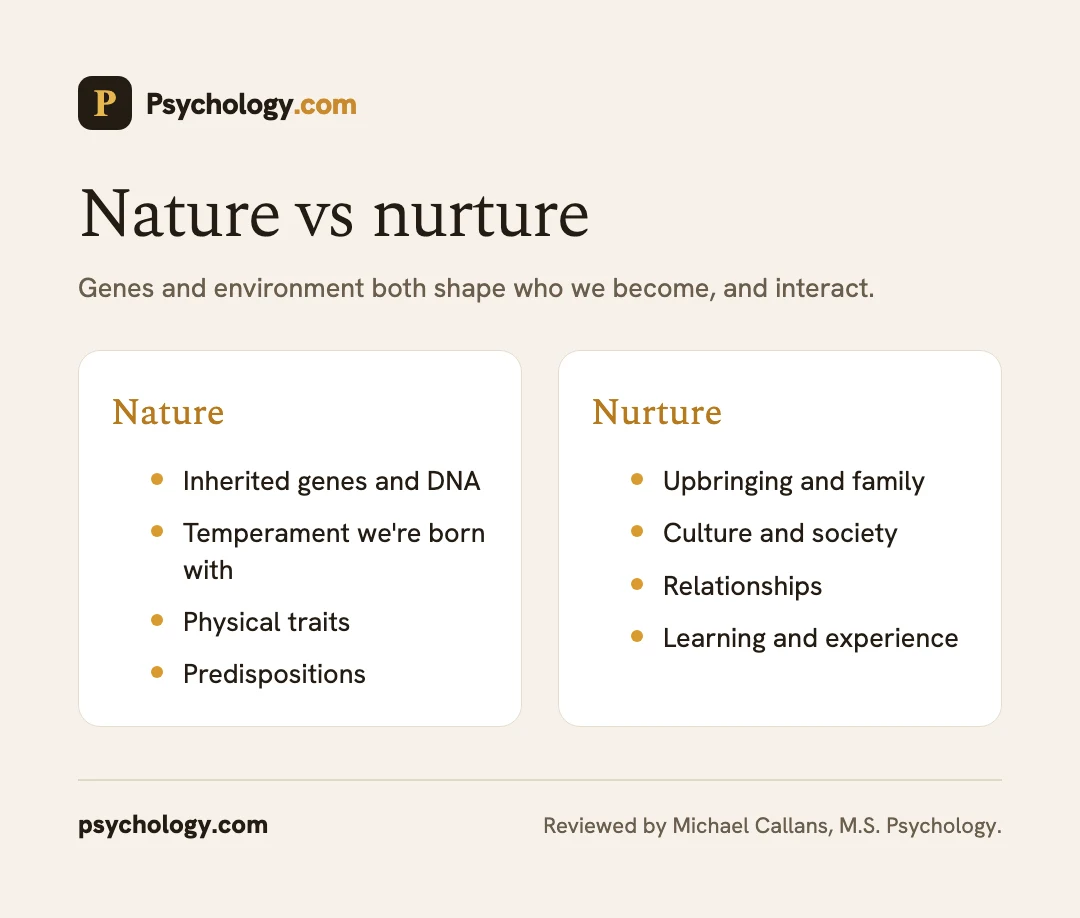
Nature versus nurture concerns the contributions of inherited biology and environment to human traits and behavior. Nature includes genetic variation; nurture includes learning, relationships, culture, and living conditions. Both can influence development, and their effects depend on context. Heritability describes population differences rather than a fixed percentage of an individual.
What the debate is about
Nature versus nurture asks how inherited biology and experience contribute to human development. Nature includes genetic influences, while nurture includes relationships, education, culture, and living conditions. Researchers study their contributions and interplay for particular traits. The answer depends on what is measured and which population and environment are studied.
The categories are broad. An environmental influence can occur before birth, and a biological process can respond to experience. Describing a trait as biological therefore does not establish that it was inherited. Describing an influence as environmental also does not make it easy for an individual to change.
The historical debate often emphasized competing explanations. Current research can estimate genetic and environmental contributions while also asking how they operate together. A useful explanation specifies the trait and evidence instead of declaring a winner for human behavior as a whole.
The case for nature
Genetic differences can contribute to variation in temperament, personality, and other psychological characteristics. Twin research, including the large review by Polderman and colleagues, supports genetic contributions across many traits. The size of an estimate depends on the trait, sample, and method.
Genetic influence can involve many variants, each making a small contribution. A family resemblance does not by itself isolate that contribution because relatives can also share routines, resources, exposures, and relationships.
For example, several relatives might enjoy reading. That observation could reflect overlapping influences from interests, access to books, encouragement, and opportunities to practice. A family story alone cannot divide those contributions precisely.
The case for nurture
Nurture includes experiences that affect learning and development: language exposure, schooling, friendships, nutrition, illness, neighborhood conditions, and access to resources. Parents are part of this environment, alongside influences that lie outside a household's control.
Learning offers concrete examples. A person may acquire a skill through instruction and practice, or learn to associate a situation with danger after an unpleasant event. Those examples identify pathways through which experience matters without assuming that everyone responds identically.
Calling an influence environmental should not become a way to assign blame. A child's difficulty can have several causes, and shared family experiences do not affect every child in the same way. Useful questions concern the support available and the particular barriers a person faces.
What twin and adoption studies show
Twin studies compare similarities among relatives with different degrees of genetic relatedness. Adoption studies examine resemblance across biological and adoptive relationships. These designs help estimate sources of variation, but their conclusions depend on assumptions about environments, placement, measurement, and family relationships.
Polderman and colleagues' review found genetic contributions across a broad range of studied traits. That does not supply a universal heritability percentage for personality, intelligence, or a particular person. Estimates from different traits and designs should be kept separate.
MedlinePlus defines heritability in terms of variation in a population. An estimate concerns how genetic differences relate to observed differences under the conditions studied. It does not identify which experiences shaped a particular individual or how much a trait could change.
A useful analogy is comparing plant heights in similar soil. Genetic differences may explain much of the variation within that garden, yet changing water or soil can still affect growth. This illustration shows why an explanation of differences within a setting is distinct from a prediction about changing that setting.
Why it is both, working together
Gene-environment interaction means that an environmental effect can differ depending on genetic variation, or a genetic association can differ across environments. Establishing a specific interaction requires a suitable study and replication. Showing that both genes and environment matter is insufficient by itself to establish statistical interaction.
Gene-environment correlation describes a different issue: genetic differences can be associated with differences in environmental exposure. A child's tendencies may influence the activities they seek or the responses they receive. Such processes complicate attempts to treat experience and inherited differences as entirely separate.
Epigenetics concerns changes in gene regulation that do not alter the underlying DNA sequence. NHGRI describes chemical marks and associated proteins that affect how cells use genetic information. Some marks respond to exposures, but a broad statement about epigenetics cannot establish the biological cause of a particular memory or behavior.
Specific genetic stories also need updating. Border and colleagues found no support for several widely studied historical candidate-gene and gene-by-environment hypotheses about depression in large samples. A simple account in which a particular gene and stress reliably predict depression would overstate that evidence.
Why it still matters
The nature versus nurture debate cannot tell a person which experience caused a current difficulty. A family history may be relevant to assessment, while symptoms, development, current circumstances, and available support also matter. Decisions about care should be based on that broader picture.
Heritability also cannot explain why the average of a trait differs between social groups. An estimate of variation within a studied population answers a different question. Extending it to group differences without relevant evidence is a methodological error.
Practical support can be worthwhile without a complete explanation of origins. Improving access, teaching a skill, reducing a recurring demand, or seeking an assessment addresses a present need. Which action helps is an empirical question about the person and circumstances.
Is mental illness nature or nurture?
Conditions such as depression and anxiety are often framed as either biological or caused by circumstances, but research generally finds contributions from both. Family and twin studies suggest genetic factors contribute to risk for many mental health conditions, while stressful experiences, relationships, and circumstances also contribute to whether and when symptoms appear.
Attempts to find a single gene that interacts with a specific stressor to predict depression have not held up well under rigorous testing. Border and colleagues found no support for several widely cited candidate-gene and gene-by-environment hypotheses for depression when tested in much larger samples than the original studies used. This does not mean genes are irrelevant to depression, only that early single-gene explanations were too simple.
For an individual, a family history of a condition raises the chance of developing it but does not make it certain, and the absence of a family history does not rule it out. A mental health professional can consider family history alongside current symptoms, circumstances, and other risk factors rather than relying on genetics or life events alone.
How much of intelligence is nature versus nurture?
Intelligence is one of the most heavily studied traits in behavioral genetics. Twin and adoption research finds genetic contributions to differences in measured intelligence, alongside contributions from education, health, and other environmental factors, and the balance found in a given study depends on the population and how intelligence was measured.
Heritability estimates for intelligence describe variation within the specific population studied, not a fixed amount of genetic determination for every person. The same heritability estimate is consistent with environmental changes, such as improved nutrition or schooling, producing large shifts in average scores over time.
A heritability estimate for intelligence cannot be used to explain average differences between social or racial groups, because those comparisons involve different environments and histories than the ones the estimate was calculated from. Extending a within-group estimate to a between-group comparison is a common misuse of heritability research.
Explore personality, context, and change
For related explanations, visit the psychology concepts hub, Big Five personality traits, and Bronfenbrenner's ecological systems theory. These pages consider patterns of individual differences and the settings in which development occurs.
The Big Five self-check can prompt reflection on current tendencies. It cannot separate their genetic and environmental causes. The habit builder worksheet can help you specify an action and the context that supports it. A licensed therapist can help assess concerns about recurring emotional or behavioral difficulties.
| Feature | Nature (genes) | Nurture (environment) |
|---|---|---|
| Main focus | Inherited genetic variation and biological development | Learning, relationships, exposures, and living conditions |
| Illustrative evidence | Genetic resemblance across relatives | Effects of experience and opportunities |
| Research methods | Twin, adoption, and genomic studies | Longitudinal studies and environmental interventions |
| Interpretation limit | Genetic influence does not establish immutability | Environmental influence does not establish parental blame |
| Combined question | How do genetic effects vary with context? | How do environmental effects vary among people? |
Key takeaways
- Heritability describes variation within a population under studied conditions. Source: MedlinePlus Genetics, What Is Heritability?
- Heritability cannot specify the genetic share of an individual's trait or determine how changeable it is. Source: MedlinePlus Genetics.
- Twin research supports genetic contributions across many human traits, with estimates depending on the trait and design. Source: Polderman and colleagues.
- Epigenetic marks can affect gene regulation without changing the DNA sequence. Source: NHGRI, Epigenomics Fact Sheet.
- Large-sample analyses failed to support several historical candidate-gene hypotheses about depression. Source: Border and colleagues, No Support for Historic Candidate Gene Hypotheses.
- Genetic and environmental factors both contribute to risk for conditions such as depression, and single-gene explanations for that risk have not held up in large samples. Source: Border and colleagues.
- A heritability estimate for a trait such as intelligence describes variation within the studied population and cannot be used to explain differences between social or racial groups. Source: MedlinePlus Genetics.
Curious what shapes the way you think and feel?
Our free, clinician-reviewed self-tests can help you understand your own patterns. No account needed.
Cite this source
Psychology.com. (2026, September 15). Nature vs Nurture: The Debate Explained. Psychology.com. https://psychology.com/concepts/nature-vs-nurture
Frequently asked questions
What is the nature versus nurture debate?
Nature versus nurture asks how inherited biology and environmental experience shape development and behavior. Genetic influences fall under nature; learning, relationships, culture, and living conditions fall under nurture. Research examines both for specific traits. The relative contribution depends on the population, methods, and context rather than a single answer for all human characteristics.
What is an example of nature and nurture working together?
Learning to read involves biological capacities alongside language exposure, instruction, practice, and access to books. Children can differ in their abilities and opportunities, with both affecting progress. The example illustrates several contributing influences. A specific claim about a genetic interaction would require research that measures genetic variation, environmental exposure, and the outcome.
Is personality nature or nurture?
Personality shows genetic influences and environmental influences. Behavioral-genetic studies estimate contributions to differences between people, while experiences and contexts can also matter. A personality questionnaire describes current tendencies and cannot identify their causes. A heritability estimate from a study should never be read as the genetic percentage of your own personality.
What do twin studies show about nature versus nurture?
Twin studies compare resemblance among twins with different genetic relatedness to estimate sources of variation in a trait. They support genetic contributions across many characteristics and also leave room for environmental influences. Interpretation depends on assumptions about environments and measurement. Their estimates describe studied populations and cannot predict a particular person's future with certainty.
Does heritability mean a trait cannot change?
Heritability describes how genetic differences relate to variation within a studied population. It does not measure how responsive a trait is to changed conditions, instruction, or support. A trait can show substantial heritability while remaining affected by its environment. MedlinePlus emphasizes this distinction when explaining what heritability estimates can tell us.
What is epigenetics in nature versus nurture?
Epigenetics studies changes in gene regulation that occur without changing the underlying DNA sequence. Chemical marks and associated proteins can influence how cells use genetic information, and some respond to environmental exposures. This is a biological pathway relevant to development. It does not establish that every experience creates a permanent or inherited molecular change.
Related concepts

References
- MedlinePlus Genetics. Inheriting Genetic Conditions: What is heritability? medlineplus.gov
- Polderman TJC and colleagues. Meta-analysis of the heritability of human traits based on fifty years of twin studies. pubmed.ncbi.nlm.nih.gov
- National Human Genome Research Institute. Gene Environment Interaction. genome.gov
- National Human Genome Research Institute. Epigenomics Fact Sheet. genome.gov
- Border R and colleagues. No support for historic candidate gene or candidate gene-by-interaction hypotheses for major depression across multiple large samples. pmc.ncbi.nlm.nih.gov