
In short
The clearest difference between sociopath and psychopath is how the terms are used: psychopathy has structured research definitions, while sociopathy is loosely defined. Antisocial personality disorder is a related clinical diagnosis with specific criteria. Labels alone cannot establish someone's motives, capacity for attachment, risk of violence, or need for treatment.
The difference between the terms
Psychopathy is a research and clinical assessment construct; sociopathy is a loosely defined term used in different ways. Antisocial personality disorder is a related formal diagnosis. These concepts overlap, but they are not interchangeable. A clinician needs a detailed assessment to determine whether a person meets criteria for a condition.
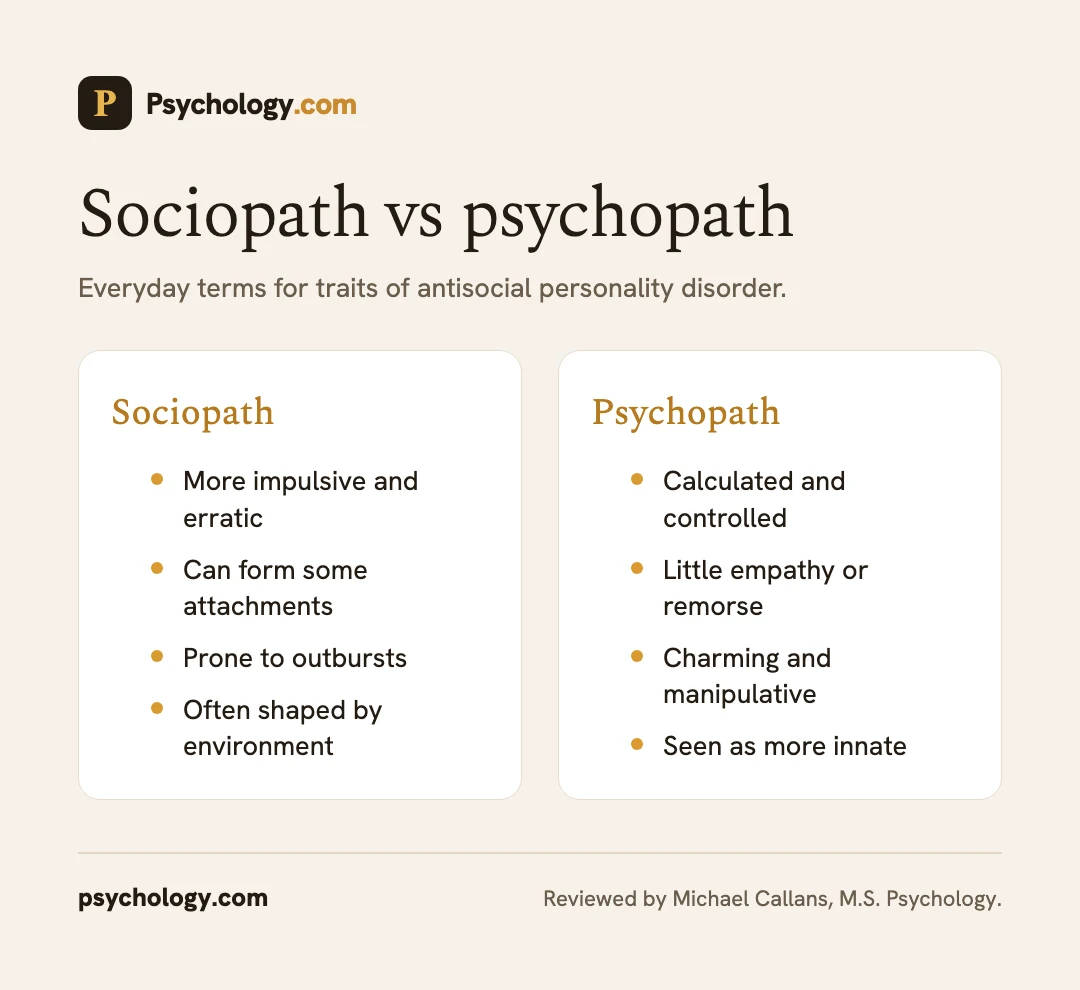
Popular descriptions often contrast a calculating psychopath with an impulsive sociopath. That distinction is too rigid to function as a clinical rule. Research measures of psychopathy can include impulsivity and behavioral problems as well as interpersonal and emotional features. A temperament description cannot establish a diagnosis.
Psychopathy and sociopathy are not standalone diagnostic categories in the DSM-5-TR. Psychopathy can still be discussed in clinical and forensic reports as a measured construct. Saying that a term is not a separate diagnosis does not mean it is absent from professional discussion.
How antisocial personality disorder fits
Antisocial personality disorder, often abbreviated ASPD, involves a persistent pattern of disregarding and violating other people's rights. Diagnostic assessment considers the pattern over time and across situations, along with developmental history and alternative explanations. Being socially withdrawn or preferring solitude has a different meaning from antisocial in this clinical context.
The DSM criteria summarized by the Merck Manual require the person to be at least 18 and to have evidence of conduct disorder before age 15. This is more specific than a history of difficult behavior during adolescence. These age requirements are part of a wider assessment, rather than a checklist that establishes the diagnosis by itself.
Psychopathy research often gives particular attention to interpersonal and emotional traits alongside behavior. The relationship with ASPD depends on the definition and measure used. An ASPD diagnosis does not automatically establish psychopathy, and a research score cannot substitute for a clinical assessment.
What psychopathy assessments examine
Robert Hare and Craig Neumann describe psychopathy as a construct studied through clinical observation and empirical measures. Commonly studied features include manipulation, limited remorse, callousness, irresponsibility, and antisocial behavior. Different research models organize these features differently, which matters when comparing findings.
The Psychopathy Checklist-Revised, or PCL-R, is a professional assessment instrument used particularly in forensic settings. Interpretation draws on information about a person's history and behavior, rather than a brief impression or a social media checklist. A qualified assessor must understand the measure and the context in which it is used.
An online quiz with the word psychopathy in its name may use a different questionnaire or an informal set of questions. Before interpreting a result, ask what was measured, whether the instrument has evidence for that use, and who the comparison group was. A label in a quiz title does not confer diagnostic authority.
Why born versus made is an unreliable distinction
Sociopathy has often been used to emphasize social influences on antisocial behavior, while some descriptions of psychopathy emphasize biology. Hare and Neumann's review discusses genetic, developmental, and neurobiological findings together. That evidence does not support assigning an individual to a simple biological or environmental category based on a popular label.
A difficult childhood cannot establish that someone will develop ASPD or psychopathic traits. Similarly, a history of harmful behavior cannot tell you which cause produced it. When seeking help, describe observable behavior and its consequences instead of trying to reconstruct a person's biology from how they act.
Broad claims that someone with these traits can never care about anyone or must be violent go beyond what a label can establish. Assessment concerns an individual pattern. Relationships should also be judged by respect, safety, honesty, and accountability, rather than speculation about an internal emotional state.
Treatment and meaningful change
Care should be organized around assessed difficulties and realistic goals. NICE guidance recommends considering cognitive and behavioral interventions for adults with ASPD to address problems such as impulsivity, interpersonal difficulties, and antisocial behavior. Engagement, circumstances, and co-occurring conditions affect what a treatment plan needs to include.
NICE advises against routinely using medication specifically to treat ASPD or its associated behaviors. Medication may be appropriate for a co-occurring condition after assessment. A prescriber should explain what symptom or condition a medication targets and how its benefits and risks will be reviewed.
If you are seeking help for yourself, useful goals might include stopping intimidation, handling anger differently, taking responsibility for harm, or addressing substance use. Discuss concrete examples with a clinician. Concern about a label alone cannot establish a diagnosis or rule it out.
If the concern involves a child or adolescent, seek a developmentally appropriate assessment. Adult labels can stigmatize a young person and obscure the specific behavior, family needs, or co-occurring problems that deserve attention.
When you are worried about someone else
Focus on conduct you can describe: repeated threats, coercion, dishonesty, aggression, or violations of boundaries. You do not need certainty about a personality diagnosis to take those experiences seriously. If you face immediate danger, contact emergency services or move toward safe support when possible.
For a difficult interaction that is safe to discuss, state the behavior and its effect clearly, then decide what boundary you can maintain. A promise of change and sustained changes in behavior are different kinds of information. Your own support, safety, and ability to make choices also matter.
Using self-tests and finding support
The sociopathy self-test can prompt reflection on your own reported behavior. It cannot diagnose ASPD or determine whether another person is a sociopath. Treat a result as material to discuss with a professional, especially if the pattern causes harm or distress.
The setting boundaries worksheet can help you clarify limits in relationships where doing so is safe. For background, read sympathy versus empathy and nature versus nurture, or browse the psychology concepts hub.
How common are psychopathy and sociopathy
Prevalence estimates depend heavily on the definition and the population studied. The DSM-5-TR lists antisocial personality disorder as affecting an estimated 0.2 to 3.3 percent of the general population, with higher rates in clinical and forensic settings. Psychopathy, as measured by structured instruments like the PCL-R, is estimated in Robert Hare's research to appear in roughly 1 percent of community samples and considerably more often, around 15 to 25 percent, among incarcerated populations.
These figures describe group patterns, not a way to estimate the odds for a specific person you know. A high rate in a prison population reflects a group already selected for a history of law violations, and it does not mean the same rate applies to a general population encounter. Prevalence numbers help explain how a construct is distributed across groups; they cannot diagnose an individual.
Narcissism vs sociopathy and psychopathy
Narcissistic personality disorder, sociopathy, and psychopathy sometimes get used as if they describe the same kind of person, but they emphasize different patterns. Narcissism centers on grandiosity, a need for admiration, and difficulty tolerating criticism, while psychopathy centers on callousness, manipulation, and a disregard for others' rights that often includes rule breaking or aggression. A person can show narcissistic traits without meeting criteria associated with psychopathy, and the reverse is also true.
There is overlap in some models, particularly around grandiosity and low empathy, and clinicians have described presentations that combine narcissistic and antisocial features. Still, a public figure's arrogance or self-promotion is not evidence of psychopathy, and a psychopathy label should not be assumed from qualities that fit narcissism just as well. A narcissism self-test or a dark triad self-test can prompt reflection on these traits, but neither instrument diagnoses narcissistic personality disorder, sociopathy, or psychopathy. A qualified clinician distinguishes these patterns using structured assessment, not a single trait.
| Feature | Psychopathy | Sociopathy |
|---|---|---|
| Use of the term | Research construct and professional assessment concept | Loosely defined term with inconsistent usage |
| Standalone DSM diagnosis | No; distinguish from an ASPD diagnosis | No; distinguish from an ASPD diagnosis |
| What it describes | Interpersonal, emotional, and behavioral traits, depending on the measure | Usually antisocial patterns, with definitions varying by writer |
| Cause inferred from the label | A label cannot identify a person's causes | A label cannot establish an environmental cause |
| Assessment | Professional measures require appropriate training and context | No single agreed clinical assessment corresponding to the popular label |
| Risk or attachment | Requires individual assessment | Cannot be inferred from the term |
Key takeaways
- ASPD assessment requires adulthood, at least age 18, and evidence of conduct disorder before age 15. Source: Merck Manual, Antisocial Personality Disorder, summarizing DSM-5-TR criteria.
- Psychopathy and ASPD are overlapping concepts assessed for different purposes. Source: Hare and Neumann, Psychopathy: Assessment and Forensic Implications.
- Psychopathy research includes interpersonal, emotional, lifestyle, and antisocial features. Source: Hare and Neumann, Psychopathy as a Clinical and Empirical Construct.
- NICE recommends considering cognitive and behavioral interventions for ASPD and advises against routine medication specifically for the disorder. Source: NICE guideline on antisocial personality disorder.
- Antisocial personality disorder affects an estimated 0.2 to 3.3 percent of the general population, while psychopathy measured by the PCL-R appears in roughly 1 percent of community samples and 15 to 25 percent of incarcerated populations. Source: American Psychiatric Association, DSM-5-TR, 2022; Hare, Without Conscience, 1993.
Concerned about a pattern in yourself or someone close?
Talking with a licensed mental-health professional is the safest next step. Search our directory for free.
Cite this source
Psychology.com. (2026, September 15). Sociopath vs Psychopath: What's the Difference? Psychology.com. https://psychology.com/concepts/sociopath-vs-psychopath
Frequently asked questions
What is the difference between a sociopath and a psychopath?
Psychopathy has structured research definitions and professional assessment methods, while sociopathy is used less consistently. Popular descriptions contrast calculated behavior with impulsivity, but that is not a reliable diagnostic distinction. Antisocial personality disorder is a related formal diagnosis. A clinical evaluation examines an individual's history and behavior rather than relying on either label.
Am I a sociopath?
A label cannot be established from a brief description or a self-test. If you are concerned about repeated deception, aggression, lack of remorse, or harm to relationships, bring concrete examples to a licensed mental health professional. The assessment can explore the pattern, its history, other explanations, and what support or treatment may help.
Can a sociopath test or quiz diagnose me?
An online sociopathy test can offer prompts for reflection, but it cannot diagnose antisocial personality disorder. Self-reports have limits, and diagnosis requires a clinician to consider development, context, functioning, and alternative explanations. Avoid using your score to label someone else. Discuss concerning patterns with a qualified professional even if the score seems reassuring.
Is a free psychopathy test the same as the PCL-R?
A free online psychopathy quiz should not be treated as equivalent to a professional PCL-R assessment. The PCL-R requires appropriate expertise and information about a person's history and behavior. Online tests vary in what they measure and how they were validated. A result cannot independently establish a diagnosis or predict an individual's dangerousness.
Can a sociopath or psychopath feel love?
A popular label cannot establish someone's capacity for attachment or tell you what they feel. Psychopathy research examines traits such as callousness and limited remorse, with variation between individuals and measures. In a relationship, evaluate observable conduct, including care, respect, honesty, and safety. Harmful behavior deserves attention regardless of whether someone describes their feelings as love.
Can antisocial personality disorder be treated?
A clinician can offer care focused on specific harmful behaviors, interpersonal difficulties, and co-occurring conditions. NICE recommends considering cognitive and behavioral interventions for adults with ASPD. Treatment engagement and goals matter, and outcomes vary. Medication may address another diagnosed condition; it is not routinely recommended as a treatment for ASPD itself.
Related concepts

References
- American Psychiatric Association. Diagnostic and Statistical Manual of Mental Disorders. 5th ed, text revision (DSM-5-TR). 2022.
- Hare RD, Neumann CS. Psychopathy as a clinical and empirical construct. Annual Review of Clinical Psychology. pubmed.ncbi.nlm.nih.gov
- Hare RD, Neumann CS. Psychopathy: assessment and forensic implications. Canadian Journal of Psychiatry. pubmed.ncbi.nlm.nih.gov
- Merck Manual Professional Edition. Antisocial Personality Disorder (ASPD). merckmanuals.com
- NICE. Antisocial personality disorder: prevention and management. Recommendations. nice.org.uk
- Hare RD. Without Conscience: The Disturbing World of the Psychopaths Among Us. Guilford Press; 1993.