 Reviewed by
Key facts
- Learning disabilities are differences in how the brain processes information, not a sign of low intelligence. American Psychiatric Association
- The most common types affect reading (dyslexia), math (dyscalculia), and writing (dysgraphia). American Psychiatric Association
- They are lifelong, but the right instruction and accommodations make a large difference. NICHD: support and treatment
- Learning disabilities often overlap with ADHD, and both can be supported together. American Psychiatric Association
What are learning disabilities?
A learning disability is a difference in how the brain takes in, processes, stores, or expresses information. It affects specific academic skills, such as reading, writing, or arithmetic, while other areas of ability remain typical. In clinical terms, professionals often use the diagnosis specific learning disorder, defined in the Diagnostic and Statistical Manual of Mental Disorders (DSM-5) published by the American Psychiatric Association. An assessment connects the pattern of difficulties to targeted instruction and practical accommodations at school, at work, or during further study.
Learning disabilities can affect people across levels of intelligence and persist despite effort and appropriate instruction. Assessment also considers the quality of teaching and opportunities to learn, since gaps in instruction can produce difficulties that need a different response. Many people with a learning disability have average or above-average intelligence and work harder than their peers to keep up. The challenge is specific and persistent, and it does not match the person's overall ability, which is exactly what makes it a learning disability rather than a general difficulty.
Learning disabilities are common. The Eunice Kennedy Shriver National Institute of Child Health and Human Development (NICHD) notes that they affect a meaningful share of school-age children, and many adults live with them too. They tend to run in families and are present from an early age, even if they are not identified until later.
Signs in children and adults
Signs vary by age and by the specific skill affected. In children, common signs include:
- Trouble learning letters, sounds, or connecting words to their meaning
- Reading slowly, inaccurately, or with great effort
- Difficulty with spelling and putting thoughts into writing
- Trouble learning number facts or following the steps in a math problem
- Difficulty following directions or staying organized
- Avoiding reading or homework, or strong frustration around schoolwork
Adults who were never assessed may carry the same difficulties into work and daily life. They might avoid tasks that involve heavy reading, struggle to take notes, find it hard to manage forms and deadlines, or feel that they have to work much harder than colleagues for the same result. Recognizing these patterns is often the first step toward getting the right support, and it can be a relief to learn that there is a name and an explanation for a long-standing struggle.
Types of learning disabilities
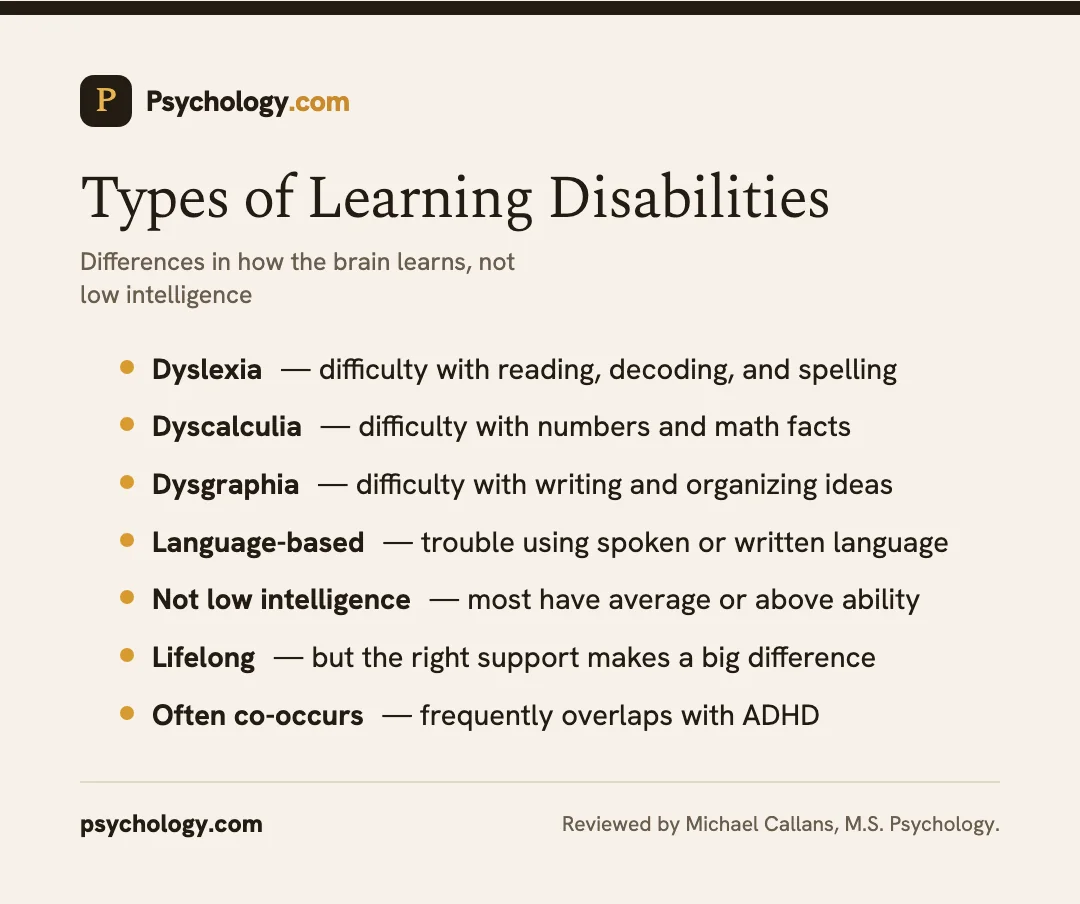
- Dyslexia: the most common learning disability, affecting reading. People with dyslexia have difficulty with accurate or fluent word reading, decoding, and spelling, despite adequate instruction.
- Dyscalculia: difficulty with numbers and math, including number sense, learning math facts, and reasoning through calculations.
- Dysgraphia: difficulty with the physical act of writing and with organizing thoughts on paper, often showing up as messy handwriting and trouble with spelling and structure.
- Language-based difficulties: trouble understanding or using spoken and written language, which can affect both reading and communication.
A person can have more than one type at once, and learning disabilities frequently co-occur with attention difficulties, which is why a thorough assessment looks at the whole picture.
| Condition | Mainly affects | Common signs |
|---|---|---|
| Dyslexia | Reading and spelling | Slow, effortful reading; trouble decoding words and spelling them |
| Dysgraphia | Writing | Messy handwriting; trouble organizing thoughts on paper |
| Dyscalculia | Math and number sense | Trouble learning math facts and following steps in calculations |
| Dyspraxia (DCD) | Movement and coordination | Clumsiness; difficulty with handwriting, typing, and planning movements |
Assessment and diagnosis
A learning disability is identified through a comprehensive evaluation, usually carried out by a psychologist, school psychologist, or other qualified specialist. The assessment looks at cognitive ability, academic skills, language, and sometimes attention and memory, and it rules out other explanations such as vision or hearing problems, a lack of instruction, or a different condition. The goal is to understand the specific pattern of strengths and difficulties and turn those findings into practical recommendations.
For children, schools in the United States can evaluate a student and, under the Individuals with Disabilities Education Act (IDEA), provide an Individualized Education Program (IEP) if the child qualifies. Families can also seek a private evaluation. Adults can request an assessment from a clinical psychologist or a specialist learning-disability service. A clear diagnosis opens the door to formal accommodations at school, university, and work, so it is worth pursuing even later in life.
Support and accommodations
“Dyslexia is a common learning difficulty where your brain works differently to most people. It mainly affects things like reading, writing, and using numbers.”
Learning disabilities respond well to the right support. Two things help most: specialized instruction that teaches skills in a structured, evidence-based way, and accommodations that remove unnecessary barriers.
For reading and writing, structured, explicit teaching of sounds, spelling, and language has strong research behind it. Common accommodations include extra time on tests, audiobooks and text-to-speech, speech-to-text software, note-taking support, calculators for math, and breaking large tasks into smaller steps. None of these make the work easier in an unfair way; they give the person a fair chance to show what they know.
Just as important is building on strengths. Many people with learning disabilities are creative problem-solvers, strong verbal communicators, or talented in hands-on and visual fields. Good support helps a person work with their brain rather than against it, and it sets realistic, encouraging expectations.
By the numbers
5 to 15%of school-age children struggle with a learning disabilityAmerican Psychiatric Association
80%of people with learning disorders have an impairment in reading, commonly known as dyslexiaAmerican Psychiatric Association
20%of the population is affected by dyslexia, which occurs in males and females equallyAmerican Psychiatric Association
Emotional impact
The academic challenge is only part of the story. Children and adults who struggle without an explanation can develop low self-esteem, anxiety, or low mood, especially if they have been told they are not trying hard enough. Years of feeling behind can wear on confidence and motivation.
This is where mental-health support matters. Counseling can help a child or adult separate their worth from their grades, rebuild confidence, and manage the frustration and anxiety that often come with a learning disability. Therapy is also useful for parents, who can learn how to advocate for their child and reduce conflict around homework. When a learning disability is understood and supported early, the emotional fallout is far smaller. Reach out to a doctor, school psychologist, or mental health professional if the struggle is affecting confidence, mood, or family life.
Free tools and worksheets
Practical, printable exercises from our free library that people managing learning disabilities often find useful. No signup needed.
Does this sound familiar? If school always felt harder for you than it seemed to be for others, these prompts may help you name why.
Free, confidential, with an instant plain-language result and a PDF you can bring to a professional. A screening is not a diagnosis.
Frequently asked questions
Are learning disabilities a sign of low intelligence?
No. Learning disabilities are not related to intelligence. They reflect differences in how the brain processes certain information, and many people with learning disabilities have average or above-average intelligence. An evaluation identifies the academic skills that need support and the strengths a person can use in learning.
Can adults be diagnosed with a learning disability?
Yes. Many adults are diagnosed later in life, often after years of struggling without an explanation. A psychologist or qualified specialist can assess adults and recommend accommodations for work and study. Bring school records if available and examples of tasks that remain difficult despite practice.
Do learning disabilities go away with age?
Learning disabilities are lifelong, but their impact can be greatly reduced. With the right strategies, instruction, and accommodations, people learn to work with their strengths and thrive in school and at work. Support needs can change when coursework, job duties, or everyday responsibilities become more demanding.
Can you have more than one learning disability?
Yes, and it is common. A child or adult can have dyslexia and dyscalculia together, for example, and learning disabilities frequently occur alongside ADHD. That is why a comprehensive evaluation looks at reading, writing, math, language, attention, and memory as a whole picture, so support can be matched to every area that needs it rather than just the most obvious one.
Are learning disabilities genetic?
They tend to run in families, and a child with a parent or sibling who has dyslexia or another learning disability is more likely to have one too. Genes appear to shape how the brain develops the circuits used for reading, writing, and math. Family history is only part of the story, but it is one reason early screening is worthwhile when a parent struggled in school.
What is the difference between an IEP and a 504 plan?
Both are formal supports in U.S. public schools. An IEP, provided under the Individuals with Disabilities Education Act, includes specialized instruction and measurable goals for a student who qualifies. A 504 plan can provide accommodations, such as extra time or assistive technology, and may include special education or related services when needed. Which one fits depends on the evaluation and how much the disability affects learning. U.S. Department of Education: Section 504 services.
Related conditions
Therapists who specialize in learning disabilities
Connect with a licensed therapist on Psychology.com who works with learning disabilities.
- Biofeedback Associates of Northeast Florida
- Charles H. Browning
- Dr. David Hanson
- Dr. Elizabeth Trace Slater
- Dr. SARA J CORNELL
Finding the right help
When you are ready to take the next step, these guides walk you through finding and starting with the right therapist.
- Getting started with therapy
- How to find the right therapist
- Find a therapist who takes insurance
- Free & low-cost therapy
References
- NICHD: Learning Disabilities
- MedlinePlus: Learning Disabilities
- American Psychological Association (APA): Learning disabilities
- Cleveland Clinic: Dyslexia
- NHS: Dyslexia
- CDC: Children with disabilities
- American Psychiatric Association: What is specific learning disorder
- NHS: Dyslexia in children
- NICHD: support and treatment
- U.S. Department of Education: Section 504 services
Preparing for a learning disability assessment
Write down the tasks that cause difficulty, when the pattern began, and what support has helped. For a child, include teacher observations and examples of schoolwork. Adults can bring work or study examples and any available school reports. Ask whether the assessment covers reading, written expression, math, attention, and language, and whether the report explains useful accommodations.
Our free learning disability screening for adults with reading concerns can organize observations before an appointment. A screening result cannot establish eligibility for school or workplace support. Use the SMART Goals Worksheet to record a manageable learning goal and the assistance needed to pursue it. Explore the conditions hub, ADHD guide, and child therapy guide when attention or emotional strain also needs support.
Dyspraxia, also called developmental coordination disorder, primarily affects movement and coordination. It can coexist with academic learning disabilities; an assessment should distinguish these needs so recommendations address both motor tasks and academic skills.
