

Key facts
- Clinical Christian counseling can integrate faith with evidence-based approaches; spiritual practices should fit the client's beliefs and treatment goals. ASERVIC competencies endorsed by ACA.
- For clinical care, check the provider's mental health credentials and experience treating your concern. Clergy may also hold clinical credentials, so ask about both roles. NIMH.
- Psychotherapy addresses distress, relationship problems, anxiety, and depression; the method should match the condition and the person's needs. NIMH.
- Clients can discuss how much religious content they want. Spiritual interventions should be acceptable to the client, and goals should respect the client's perspective. ASERVIC competencies endorsed by ACA.
What is Christian counseling?
Christian counseling is a form of therapy that brings a person's Christian faith into the counseling process. It may draw on scripture, prayer, and Christian values as part of how a client makes sense of their life and works toward change, with the client's agreement. The aim is the same as any good therapy, to relieve distress and help a person live more fully, with faith as a resource along the way.
When comparing services, ask whether you are booking clinical psychotherapy or pastoral guidance. The label Christian counseling alone does not tell you the provider's training, treatment methods, or ability to assess a mental health condition. Clarifying the service helps you choose support that fits your needs.
The term covers a range of practice. At one end is pastoral care, offered by clergy as part of a church community and usually focused on spiritual guidance. At the other is licensed clinical counseling, provided by a credentialed mental health professional who happens to integrate Christian faith into evidence-based treatment. This page focuses on the clinical form, because that is what most people need when they are dealing with conditions like anxiety, depression, grief, or relationship problems. The two can work together. Many people draw on both their pastor and a licensed Christian counselor.
A person's faith can be a meaningful resource within psychological care. Major professional bodies recognize religion and spirituality as a meaningful part of human life that competent care respects. Christian counseling simply makes that respect explicit.
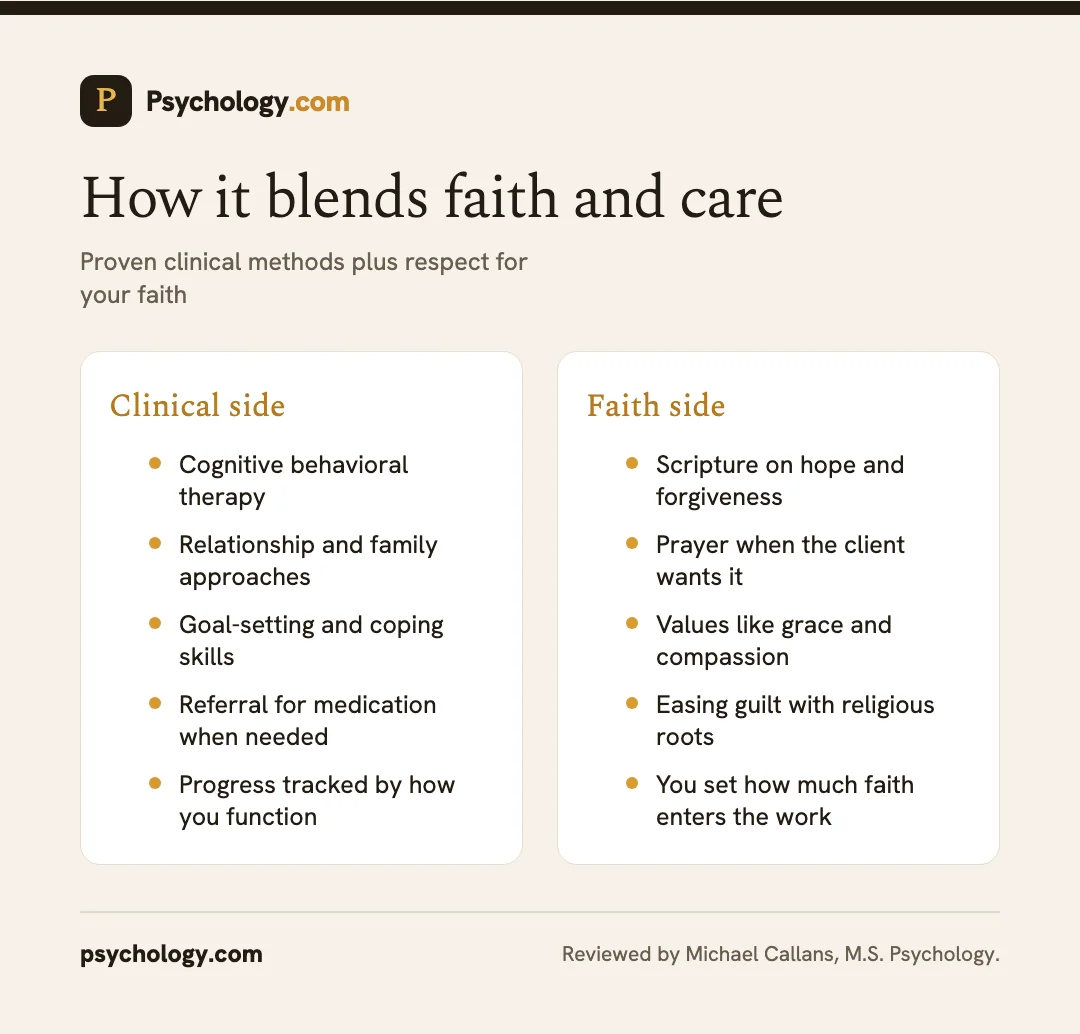
How it blends faith and clinical practice
A skilled Christian counselor works on two levels at once. On the clinical side, they use the same proven methods as any therapist, such as cognitive behavioral therapy, which helps people recognize and reshape unhelpful thinking, along with approaches drawn from relationship and family work. On the faith side, they connect that work to a client's beliefs, perhaps using scripture that speaks to hope and forgiveness, incorporating prayer when the client wants it, or exploring how values like grace and compassion can ease guilt and self-criticism.
The balance is set by the client. Some people want faith woven through every session. Others want a counselor who shares their worldview but mostly focuses on practical problem solving. A good counselor never imposes their own interpretation of doctrine, pressures a client, or substitutes prayer for the clinical care a serious condition requires. Faith complements treatment; it does not replace it. The American Psychological Association recognizes religion and spirituality as part of the diversity that competent therapists are trained to honor, and that principle holds here.
What to expect in sessions
A first session looks much like any intake. The counselor asks what brought you in, gathers some history, and talks through your goals. They will also ask how you would like your faith handled, which is your chance to set the tone. From there, sessions combine talking through what you are facing, learning coping skills, and, when you want it, drawing on prayer, scripture, or your church community as part of the process.
Progress is tracked the way it is in any therapy, by how you feel and function over time, not by your level of religious observance. A trustworthy counselor will also be honest about the limits of their role. If your situation calls for medication or a higher level of care, they should be willing to refer you to a psychiatrist or another specialist rather than keeping everything within a faith framework.
Who it suits
Christian counseling tends to suit people for whom faith is central to identity and decision making, and who want a therapist who understands that without needing it explained. It can help with the same range of concerns as any counseling, from anxiety, depression, and grief to marriage difficulties, parenting, life transitions, and questions of meaning. It is also a fit for people working through guilt or shame that has religious roots, since a counselor inside the tradition can address those feelings with both clinical skill and genuine understanding.
You do not need to be devout to benefit. People who are questioning, returning to faith, or simply raised in a Christian context can all find value in a counselor who respects that background. And if faith matters to you but a Christian framing is not essential, a therapist who broadly respects your spirituality may serve you just as well. The right fit is personal.
What to look for in a counselor
The single most important thing is proper licensure. Titles like "biblical counselor" or "faith-based coach" are not always backed by clinical training, and they vary widely. For a diagnosable condition, look for a licensed professional, such as a licensed professional counselor, licensed clinical social worker, licensed marriage and family therapist, or psychologist, who also integrates Christian faith. That combination gives you both real clinical competence and the spiritual grounding you are seeking.
When you reach out, it is reasonable to ask about their credentials and license, how they integrate faith into therapy, their experience with your specific concern, and how they would handle a situation that called for medication or specialist care. You are looking for someone who is open about all of it. As with any therapist, a sense of trust and comfort in the first few sessions is one of the best predictors that the work will help.
Frequently asked questions
What is the difference between Christian counseling and pastoral counseling?
Pastoral counseling usually focuses on spiritual guidance offered through a faith community. Clinical Christian counseling is psychotherapy provided by a licensed mental health professional who incorporates the client's faith. Some clergy are also licensed clinicians. Ask what role the provider is serving, what training they have, and how they would respond to a mental health condition.
Does Christian counseling use real, evidence-based therapy?
Clinical Christian counseling can use evidence-based methods such as cognitive behavioral therapy while incorporating the client's beliefs. Ask which approach the counselor uses for your specific concern and how progress will be assessed. A Christian label alone does not establish treatment quality. Appropriate spiritual practices are chosen with the client and used alongside the clinical plan.
Do I have to be a devout Christian to benefit?
You can seek Christian counseling while questioning your faith, returning to it, or wanting your religious background understood. Explain what you want included and what feels uncomfortable. A suitable counselor respects those preferences and discusses them openly. If you prefer broader spiritual support, ask prospective clinicians how they work with beliefs that differ from their own.
How do I find a Christian counselor?
Start by looking for a licensed mental health professional who describes experience integrating Christian faith into care. Ask about training, your specific concern, fees, and whether prayer or scripture is optional. Our guide to finding the right therapist can help you prepare for a consultation and compare the answers you receive.
Can Christian counseling help with marriage problems?
A licensed clinician trained in couples work can incorporate a couple's Christian beliefs into counseling for communication, trust, intimacy, or decisions about the relationship. Ask how the counselor works when partners interpret faith differently. The couples counseling guide explains common approaches. Shared religious beliefs should be discussed alongside each partner's goals, concerns, and safety.
Related
- Spirituality and Mental Health
- Relationships
- Anxiety
Therapists who specialize in christian counseling
Connect with a licensed therapist on Psychology.com who works with christian counseling.
- Barbara L Edwards
- Caring Counseling Center
- Charles H. Browning
- Dr. David Hubbard
- Dr. Don Zeidlhack
- Dr. John Knight
More guidance on finding help →
Finding the right help
When you are ready to take the next step, these guides walk you through finding and starting with the right therapist.
- Getting started with therapy
- How to find the right therapist
- Find a therapist who takes insurance
- Free & low-cost therapy
Preparing for a faith-informed session
Write down what you want help with and which religious practices feel supportive, uncomfortable, or uncertain. The values clarification worksheet can help you put those preferences into words. The Do I Need Therapy? quiz offers a starting point for reflection about distress and functioning; a clinician can assess your needs. Explore marriage and family therapy and the Life & Relationships hub for related guidance about relationships and support.
References
- American Psychological Association: Religion and spirituality
- American Psychiatric Association: How spirituality shapes mental health journeys
- National Alliance on Mental Illness (NAMI): Finding a mental health professional
- SAMHSA: National Helpline and finding treatment
- HelpGuide: Finding a therapist who can help you heal
- ASERVIC: Competencies for Addressing Spiritual and Religious Issues in Counseling
- NIMH: Psychotherapies and choosing a therapist