
In short
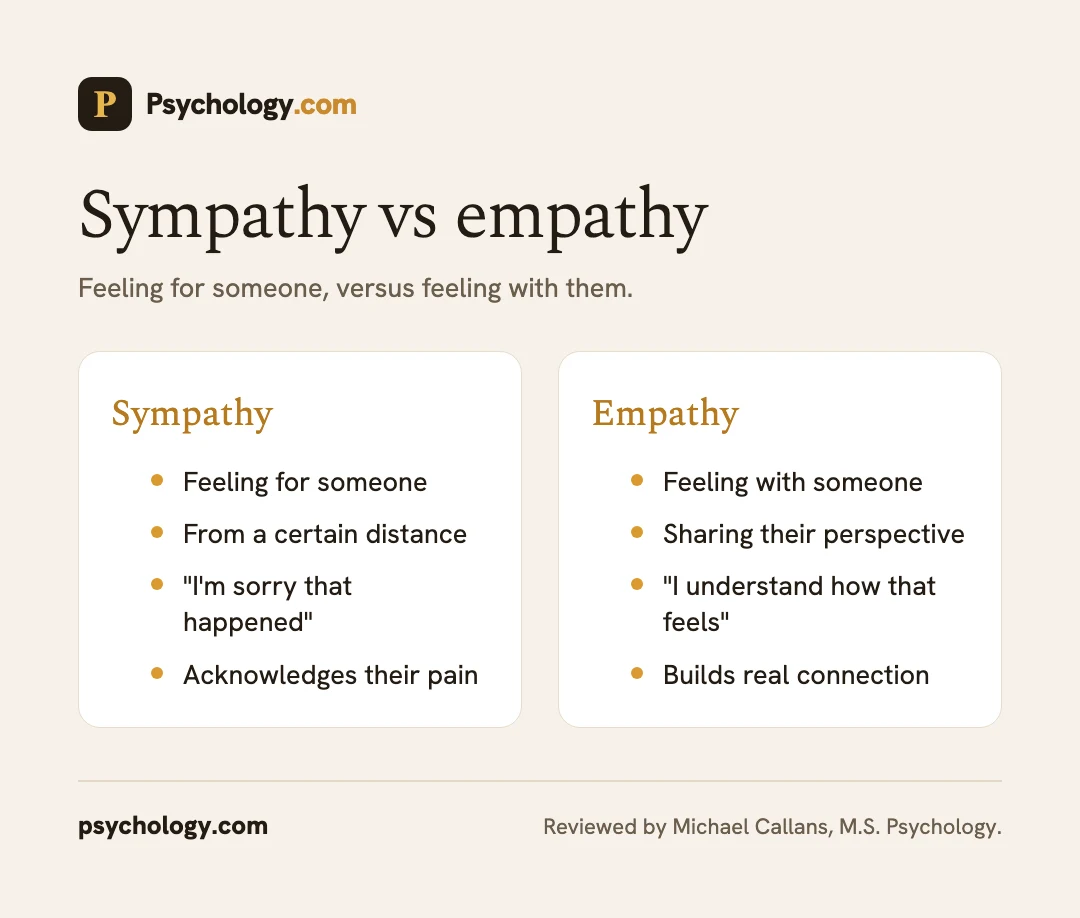
Sympathy is concern for another person's difficulty. Empathy involves understanding their perspective or sharing some of their feelings while recognizing that the experience is theirs. Compassion adds a wish to help. These responses can overlap, and the most useful response depends on the person's needs rather than a fixed ranking.
The difference between sympathy and empathy
Sympathy is feeling concern for someone who is struggling. Empathy is understanding their perspective or sharing some of their emotion while knowing the experience belongs to them. You can show both in the same conversation. Compassion adds a wish to help, such as offering practical support after listening.
The APA Dictionary of Psychology distinguishes understanding another person's frame of reference from feelings of concern. Everyday usage overlaps, so a person may use the words differently from a researcher. A short condolence can express care even if it contains no detailed reflection of the other person's emotions.
Empathy also does not require an identical life experience. You can ask questions and try to understand grief, uncertainty, or disappointment that differs from your own. The other person remains the best source of information about what this particular experience means to them.
Examples of sympathy, empathy, and compassion
Imagine a friend loses a job. A sympathetic response might be, "I'm sorry this happened. I care about how you're doing." An empathic response could be, "It sounds like the uncertainty about what comes next is the hardest part. Have I understood that?" A compassionate offer might be, "Would help reviewing your resume be useful?"
After a bereavement, "I'm sorry for your loss" can be an appropriate expression of sympathy. Empathy might involve listening as the person describes what they miss and reflecting their own words. Practical support could mean bringing a meal or helping with a task they choose.
During a disagreement, empathy can sound like, "You felt excluded when the decision was made before we talked." You can understand that experience while still discussing your own perspective and responsibilities. Recognizing a feeling does not settle who is right about every fact.
These are examples, rather than scripts everyone should follow. Someone may prefer quiet company, a brief acknowledgment, or practical help. Ask what would be useful, and leave room for the person to decline. A supportive response is responsive to the situation.
Cognitive empathy, emotional empathy, and concern
Cognitive empathy refers to understanding another person's perspective or emotional state. You might recognize that a colleague feels embarrassed after a mistake, even while you feel calm yourself. Perspective-taking is useful when you check your understanding instead of assuming your interpretation is correct.
Emotional or affective empathy involves sharing some of another person's emotion. You may feel a wave of sadness when someone describes a loss. Decety and Jackson's account emphasizes the importance of self-awareness and emotion regulation: understanding another person involves maintaining a distinction between their experience and your own.
Empathic concern and compassion refer to caring about someone's welfare and wanting to help. Popular explanations sometimes call this compassionate empathy. Researchers use different frameworks, so there is no single list of empathy types that every study measures in the same way.
The distinction matters in practice. Understanding someone's feelings, sharing those feelings, and deciding to help are related experiences that can differ. A person who remains emotionally steady can still understand a difficult situation and offer thoughtful support.
Emotional contagion is a useful comparison: you might become tense in a tense room without identifying whose feeling you are responding to. In Decety and Jackson's model, empathy includes awareness that the other person's experience is separate from your own. Feeling strongly therefore does not, by itself, show that you have understood someone accurately. Checking the meaning of their experience remains part of the task.
Is empathy better than sympathy?
A fixed ranking is too simple. Sympathy can communicate warmth and respect; empathy can help someone feel that their perspective has been heard. How a response lands depends on timing, wording, the relationship, and what the person wants from the conversation.
A response can become unhelpful when it makes assumptions or shifts attention to the listener. For example, immediately telling your own story may leave little space for the other person. Before sharing an experience, consider whether it would help them or simply satisfy your wish to say something.
The phrase "I know exactly how you feel" may overstate your understanding. A more open response is, "I want to understand what this has been like for you." If you misread the feeling, accept the correction. Empathy is a process of checking and revising your understanding.
When other people's emotions feel overwhelming
Sharing distress can become uncomfortable or exhausting. Singer and Klimecki distinguish empathic distress from compassion: attention can become centered on escaping your own discomfort, or remain directed toward the other person's welfare. This distinction is useful for understanding why caring and feeling overwhelmed can occur together.
In an experimental training study, Klimecki and colleagues found different emotional and neural responses after empathy and compassion training. The findings suggest these responses can be distinguished and practiced. A laboratory result does not establish that an exercise will prevent burnout or work the same way for every caregiver.
You can care about someone while setting limits on what you can offer. You might say, "I can listen now, and then I need to rest," or ask who else can share a practical responsibility. If supporting others is affecting your sleep, functioning, or health, consider getting support for yourself.
How to practice an empathic response
Start by making space for the person to speak. Ask an open question, then let them finish before preparing your answer. If you notice yourself guessing, return to the details they have actually shared. Your goal is to understand their account accurately enough to respond with care.
Reflect what you heard in tentative language: "It sounds as though you felt dismissed." Ask whether that fits. If the person corrects you, use their wording. This keeps the conversation centered on their experience and reduces the chance of imposing your own interpretation.
Before giving advice, ask whether they want ideas, practical help, or someone to listen. Offer something specific you can reasonably do. Follow through on agreed help, and be honest about your limits. These practices are ways to make care concrete, rather than measures of your worth as a person.
If your first response misses the mark, try a repair: "I assumed you wanted advice. What did you need me to hear?" For example, a friend may explain that embarrassment, rather than uncertainty, is bothering them after losing a job. You can acknowledge that correction and ask what made the experience embarrassing. This is an illustrative application of perspective-taking, not a tested script or a guarantee that the conversation will improve.
Reflection tools and related concepts
The Empathy Test self-assessment offers reflection on self-reported tendencies. A score cannot tell you how every other person experiences your listening or diagnose the cause of overwhelming emotions. Feedback from a real conversation can reveal something a questionnaire misses. The Validation Practice Worksheet can help you practice acknowledging feelings. For related background, explore attachment theory and the fundamental attribution error, or browse the psychology concepts hub. If emotional overload or relationship difficulties are affecting daily life, the Psychology.com therapist directory can help you find a licensed therapist to discuss the pattern and appropriate support.| Feature | Sympathy | Empathy |
|---|---|---|
| Core meaning | Concern for another person | Understanding or sharing another person's experience |
| Example | I'm sorry this happened to you | It sounds like the uncertainty feels frightening |
| Same experience required? | No | No; ask rather than assume |
| Emotional response | Care or concern about the person | Perspective-taking, shared feeling, or both |
| Possible pitfall | Unwanted pity or assumptions | Misreading feelings or becoming overwhelmed |
| Helpful follow-up | Ask what support would be useful | Check whether you understood accurately |
Key takeaways
- The APA Dictionary distinguishes empathy, understanding another person's experience, from sympathy, concern for that person. Source: APA Dictionary of Psychology, Empathy and Sympathy entries.
- Decety and Jackson's model of empathy includes self-awareness, perspective-related processes, and emotion regulation. Source: The Functional Architecture of Human Empathy.
- Empathic distress and compassion are distinguishable responses to another person's suffering. Source: Singer and Klimecki, Empathy and Compassion.
- An experimental study found different patterns of emotional response after empathy and compassion training. Source: Klimecki and colleagues, Differential Pattern of Functional Brain Plasticity After Compassion and Empathy Training.
Want to understand your own emotional patterns?
Our free, clinician-reviewed self-tests can help you reflect on how you connect with others. No account needed.
Cite this source
Psychology.com. (2026, September 15). Sympathy vs Empathy: What's the Difference? Psychology.com. https://psychology.com/concepts/sympathy-vs-empathy
Frequently asked questions
What is the difference between sympathy and empathy?
Sympathy is concern for someone experiencing difficulty. Empathy involves understanding their perspective or sharing some of their feelings while recognizing that the experience is theirs. Both can appear in the same conversation. Compassion adds a wish to help. Which response is useful depends on what the person needs and how you communicate it.
What is an example of sympathy versus empathy?
If a friend loses a job, sympathy might sound like, "I'm sorry this happened to you." Empathy might sound like, "It seems the uncertainty is especially stressful. Have I understood?" Both can express care. Asking whether your friend wants listening, practical help, or ideas makes the response more attentive to their needs.
Is empathy better than sympathy?
Empathy and sympathy serve overlapping purposes, so a universal ranking is unhelpful. A brief expression of sympathy may be welcome, while a deeper conversation may call for perspective-taking and careful listening. Avoid assuming what another person feels. Check your understanding and ask what support they would find useful in that situation.
What are the types of empathy?
Common distinctions include cognitive empathy, understanding another person's perspective, and affective empathy, sharing some of their emotion. Empathic concern or compassion involves caring about their welfare and wanting to help. Some popular explanations call this compassionate empathy. Researchers use different models, so the categories depend on the framework and measure being discussed.
Can you have empathy without the same experience?
You can try to understand another person's experience without having lived through the same event. Ask open questions, listen to their account, and check that you understood. Similar experiences can provide context, but feelings and circumstances still differ. Avoid assuming that what helped you is what the other person wants.
Can a hyper empathy disorder test diagnose me?
An online empathy questionnaire cannot establish a diagnosis or explain why other people's feelings overwhelm you. It usually relies on your description of your own tendencies. If emotional overload affects sleep, relationships, or daily functioning, discuss the specific difficulties with a licensed clinician. The assessment can explore context and what support would help.
Related concepts

References
- American Psychological Association. Dictionary of Psychology: Empathy. dictionary.apa.org
- American Psychological Association. Dictionary of Psychology: Sympathy. dictionary.apa.org
- Decety J, Jackson PL. The functional architecture of human empathy. Behavioral and Cognitive Neuroscience Reviews. 2004;3(2):71-100. pubmed.ncbi.nlm.nih.gov
- Singer T, Klimecki OM. Empathy and compassion. Current Biology. 2014;24(18):R875-R878. pubmed.ncbi.nlm.nih.gov
- Klimecki OM, Leiberg S, Ricard M, Singer T. Differential pattern of functional brain plasticity after compassion and empathy training. Social Cognitive and Affective Neuroscience. pubmed.ncbi.nlm.nih.gov