Mindfulness Meditation Exercise: A Guided Practice for Noticing the Present Moment
Mindfulness meditation is a practice of noticing the present moment and returning attention when it wanders. This guided exercise helps you practice that skill and reflect on what you notice.
 Reviewed byMichael Callans, MSW
Related tools & tests
Want to go deeper with guidance?
Browse licensed therapists who use mindfulness-based approaches. Free to search, no account needed.
About this tool
Mindfulness meditation is a practice of paying attention to the present moment with openness and acceptance. This guided exercise helps you notice distraction, return to an anchor, and describe your experience without grading yourself. Mindfulness meditation is the practice of paying attention, on purpose, to the present moment, with an attitude of openness and acceptance rather than judgment. It was brought into mainstream healthcare by Jon Kabat-Zinn through Mindfulness-Based Stress Reduction (MBSR), and it now sits at the heart of widely studied programs for stress, anxiety, depression relapse, and chronic pain. The aim is not to empty the mind or to force calm. It is to change your relationship with whatever is already here.
A basic sitting practice usually follows the same shape. You settle into a steady posture, bring attention to the breath or body as an anchor, and then, each time the mind wanders, you notice where it went and gently guide attention back. That noticing-and-returning is not a failure of meditation: it is the repetition that builds the skill, the way a single repetition builds a muscle. You can also try this practice while listening to someone speak or noticing sensations while washing your hands. Feeling calm is a possible experience, rather than a required result.
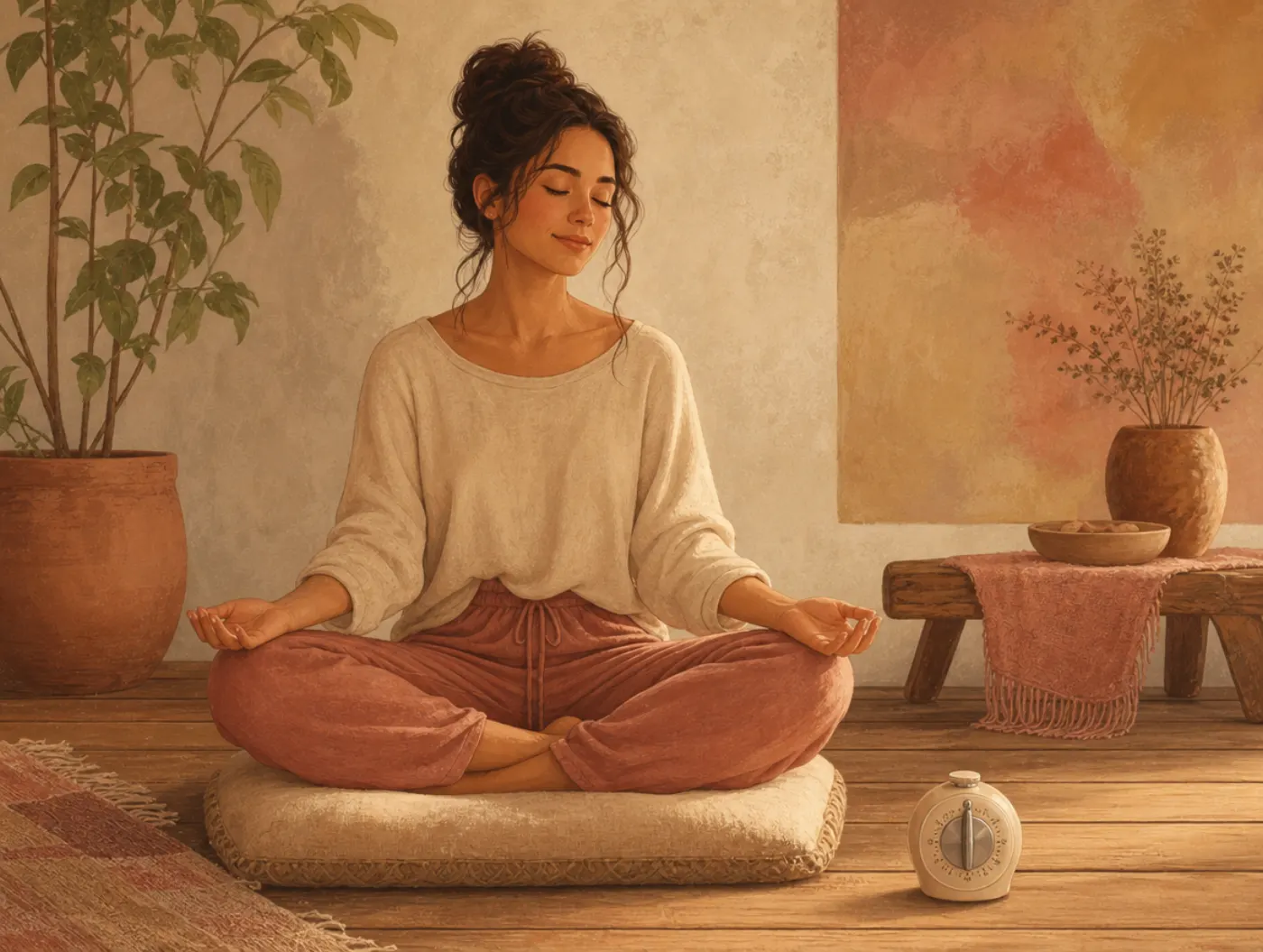
Here is a short script you can follow. Sit upright but relaxed and let your eyes close or soften. Take three slow breaths, letting each out-breath be a little longer. Now let the breath return to its natural rhythm and rest your attention on the place you feel it most clearly: the nostrils, the chest, or the belly. When you notice the mind has wandered, silently name it (thinking, planning, remembering), then come back to the breath without criticism. After a few minutes, widen your attention to the whole body, then to the sounds around you, before slowly opening your eyes.
Mindfulness is a skill you can practice in manageable sessions that fit your circumstances. Choose a familiar cue, such as sitting down after breakfast, and give yourself permission to finish when the practice becomes uncomfortable. The reflection below helps you notice what came up and describe the experience without grading it. There is no required session length for completing this worksheet or evidence that its suggested timing is a treatment dose.
The evidence base is broader than any single program. Kabat-Zinn first described the approach in a 1982 paper on an outpatient program for chronic pain built around mindfulness meditation, and researchers have since studied it as a standalone skill and as part of structured courses. A large systematic review and meta-analysis published in JAMA Internal Medicine examined mindfulness meditation programs across dozens of trials and found consistent, moderate evidence that they reduce anxiety, depression, and the psychological impact of pain compared with an inactive control. It did not find good evidence that meditation outperforms active treatments like exercise or therapy, which is one reason it works best alongside other support rather than instead of it.
The scale and reflection fields above are not a test to pass. A low score on bringing attention back, or a long list of places your mind wandered, simply describes what a normal mind does. What is worth tracking over repeated sessions is direction, not any single number: does settling in feel a little more familiar, does noticing the wander happen a little sooner, does the gap between sessions feel easier to close. If a session leaves you more agitated than when you started, that is useful information too, not a sign to push harder.
Mindfulness meditation is not a substitute for treatment when anxiety, depression, or trauma symptoms are severe or persistent, and it can occasionally bring up strong emotions or memories that are hard to sit with alone. If that happens, or if low mood or worry are getting in the way of daily life, a licensed therapist can help you work through it in a way a self-guided script cannot. Psychology.com's therapist directory lets you search by specialty, including mindfulness-based approaches, at no cost.
If focusing on breathing makes you uneasy, try keeping your eyes open and resting attention on sounds or the contact between your feet and the floor. You can pause, look around, or stop. NCCIH notes that some people experience unwanted effects during meditation; persistent distress deserves support rather than pressure to keep practicing. This self-guided script has not itself been tested as a clinical program.
For a narrower attention practice, try Mindful Breathing Exercise. Body Scan Meditation offers a way to explore physical sensations, while the Mindfulness Exercises Library provides other formats. The Mindfulness Test is a self-assessment for reflection, not a diagnosis or a measure of how successfully you meditated. When reviewing your notes, describe the anchor you used, what interrupted attention, and what made returning feel more workable.
References
- Kabat-Zinn J. Full Catastrophe Living: Using the Wisdom of Your Body and Mind to Face Stress, Pain, and Illness. Rev. ed. Bantam Books; 2013.
- Khoury B, et al. Mindfulness-based therapy: a comprehensive meta-analysis. Clin Psychol Rev. 2013;33(6):763-771.
- Kabat-Zinn J. An outpatient program in behavioral medicine for chronic pain patients based on the practice of mindfulness meditation: theoretical considerations and preliminary results. Gen Hosp Psychiatry. 1982;4(1):33-47.
- Goyal M, et al. Meditation programs for psychological stress and well-being: a systematic review and meta-analysis. JAMA Intern Med. 2014;174(3):357-368.
- National Center for Complementary and Integrative Health. Meditation and Mindfulness: Effectiveness and Safety. https://www.nccih.nih.gov/health/meditation-and-mindfulness-effectiveness-and-safety
Cite this source
Psychology.com. (2026, September 16). Mindfulness Meditation Exercise. Psychology.com. https://psychology.com/tools/mindfulness-meditation
Mindfulness Meditation Exercise FAQ
What is mindfulness meditation?
It is the practice of paying attention to the present moment on purpose, without judgment, usually by anchoring your attention on the breath or body and gently returning whenever the mind wanders. This free exercise gives you a script and reflection prompts to try that process. You can use the PDF to revisit your notes or discuss the experience with a therapist.
How long should I meditate?
Choose a short, manageable practice that you can fit into your day without straining to finish. There is no required duration for this worksheet, and longer sessions do not automatically mean better practice. Adjust the length to your comfort and circumstances, and pause if sitting quietly increases distress or leaves you feeling disconnected.
My mind keeps wandering. Am I doing it wrong?
Mind wandering is an expected part of mindfulness meditation. When you notice it, acknowledge what caught your attention and gently return to your chosen anchor. You do not need to criticize yourself or restart the whole exercise. Your reflection can record the distraction and what helped you return, without treating either as a grade.
Is my information saved?
No. Everything stays in your browser and is never uploaded or stored. The PDF is generated on your own device.
Does mindfulness meditation actually help with anxiety?
Research reviews, including a large meta-analysis in JAMA Internal Medicine, found moderate evidence that mindfulness meditation programs reduce anxiety compared with an inactive control. It works best as one part of a broader plan rather than a stand-alone fix for severe or persistent anxiety.
What is the difference between mindfulness meditation and deep breathing?
Deep breathing is a technique for calming the body by slowing and deepening each breath. Mindfulness meditation uses the breath as an anchor for attention, but the goal is noticing and returning focus, not controlling the breath itself, so the two can be combined or used separately.