Mindful Breathing Exercise: Use Your Breath as an Anchor to Calm Body and Mind
Mindful breathing is an attention exercise: notice your natural breath and gently return when your mind wanders. Use the free guided script and PDF to practice and record what you observe.
 Reviewed byMichael Callans, MSW
Related tools & tests
Want help building a mindfulness practice?
Browse licensed therapists who use mindfulness-based approaches. Free to search, no account needed.
About this tool
This Mindful Breathing Exercise helps you practice noticing your natural breath and returning your attention when thoughts pull you away. It provides a guided script and reflection prompts for moments when you feel distracted or caught up in worry, without requiring you to change your breathing or clear your mind. The breath gives your attention a place to return to; the skill is recognizing that you drifted and beginning again.
Mindful breathing differs from deliberate breath control. The Zaccaro and colleagues review examines slow breathing and its physiological correlates, including changes associated with the autonomic nervous system. Those findings should not be treated as evidence that simply observing a natural breath will lower your heart rate or produce calm on demand. This exercise asks you to notice breathing as it happens. If your breath settles on its own, observe that change without trying to force or reproduce it.
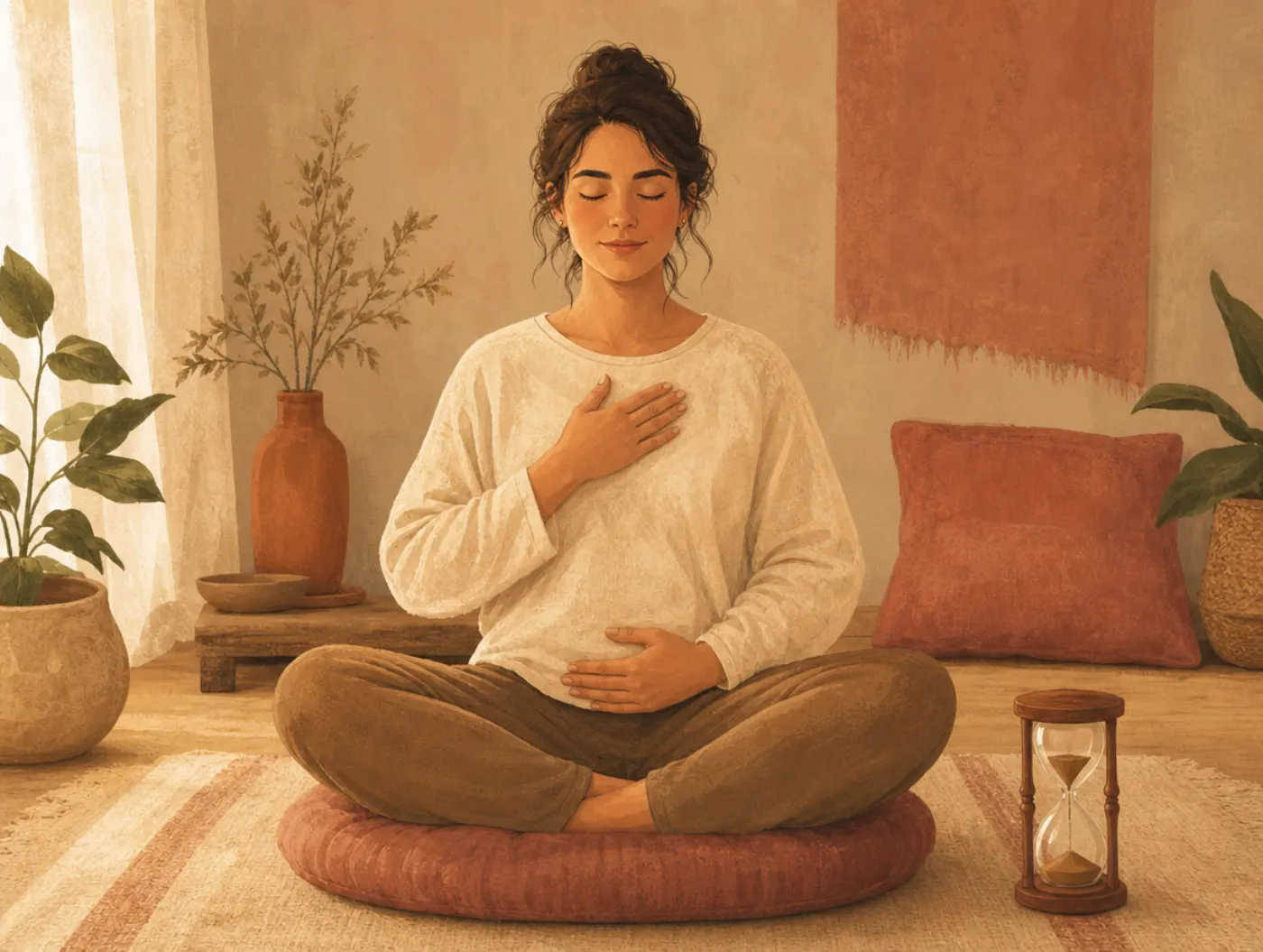
Here is a short script. Sit upright and let your eyes close or soften. Notice the breath as it is, without changing it: the cool air coming in, the warm air going out, the rise and fall of the chest or belly. Pick the place you feel it most clearly and let your attention rest there. When you notice you have drifted into thinking, that is the practice working: gently label it (thinking) and return to the next breath. Continue for a few minutes, then widen your attention and slowly open your eyes.
Mindful breathing can be practiced at a regular time or during a stressful moment when it feels comfortable to pause. Choose a duration you can approach without strain, and let your breathing remain natural. Use the reflection below to record what drew your attention away and how you responded. Feeling restless at the end does not mean you completed the exercise incorrectly; noticing restlessness is also an observation.
It pairs naturally with other practices on Psychology.com, such as a Mindfulness Meditation Exercise or a Loving-Kindness Meditation. You might try it during a break or as part of a wind-down before sleep, while staying open to whether it suits you. Focusing closely on the breath can feel uncomfortable or increase anxiety for some people. If that happens, stop, open your eyes, and allow your breathing to return to its usual rhythm. You can focus on nearby sounds or the feeling of your feet on the floor instead. If anxious or racing thoughts are a frequent struggle, a therapist can help you explore what support fits; you can search the Psychology.com therapist directory by specialty.
Jon Kabat-Zinn helped bring mindfulness into clinical care through the stress reduction program established at UMass in 1979. His book Full Catastrophe Living describes mindfulness practices within a broader approach to stress and illness. NCCIH reports that mindfulness approaches may help with anxiety and other symptoms, while also describing limitations in study quality and differences between programs. Research on a supported program does not validate this brief worksheet as a treatment.
Use the reflection as a description of your experience rather than a performance score. You might write that planning thoughts returned repeatedly, that you noticed your shoulders tightening, or that sounds became a more comfortable focus than breathing. A calmness rating describes the moment you entered it; it cannot establish a mental health diagnosis or show whether mindfulness is the right approach for you. For example, if a worry about an unfinished task keeps returning, your reflection might read: I noticed planning, returned to the breath, and decided to write down the next practical step afterward. Returning attention during practice does not require ignoring a problem that needs action once you finish.
The Mindfulness Exercises Library offers other ways to practice attention. Box Breathing uses a deliberate breathing pattern, so it has a different instruction from observing your natural breath. If worry is the main reason you are practicing, an Anxiety Test can provide screening information to discuss with a professional. Choose practices that feel manageable and bring persistent distress to a clinician instead of extending sessions to push through discomfort.
If you want guided instruction, ask about the teacher's training and experience, as NCCIH recommends. Describe what happened during your own practice, including whether breath attention felt manageable or brought more distress. Ask how the instructor adapts exercises and what support is available if discomfort continues. This gives you more useful information than a promise that meditation will always make you calm.
References
- Kabat-Zinn J. Full Catastrophe Living: Using the Wisdom of Your Body and Mind to Face Stress, Pain, and Illness. Rev. ed. Bantam Books; 2013.
- Zaccaro A, et al. How breath-control can change your life: a systematic review on psycho-physiological correlates of slow breathing. Front Hum Neurosci. 2018;12:353.
- National Center for Complementary and Integrative Health. Meditation and Mindfulness: Effectiveness and Safety. https://www.nccih.nih.gov/health/meditation-and-mindfulness-effectiveness-and-safety
- UMass Medical School. With deep roots at UMMS, mindfulness meditation proves beneficial. https://www.umassmed.edu/news/articles/archives/2014/01/with-deep-roots-at-umms-mindfulness-meditation-proves-beneficial/
Cite this source
Psychology.com. (2026, September 16). Mindful Breathing Exercise. Psychology.com. https://psychology.com/tools/mindful-breathing
Mindful Breathing Exercise FAQ
What is mindful breathing?
Mindful breathing is a mindfulness practice that uses the natural breath as a place to rest your attention. You notice sensations of breathing and gently return when your mind wanders. There is no need to empty your mind or control the rhythm. This exercise provides a script and reflection prompts to help you describe the experience.
How is it different from a breathing technique like box breathing?
Box breathing changes the rhythm of the breath deliberately. Mindful breathing usually leaves the breath natural and focuses on observing it. Both can help; this one is more about attention training. With mindful breathing, you can notice a quick or uneven breath without correcting it. Choose the approach that feels comfortable, and stop if concentrating on breathing increases discomfort.
How long should I practice?
Start with a short practice that fits your attention and comfort, and stop when you need to. This worksheet does not prescribe a clinical dose or a required streak. Returning gently after distraction is the skill you are practicing. A longer session is optional, and you do not need to remain seated until you feel calm.
Is my information saved?
No. Everything stays in your browser and is never uploaded or stored. The PDF is generated on your own device.
Does mindful breathing help with anxiety?
Mindfulness approaches may help with anxiety symptoms, according to NCCIH, but research often studies broader programs rather than a brief breathing script. This exercise can help you practice returning your attention when worries arise. If anxiety is frequent, severe, or interfering with daily life, seek professional support and treat the worksheet as an optional practice alongside that care.
What if focusing on my breath makes me more anxious?
Stop the exercise and let your breathing return to its usual rhythm. Open your eyes and notice something outside your body, such as sounds in the room or objects nearby. Breath-focused attention can feel uncomfortable for some people, and pushing through is unnecessary. If this keeps happening, a therapist can help you choose or adapt a practice that feels more manageable.